




French Gilt Clock Set
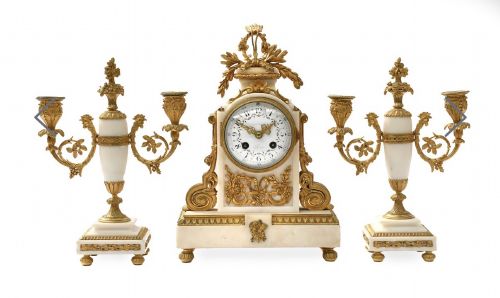
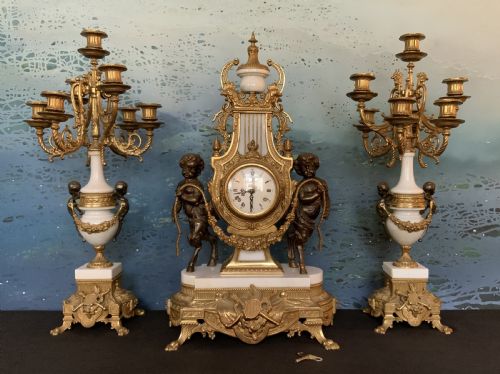
A french gilt clock set brings grand nineteenth-century reception rooms into focus with matching candelabras and urns.
French Gilt Clock Set
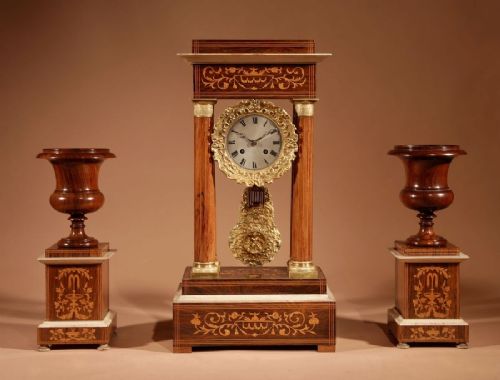
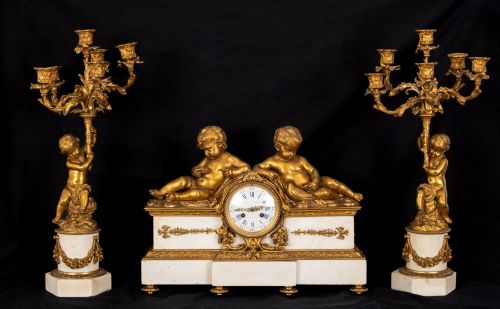
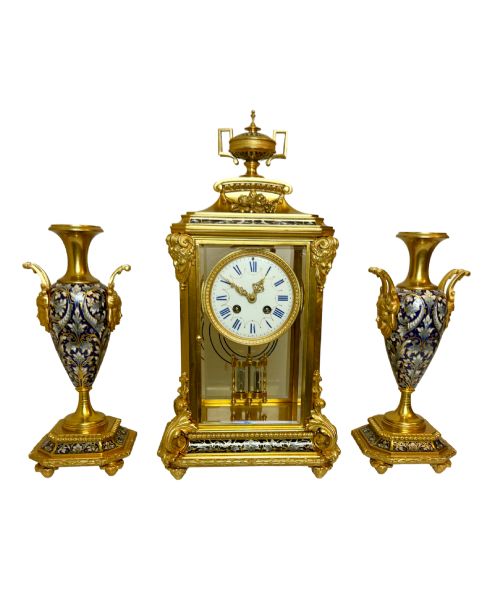
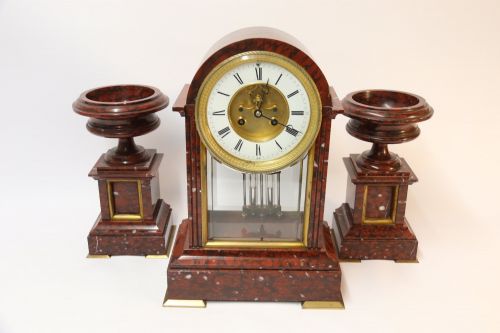
A french gilt clock set typically comprises a central mantel timepiece flanked by matching side ornaments such as candelabras, urns, or vases. These imposing ensembles emerged primarily during the nineteenth century across periods spanning the Second Empire, Victorian era, and various revivalist movements.
Makers designed these tripartite arrangements for prominent display on mantelpieces or console tables in formal drawing rooms. The central clock governs the arrangement, supported visually by matching side pieces that complete a balanced decorative scheme.
Buyers encounter numerous stylistic variations on this page, dominated by Louis XVI style symmetry, ornate Rococo asymmetry, and formal Empire proportions. White marble, black block marble, onyx, and porcelain frequently anchor the gilt metal work.
Materials and Construction
Foundries cast the structural components in bronze, brass, or gilt metal, applying mercury gilding or electroplating to achieve the characteristic golden surface. Ormolu, or gilt bronze, provides a deep, warm lustre that distinguishes finer examples from simpler brass alternatives.
Craftspersons combined these gilded frames with contrasting natural materials such as white marble, Siena marble, onyx, and hand-painted porcelain panels. Enamel dials, often featuring individual cartouches for numerals, required specialised kiln firing before mounting into the cast bezels.
Clockmakers integrated eight-day mechanical movements utilising anchor or pendulum escapements, sometimes incorporating striking mechanisms for hours and halves. Side garnitures were cast to match the decorative vocabulary of the central clock case precisely.
Current listings feature nineteenth-century French mantel clocks paired with marble, gilt bronze, and hand-painted porcelain garnitures.
Factors of Quality
The crispness of the bronze chasing dictates the visual hierarchy of these sets, separating sharp, hand-finished ornamentation from soft, commercially cast replicas. Finer pieces retain intricate detailing in foliate scrolls, cherubs, and classical drapery.
The selection and mass of supporting materials heavily influence overall grade, with solid marbles and heavy bronzes commanding greater presence than lighter plated substitutes. Integrated porcelain elements bearing hand-painted floral or figural scenes further elevate an ensemble.
Movements signed by notable makers or Paris foundries indicate higher workshop standards and better mechanical longevity. Original matching glass domes and corresponding side vases preserved together complete the highest tier of surviving sets.
Samuel Marti·Henry Dasson·A D Mougin·H Luppens Paris·Vincenti of Paris·Japy Freres·Verger Freres of Paris·Louis Japy
The French Gilt Clock Set Glossary
- Ormolu
- Gilded bronze produced by applying a mercury and gold amalgam to cast bronze before heating. This historic technique creates a rich, matte golden surface that resists tarnishing.
- Garniture
- A set of matching decorative objects designed for symmetrical display together. In these groupings, a central clock is flanked by matching candelabras or urns.
- Champlevé
- An enamelling technique where troughs are dug into a metal surface and filled with vitreous paste before firing. This method creates colourful geometric or floral patterns across the metal mountings.
- Escapement
- The mechanical linkage that regulates the release of power in a clock movement. Common variations include anchor and cylinder escapements governing the pendulum.
- Bleu de Roi
- A deep cobalt blue ceramic glaze used extensively on decorative porcelain panels. Factories applied this rich hue underneath gilding and hand-painted reserves.
French Gilt Clock Set: Frequently Asked Questions
What is a clock garniture?
A clock garniture is a matched suite consisting of a central mantel clock accompanied by side pieces such as candelabras, urns, or vases. These sets were designed to create a balanced, symmetrical arrangement on a fireplace mantel or sideboard.
The side pieces repeat the motifs, materials, and gilding of the main clock case to unify the decorative scheme of a nineteenth-century interior.
How do I wind a french gilt clock set?
Most nineteenth-century movements utilise an eight-day mechanical spring driven through winding holes on the enamel dial. A matching key is inserted to tension the springs manually once a week.
Care must be taken not to overwind the mechanism, stopping as soon as resistance is felt to protect the historical spring steel.
How do I distinguish Louis XVI style from Rococo?
Louis XVI style pieces rely on classical symmetry, straight architectural lines, urns, ribbons, and restrained fluting. The overall silhouette remains balanced and geometric.
By contrast, Rococo designs embrace asymmetry, swirling C-scrolls, naturalistic foliage, and dynamic organic movement without strict parallel geometry.
Where should I place a heavy marble clock set?
These ensembles require a stable, level surface capable of supporting considerable weight from marble bases and cast bronze components. A sturdy mantelpiece or heavy console table provides the necessary foundation.
Positioning the clock away from direct sunlight and damp walls protects both the mercury gilding and the delicate interior ironwork from environmental degradation.