






Gold Brass Clock Garniture
A gold brass clock garniture brings monumental presence and matched harmony to a mantelpiece, combining a central timepiece with flanking ornaments.
Gold Brass Clock Garniture
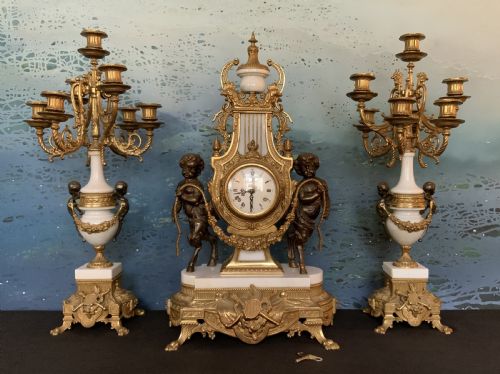
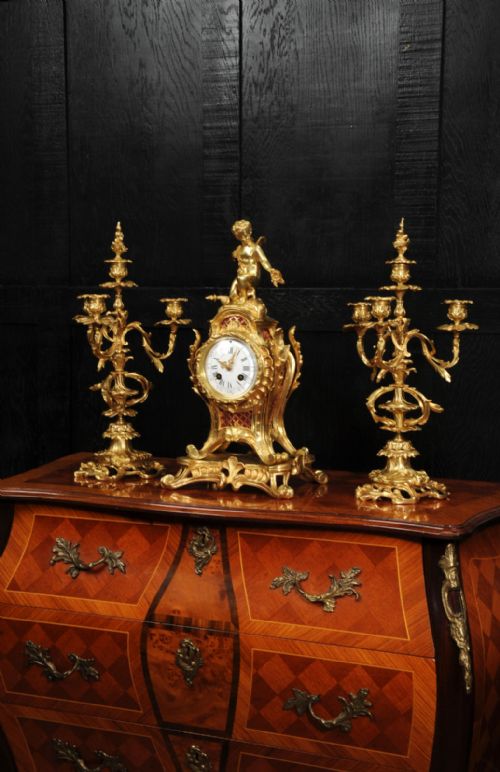
When you search for a gold brass clock garniture, you encounter matched table sets designed to dominate a Victorian or late nineteenth-century interior with coordinated metallic brilliance. These ensembles typically comprise a central mantel clock accompanied by matching candelabra, urns, or figural ornaments designed in dialogue with the primary timepiece.
The prevailing form on this page is the multi-piece French set from the nineteenth century, drawing heavily upon Louis XVI, Louis XV, and Neoclassical vocabularies. Such groups reflect an era when domestic interiors demanded symmetry and lavish decorative coordination across every prominent surface.
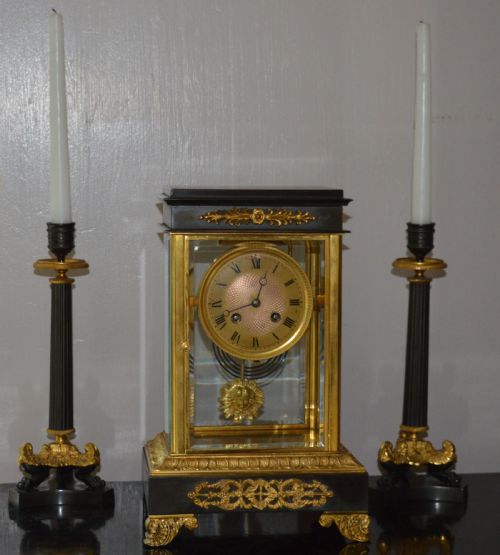
Beyond French masterworks, variations span from Italian bronze and marble compositions to intricate four-glass chambers and boudoir clock sets. Each configuration maintains the fundamental principle of unified materials and shared stylistic motifs across all included components.
Materials and construction
The physical weight and luminous surface of these sets stem from the combination of cast metals, particularly ormolu, gilt bronze, and brass, often paired with contrasting white or coloured marble. Foundries shaped these metallic components through detailed casting before applying mercurial gilding or chemical patination to achieve enduring lustre.
Dial faces frequently incorporate delicate enamel work with painted numerals, protected behind bevelled glass panels or housed within complex four-glass clock cases. Stonework elements, such as marble bases and columns, were meticulously cut and polished to anchor the soaring metallic ornament above.
The object forms recorded here range from standard mantel clocks to comprehensive three-piece and multi-piece garniture sets with candelabra.
Judging quality and execution
Distinction across this range rests upon the crispness of the original metal chasing and the depth of the gilding, where superior examples exhibit sharp relief in foliage, cherubs, and classical scrolls. Lesser pieces often rely on softer castings with smoothed details and mechanical assembly rather than hand-finished integration.
The integrity of the ensemble depends heavily on whether the components originated together, as matched sets maintain consistent wear patterns and tonal ageing across both clock and flanking ornaments. The inclusion of signed movements by established makers further elevates the standing of an individual garniture.
A.D Mougin·Deniere Paris·Vincenti·Japy Freres
The Gold Brass Clock Garniture Glossary
- Garniture
- A set of ornamental objects designed to match and be displayed together, usually consisting of a central clock flanked by two matching vases, urns, or candelabra. These sets created visual balance on nineteenth-century mantelpieces.
- Ormolu
- Finely ground high-carat gold applied to a bronze base using a mercury amalgamation technique. This historic process yields a warm, enduring golden finish distinct from modern electroplating.
- Four Glass Clock
- A mantel clock housed within a brass or gilt frame featuring glass panels on all four sides, allowing light to pass through and the pendulum to remain visible. Such pieces often incorporate mercury pendulums.
- Visible Pendulum
- A clock design incorporating an escapement or pendulum arrangement that can be viewed directly from the front of the dial. This feature allowed nineteenth-century owners to observe the mechanical heartbeat of the movement.
Gold Brass Clock Garniture: Frequently Asked Questions
What is a gold brass clock garniture?
A gold brass clock garniture is a matched decorative set featuring a central mantel clock accompanied by matching side pieces such as candelabra or urns.
These ensembles were created to ornament nineteenth-century drawing rooms with a unified metallic aesthetic.
How do I care for gilt bronze?
Gilt bronze surfaces require only gentle dusting with a soft, dry brush to prevent the accumulation of grit within recessed chased details.
Harsh chemical polishes must be avoided entirely, as they strip away the historic gold layer beneath.
Where were these clock sets made?
The majority of these sets originated in French workshops and Parisian foundries during the nineteenth century, drawing on established Neoclassical and Rococo traditions.
Italian and regional European makers also produced comparable multi-piece garnitures.
How do I distinguish periods?
Period distinction relies on decorative vocabulary, contrasting Louis XV asymmetry with the strict symmetry of Louis XVI and Neoclassical styles.
Victorian interpretations often blend these continental revivals with heavier proportions and varied marble selections.