




French Gilt Buffet Lamp
A french gilt buffet lamp brings nineteenth-century Continental elegance to a side table through gilded bronze and classic proportions.
French Gilt Buffet Lamp
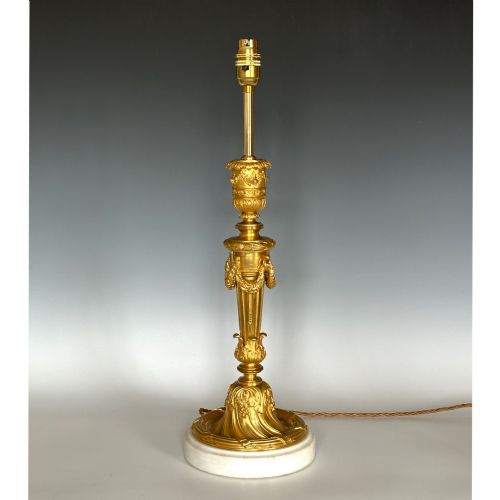
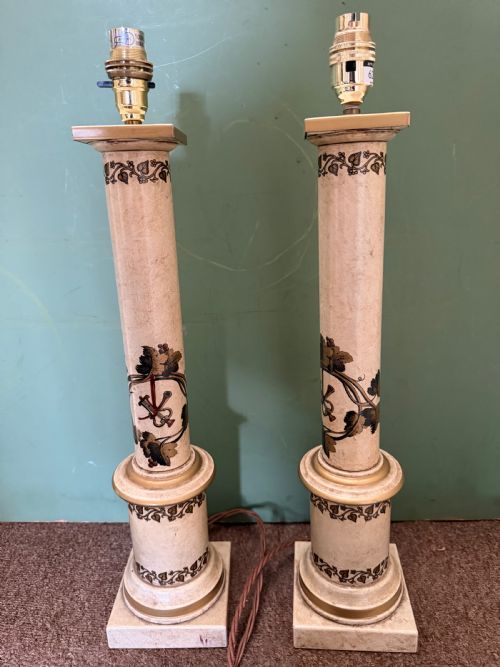
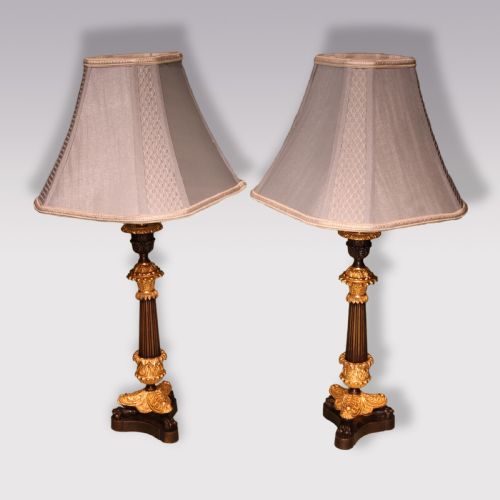
A french gilt buffet lamp is primarily represented on this page by table lamps fashioned in nineteenth-century and early twentieth-century styles. These pieces draw heavily on French Empire, Louis XV, Louis XVI, and Neoclassical design vocabularies.
The physical forms include slender column lamps, converted church candlesticks, and bodies adapted from Sevres-style vases and toleware. Pairs feature frequently alongside single sculptural examples.
Origins trace directly to Continental workshops spanning the eighteen-hundreds up to nineteen-thirty, utilising traditional forms scaled for sideboard or buffet illumination.
Materials and Construction
Construction relies upon cast metals such as bronze, brass, and ormolu, often paired with contrasting elements of marble, cobalt blue ceramics, and hand-painted toleware. Giltwood and carved wooden bases also appear among the Continental examples.
Surface decoration involves meticulous mercury gilding, hand-painting, and carved detailing that reflects specific historical periods from the nineteenth century through the nineteen-twenties.
Object forms recorded here include converted church candlesticks, classical columns, and Sevres-style vases adapted as table lamps.
Assessing Quality and Execution
Quality rests upon the crispness of the metal casting, the depth of the ormolu or gilt finish, and the integration of secondary materials like marble or porcelain. Superior examples exhibit finely chiselled details and cohesive proportions.
The distinction between ordinary production and finer work lies in the hand-finishing of the bronze surfaces and the authenticity of period conversion from earlier candlesticks or vases.
Jean Demosthene Dugourc
The French Gilt Buffet Lamp Glossary
- Ormolu
- Gilded bronze produced through a mercury amalgamation process on cast metal. This technique creates a durable, luminous surface characteristic of fine nineteenth-century French metalwork.
- Toleware
- Painted and lacquered metalware used for decorative objects and lamp bodies. It provides a smooth coloured surface often enhanced with hand-painted motifs.
- Sevres Style
- Ceramic decoration inspired by the famous French porcelain factory. Pieces often feature rich blue glazes and hand-painted details.
- French Empire
- A neoclassical design style spanning the early nineteenth century. It draws heavily on ancient Roman and Greek motifs with robust use of bronze and ormolu.
French Gilt Buffet Lamp: Frequently Asked Questions
How do I date these lamps?
Dating relies on identifying the underlying material, casting technique, and stylistic markers associated with specific nineteenth-century periods or the nineteen-twenties.
Evidence of hand-chiselling on bronze, the specific tone of the gilding, and structural assembly methods offer reliable clues to the age of the piece.
Were these originally lamps?
Many examples began life as church candlesticks, decorative vases, or boudoir candlesticks before being converted into table lamps at a later date.
This adaptation is common among nineteenth-century Continental pieces, preserving the original decorative body while adding modern electrical fittings.
How do I style a buffet lamp?
A buffet lamp is designed with a tall, slender profile specifically to sit on narrow sideboards, buffets, or console tables without taking up excessive depth.
Pairing matching columns or candelabra lamps creates symmetry on a larger piece of furniture, while fabric shades soften the direct light from the gilt body.