



French Gilt Bronze Gueridon
A french gilt bronze gueridon brings classical French proportion and metalwork to a room as a centre or occasional table.
French Gilt Bronze Gueridon
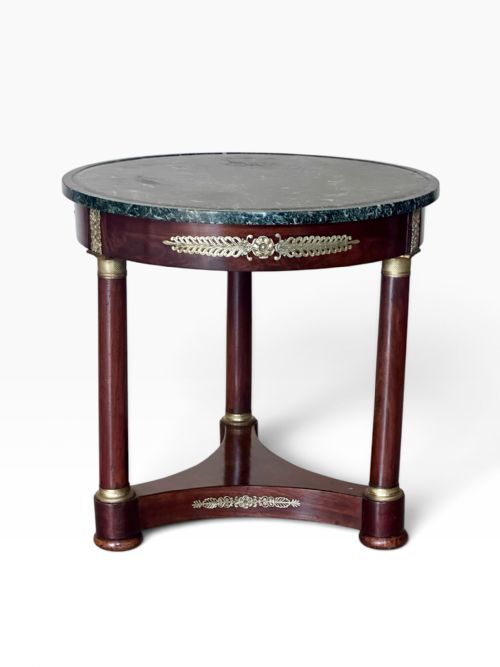
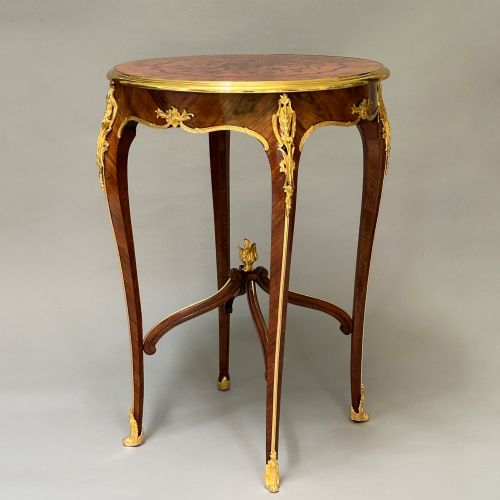
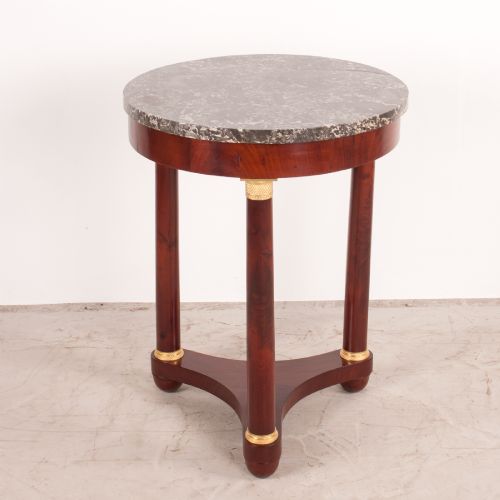
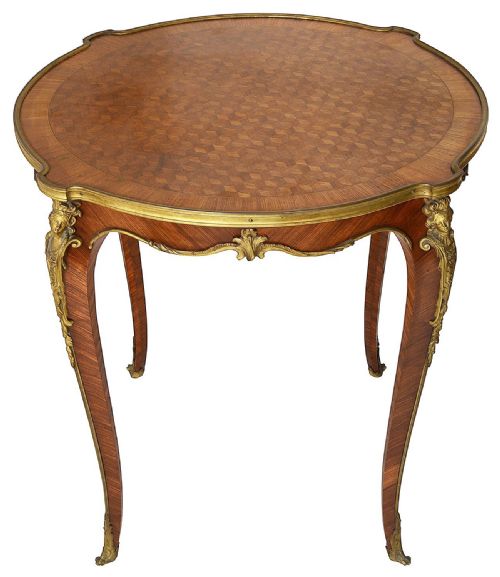
A french gilt bronze gueridon is a round freestanding small table designed for the centre of a room, a corner, or beside seating. These pieces emerge primarily from the nineteenth century, spanning Empire, Louis XVI, and Rococo revival styles.
The form typically rests on a central pillar or three slender legs topped by an inset marble slab. Surviving examples range from austere neoclassical designs in mahogany to heavily ornamented tables featuring porcelain plaques and parquetry.
Makers and workshops working in Paris during the nineteenth century produced these tables as side, lamp, or wine tables. They function today precisely as intended, serving as sturdy surfaces with decorative metal mounts.
Materials and Construction
Cabinetmakers constructed the wooden carcasses using mahogany, kingwood, walnut, and burr elm, often applying marquetry or parquetry geometric patterns. Solid hardwood forms the core structure, while secondary timbers line the interiors.
Gilt bronze, ormolu, and gilded brass mounts are cast, chased, and secured to the frame with screws or pins. These metal ornaments accent the edges, feet, and capitals of the legs.
Heavy marble slabs, sometimes porphyry, sit atop the wooden frames as inset tops, supported by the stiffness of the stone itself.
Some nineteenth-century tables served strictly to hold wine bottles close to the guest.
Factors of Quality
The crispness of the gilt bronze chasing dictates the visual success of the mountwork. Finer tables display sharp detail in the acanthus leaves, swags, and figural mounts, whereas lesser pieces show softer, shallower casting.
Timber selection and inlay precision separate standard production from master workshop output. Matched veneers, tight parquetry, and dense mahogany indicate deliberate material choice.
The quality of the marble top and its edge profiling complete the piece. Thick stone slabs with precise bevelling outlast thin or poorly fitted replacements.
Francois Linke·Zwiener Jansen Sucesseur·Henry Dasson·Weisweiler
The French Gilt Bronze Gueridon Glossary
- Gueridon
- A small circular French table designed as a centre table or stand. The form evolved from seventeenth-century torchères to become a domestic table by the nineteenth century.
- Ormolu
- Gilded bronze produced by applying a mercury and gold amalgam to cast bronze and heating it. This technique creates a durable golden finish characteristic of French furniture.
- Parquetry
- Geometric wood inlay arranged in patterns such as cubes or chequers. Craftsmen used contrasting timbers like kingwood and mahogany to achieve this effect.
- Porphyry
- An igneous rock with large crystals, highly prized for tabletops in neoclassical furniture. It provides a dense, speckled surface that resists scratching.
- Marquetry
- The art of applying pieces of veneer to a structure to form decorative pictures or designs. It differs from parquetry through its use of pictorial and floral motifs.
French Gilt Bronze Gueridon: Frequently Asked Questions
What is a gueridon table?
A gueridon is a round French occasional table designed for lamps, wine, or display. They typically feature a marble top supported by a central column or cabriole legs.
Historically used in grand salons, these tables suit modern interiors as bedside surfaces or lamp stands.
How do I date a french gilt bronze gueridon?
Dating relies on stylistic clues, timber choices, and construction methods. Nineteenth-century pieces frequently draw on Empire or Louis XV revival designs.
Examine the mounting techniques and wood ageing to distinguish mid-nineteenth-century production from later revivals.
Are these tables sturdy enough for daily use?
These tables were built to support heavy marble tops and decorative objects, making them structurally sound for everyday rooms. The heavy stone slab rests securely within the wooden frame.
Care should be taken with liquids near unsealed wood and antique veneers, using coasters for protection.
What is the difference between ormolu and gilt bronze?
Ormolu specifically refers to gilt bronze created using the traditional mercury amalgamation process common in eighteenth and nineteenth-century France. Gilt bronze is a broader term that also encompasses modern electroplating methods.
Both terms describe the golden metallic mounts that define the luxury aesthetic of these tables.