

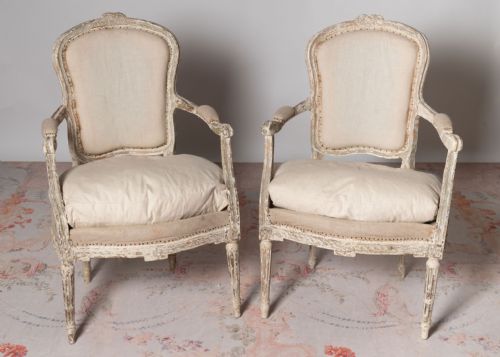


French Country Salon Seating
French country salon seating brings together stately walnut frameworks and tactile needlepoint textiles to anchor a traditional room.
French Country Salon Seating
When you search for french country salon seating, you encounter diverse forms ranging from single open armchairs to complete three-piece suites and multi-piece salon sets. The selections span the eighteenth, nineteenth, and early twentieth centuries, drawing heavily on Louis XV and Louis XVI stylistic revivals alongside French provincial traditions.
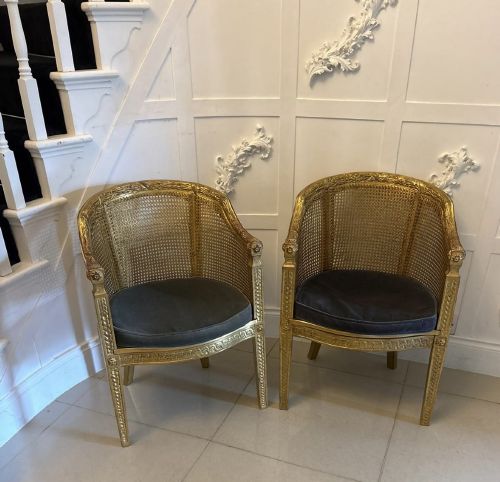
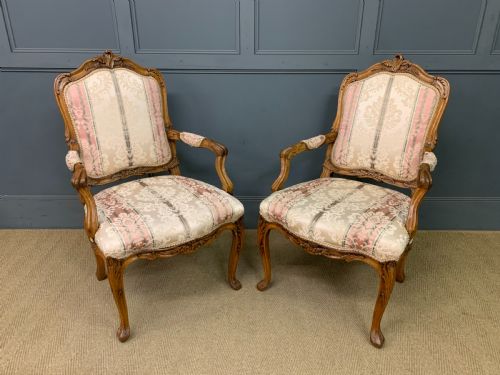
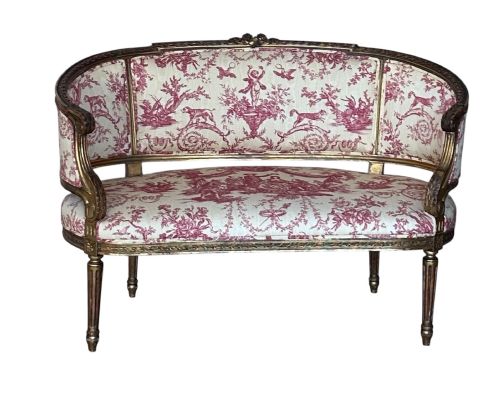
Armchairs and settees dominate the selection, often appearing as matched pairs or integrated suites with carved wooden frames. These pieces bridge formal court aesthetics and rustic provincial execution, offering comfortable proportions suited to domestic drawing rooms and reception spaces.
How these pieces were made
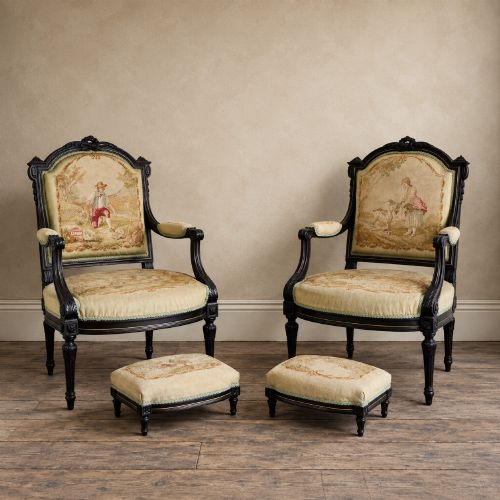
Makers shaped these frames primarily from solid walnut, beech, and mahogany, applying carved details directly into the timber. Many surfaces feature painted finishes, ebonised treatments, or complete gilding with gold leaf to elevate the underlying woodwork.
Upholstery relies on traditional textile applications, incorporating woven tapestry panels, needlepoint, and contemporary upholstery fabrics. Craftsmen secured these textiles over supportive padding to build resilient seats and backs on both armchairs and canapés.
Some nineteenth-century makers carved small two-seater settees specifically scaled as end-of-bed furniture for grand bedrooms.
What varies in quality
The sophistication of the wood carving dictates much of the distinction between standard and superior pieces, with crisp, deep relief work marking out better workshops. Hand-painted or gilded surfaces show greater depth and nuance when executed by skilled hands compared to flat or uniform finishes.
The integrity of the structural joinery and the survival of period textiles, such as genuine Aubusson covers or detailed needlepoint, elevate a piece's standing. Complete suites that retain their original matching upholstery and coordinated frames represent the upper tier of the range.
The French Country Salon Seating Glossary
- Canapé
- An upholstered sofa or settee featuring an exposed wooden frame, commonly seen in eighteenth and nineteenth-century French seating.
- Bergere
- A closed-arm armchair with upholstered sides, designed for comfort and typically constructed during the eighteenth and nineteenth centuries.
- Giltwood
- Wood that has been coated with a thin layer of gold leaf or gold paint to provide a reflective, luxurious surface finish.
- Needlepoint
- A type of counted thread embroidery stitched onto a canvas mesh, frequently utilised for historic chair and sofa seat covers.
French Country Salon Seating: Frequently Asked Questions
Can I mix armchairs with a settee?
Mixing individual armchairs with a settee creates a cohesive seating arrangement, particularly when the frames share similar periods or wood tones. Matching upholstery fabrics help unify disparate pieces.
Many period salons were furnished with assembled suites rather than rigid factory sets.
What is the difference between a salon suite and a seating suite?
A salon suite typically includes a larger complement of matching chairs and a settee, designed for formal reception rooms. These groupings often feature uniform giltwood or carved walnut frames.
Smaller seating suites generally consist of a compact sofa and a pair of matching armchairs suitable for private parlours.
How should I care for antique upholstery fabrics?
Historic textiles like needlepoint and tapestry require gentle handling, protection from direct sunlight, and regular light vacuuming with a low-suction brush attachment. Avoiding moisture keeps fragile fibres intact.
Professional textile conservation is recommended for older or heavily worn coverings.