
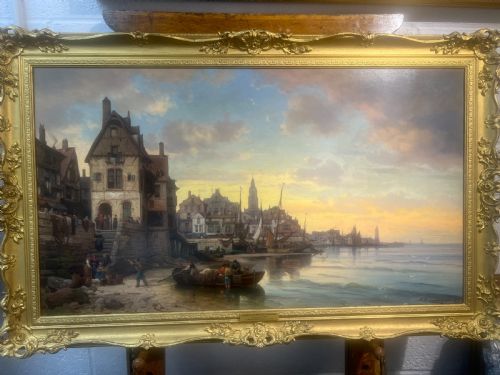


French Coastal Landscape Art
French coastal landscape art captures the maritime charm and shifting light of northern shores and southern ports across canvas and paper.
French Coastal Landscape Art
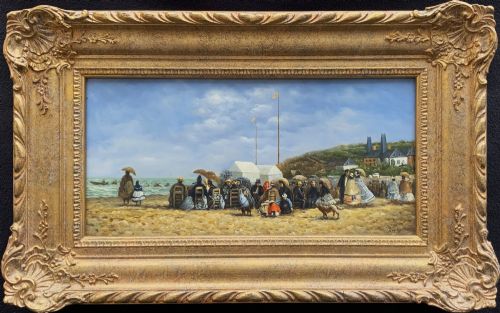
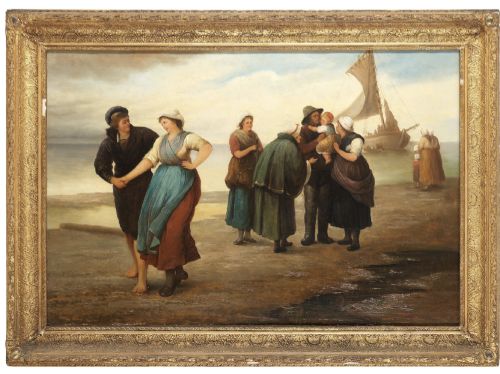
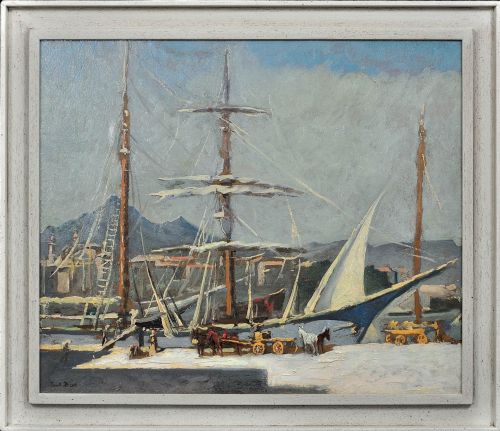
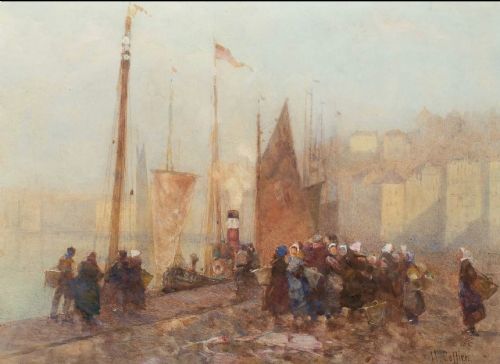
French coastal landscape art encompasses paintings, watercolours and framed artworks depicting harbours, cliffs and seaside gatherings along the Channel and Mediterranean shores.
The pieces on this page span from the nineteenth century through the mid twentieth century, reflecting movements from post-impressionism to realism.
Buyers will encounter oil paintings on canvas or board alongside delicate watercolours housed in wood frames, representing both northern fishing ports and sunlit southern towns.
Materials and techniques
Artists relied primarily on oil paint applied to canvas, wood panels or board to build texture and capture marine light.
Watercolour on paper appears frequently for lighter, more luminous coastal studies, often preserved beneath glass in traditional wood frames.
Listings feature works spanning from the nineteenth century through the 1960s, executed in oil, watercolour and pastel.
Evaluating quality and execution
Quality rests upon the artist's handling of coastal atmosphere, where confident brushwork and nuanced colour convey the distinct air of Normandy, Brittany or the Riviera.
Superior works demonstrate a secure command of proportion and perspective within complex harbour scenes, while lesser examples rely on formulaic compositions.
Paul Bret·Hector Caffieri·Charles Euphraisie Kuasseg·Erich Mercker·Raymond Moritz·Louis Suire·Gustave Vidal·Jean-Baptiste Olive·Raymond Picque·William Lee Hankey·Cecil Rochfort D'Oyly-John·Charles Malfroy·Roger de la Corbiere·Edward Henry Holder·Henri Ottman·Yves Brayer·Augustus William Enness·Charles Eyres Simmons
The French Coastal Landscape Art Glossary
- Post-Impressionism
- An artistic movement developing from impressionism that explored emotional response and structural form through bolder brushwork and simplified colours.
- Fauve
- A style characterised by vibrant, non-naturalistic use of colour and strong brushwork, often seen in early twentieth century seaside scenes.
- Medium
- The material used by the artist, such as oil paint, watercolour or pastel applied to canvas, board or paper.
- Provenance
- The documented history of ownership and origin associated with a work of art, establishing authenticity and period context.
French Coastal Landscape Art: Frequently Asked Questions
What periods do these coastal paintings represent?
The selection spans from the nineteenth century through the mid twentieth century, capturing distinct eras of European painting.
Works range from early realism to post-impressionist and mid-century modernist interpretations of French seaside locations.
Which regions of France appear most often?
Artists frequently recorded the rugged northern shores of Normandy and Brittany, alongside the luminous ports of the Mediterranean and Côte d'Azur.
Locations include Concarneau, Honfleur, Cannes, Marseille and Toulon.
Are these artworks typically framed?
Many pieces are presented in their original or period-appropriate wood frames that complement the painting style.
Framing materials and profiles vary according to the decade of creation, ranging from simple mouldings to decorative surrounds.
How do oil and watercolour works differ?
Oil paintings utilise heavy pigment on canvas or board to build rich textures and deep tones suitable for dramatic seascapes.
Watercolours employ fluid washes on paper to capture transient atmospheric effects and bright coastal light.