

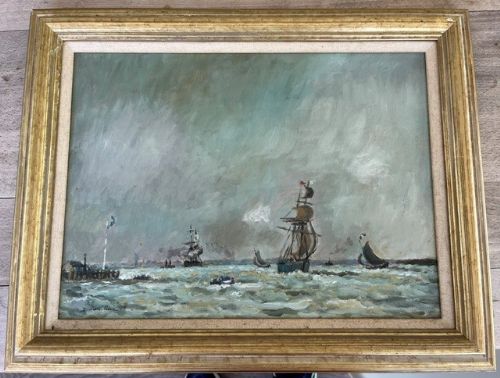


French Coastal Artwork
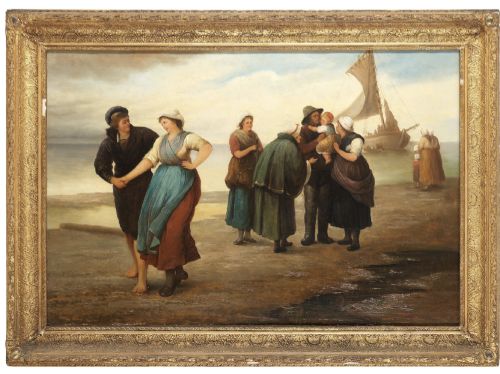
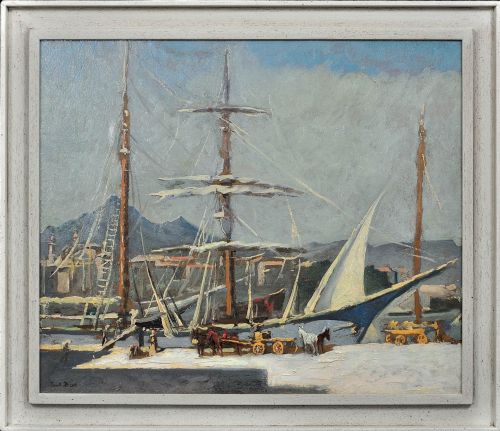
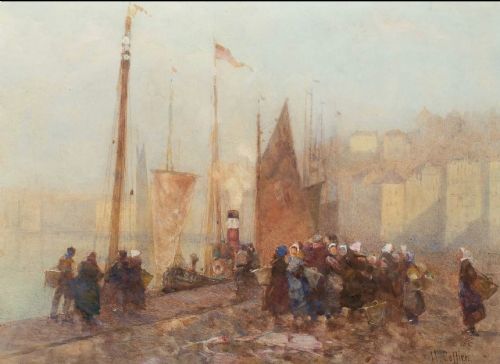
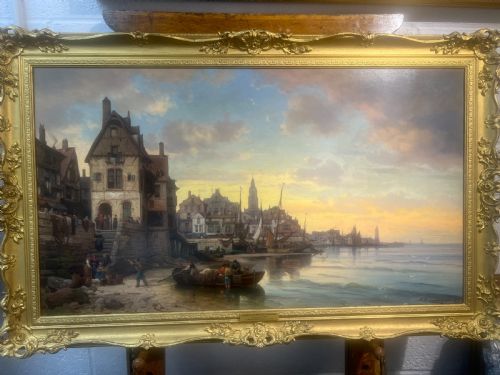
French coastal artwork captures harbours, cliffs and seaside towns through the brush of painters working across the nineteenth and twentieth centuries.
French Coastal Artwork
When collectors search for french coastal artwork, they look at framed paintings and works on paper depicting maritime scenes from ports and beaches in regions such as Normandy, Brittany and the Côte d'Azur.
The pieces on this page span from the nineteenth century through to the mid-twentieth century, capturing busy harbours, quiet fishing villages and sunlit cliffs.
Most examples originate from the early decades of the twentieth century, reflecting the strong interest artists took in Mediterranean light and Atlantic tides during that era.
Materials and methods
Artists painted these coastal subjects primarily in oil paint upon canvas, board or panel, building up textured surfaces to render the movement of the sea and the atmosphere of the shore.
Watercolour and pastel on paper also appear frequently, allowing creators to capture the bright, translucent light of the French coastline with swift, transparent washes.
Framed works often preserve the original wooden mouldings and glass protections chosen to house these canvases and watercolours over the decades.
Materials recorded across these coastal works include canvas, oil paint, wood, paper and glass.
Distinctions in execution
Quality in these coastal paintings rests upon the artist's ability to handle natural light and atmospheric conditions, moving beyond a simple topographical record to convey the actual mood of the sea or harbour.
Stronger pieces demonstrate confident brushwork and a coherent palette that anchors the composition, whereas lesser examples rely on formulaic repetition without genuine observation of the coast.
Paul Bret·Hector Caffieri·Charles Euphraisie Kuasseg·Erich Mercker·Raymond Moritz·Paul Delvaux·Louis Suire·Gustave Vidal·Raymond Picque·William Lee Hankey·Cecil Rochfort DOylyJohn·Charles Malfroy·Roger de la Corbiere·Edward Henry Holder·Eugene Boudin·Henri Ottman·Yves Brayer·Augustus William Enness
The French Coastal Artwork Glossary
- Post-Impressionism
- A stylistic development following Impressionism where artists extended its use of vivid colour and thick application while placing greater emphasis on geometric forms or expressive content.
- Seascape
- A work of art depicting the sea, shoreline or marine views, often focusing on the interaction between water, land and sky.
- Provenance
- The documented history of ownership surrounding an artwork, which helps establish its authenticity and historical path.
- Medium
- The materials used by an artist to create a piece, such as oil paint, watercolour or charcoal on paper.
French Coastal Artwork: Frequently Asked Questions
What periods do these paintings cover?
The selection spans from the nineteenth century through the 1960s, capturing shifting artistic approaches to the French seaside over more than a century.
Most pieces date from the early to mid-twentieth century, reflecting popular modernist and impressionist movements of that era.
Which regions of France are depicted?
Artworks frequently feature northern shores like Normandy and Brittany, known for dramatic cliffs and moody Atlantic waters.
Others focus on southern locations including Cannes, Marseille, Toulon and the wider Mediterranean coast of the French Riviera.
Are these works on canvas or paper?
The collection includes both mediums, with oil paintings executed on stretched canvas, wood panels or boards.
Watercolours and drawings on paper also appear regularly, offering a lighter touch suited to coastal atmospheres.
How do I care for antique oil paintings?
Keep framed canvases away from direct sunlight and sudden fluctuations in room temperature or humidity to protect the paint surface.
Dust gently with a soft, dry brush and avoid using any liquid cleaners on the canvas or the original wooden frames.