

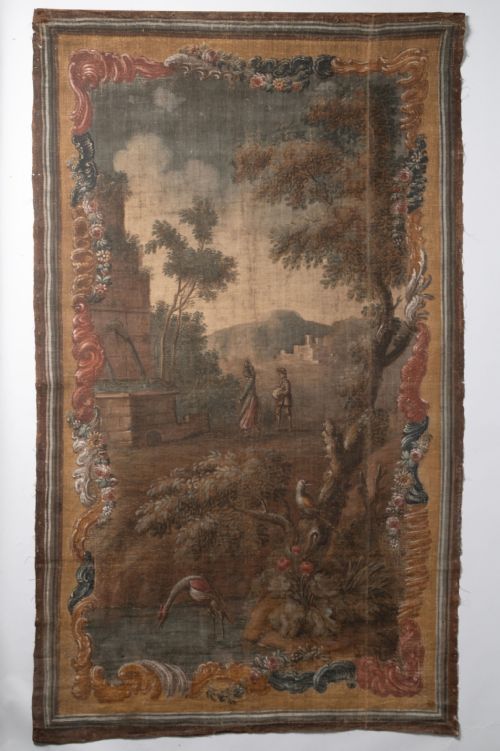
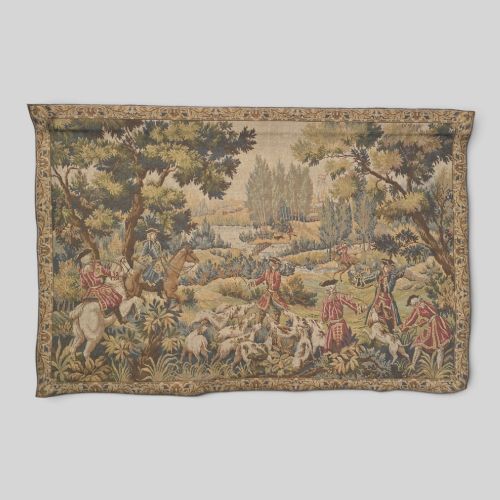


French Chateau Style Tapestry
These french chateau style tapestry pieces bring historic textile richness and dramatic interior presence to a room.
French Chateau Style Tapestry
A french chateau style tapestry collection centres on woven wall art, cushions, and rugs that evoke grand country houses. Buyers search this phrase to capture the stately atmosphere of historic European interiors.
The objects on this page span several centuries, including 17th century pieces alongside 19th century interpretations and 1920s works. You will most frequently encounter wall tapestries, framed textile panels, and smaller decorative cushions.
Seating and furniture also appear within this aesthetic, notably carved giltwood chairs, fauteuils, and footstools upholstered in heavy woven fabrics. These companion pieces share the opulent textile focus of the wall hangings.
How they were made
The textiles rely on traditional weaving techniques using wool, cotton, and silk threads to build dense pictorial scenes. Artisans combined these fibres to achieve subtle tonal gradations and durable surfaces suitable for wall display or heavy domestic use.
Wooden furniture frames associated with these textiles utilise carved walnut and other timbers finished with gilt or paint. Giltwood elements provide the metallic sheen characteristic of French Baroque and Neoclassical interior schemes.
French Chateau Style Tapestry Retail Price Guide 2026
Typical asking prices for french chateau style tapestry among the pieces listed under this phrase on Sellingantiques today, from the lower quarter to the upper quarter. They describe what is for sale here now, not the wider market.
Listings feature items spanning from the 17th century through to the 1920s, incorporating wool, silk, cotton, walnut, and giltwood.
What varies in quality
Quality rests in the intricacy of the pictorial weave and the fidelity of the historical style, whether following French Baroque or Neoclassical conventions. Finer examples display complex figure work and rich colour blending that command the eye.
On the furniture side, the depth and sharpness of the wood carving distinguish superior items. Frames featuring meticulous parcel gilt work sit above simpler constructions.
The French Chateau Style Tapestry Glossary
- Aubusson style
- A design tradition originating from the French town famed for its woven wall art and floor coverings. These patterns often feature pastoral scenes or floral motifs within decorative borders.
- Fauteuil
- An open-armed wooden armchair with upholstered back and seat, typical of French period seating. The exposed wooden frame is frequently carved and gilded.
- Giltwood
- Timber treated with gold leaf or gold paint to create a brilliant metallic finish. This treatment was widely employed on 19th-century frames and seating.
- Parcel gilt
- A decoration method where only specific carved portions of a wooden object receive gold leaf, contrasting with painted surfaces. It highlights intricate details on beds and chairs.
French Chateau Style Tapestry: Frequently Asked Questions
How do I hang a large wall tapestry?
Heavy wall hangings require even weight distribution across a sturdy wooden batten or metal rod fixed securely to the wall. Avoid hanging textiles directly in strong sunlight to protect the wool and silk fibres from fading.
Ensure the mounting method supports the entire width of the piece without stressing the upper edge. Proper installation keeps the weave hanging straight and flat.
Can I use these cushions on modern furniture?
Antique textile cushions introduce rich texture and historic colour to contemporary sofas and armchairs. Their dense weave stands up well to everyday placement in living spaces.
Pairing older covers with modern upholstery creates a balanced interior scheme. Handle them gently to preserve the historic fabric.
How do I distinguish 17th century work from 19th century revivals?
Seventeenth-century pieces display the specific hand-weaving techniques, dye methods, and wear patterns characteristic of their early origin. Nineteenth-century revivals often reinterpret these historic designs with cleaner cotton and wool blends.
Examining the reverse side and the specific style of the motifs helps clarify the period. Comparing material crispness also aids in telling them apart.
What is French Neoclassical style?
French Neoclassical design draws inspiration from classical antiquity, favouring symmetry, restrained ornamentation, and architectural motifs. It emerged as a reaction against the excessive curves of earlier Baroque periods.
In tapestries and furniture, this translates to orderly compositions and balanced framing. The aesthetic values classical harmony above all.