





French Campana Vases
French campana vases are classical pedestal vessels shaped like inverted bells, bringing monumental antique proportion and architectural dignity to interior spaces.
French Campana Vases
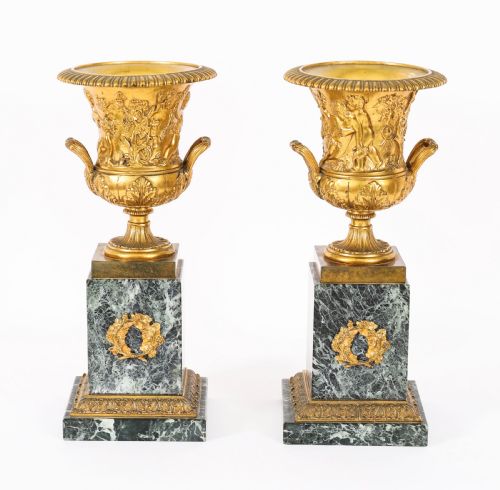
French campana vases derive their distinctive inverted bell silhouette from ancient Roman pottery and stone vessels discovered during archaeological excavations. When collectors search for french campana vases, they encounter pieces originating predominantly from the nineteenth century, reflecting a sustained fascination with classical antiquity. These decorative objects function as focal points on mantelpieces, pedestals, and side tables, often appearing as matched pairs.
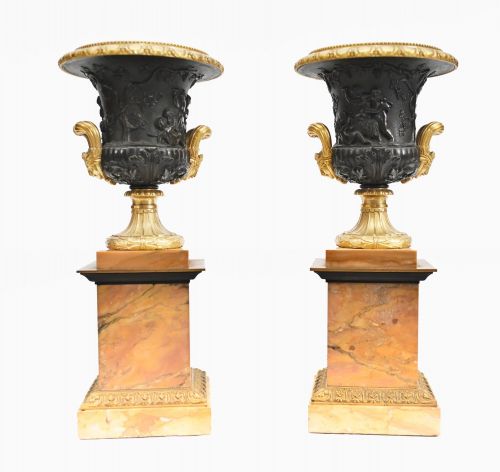
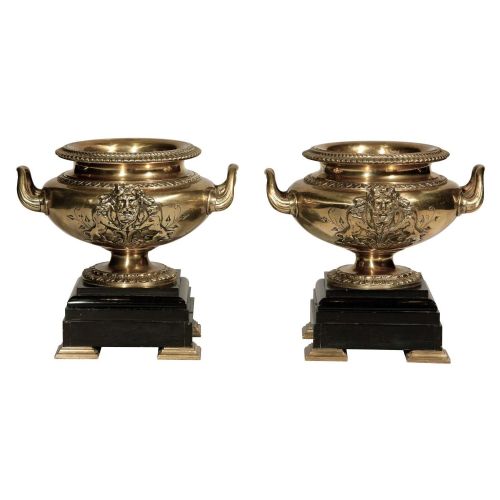
The materials utilised in these pieces range from cast bronze and gilt bronze to green marble, porcelain, and spelter. Many examples manifest through Grand Tour reductions of famous antiquities, whilst others incorporate Charles X period styling or neoclassical ornament. Forms vary from lidded garden urns and wine-coolers to decorative table vases mounted on stepped plinths.
Distinguishing quality in the range
The calibre of a cast separates standard production from exceptional work, particularly in the crispness of relief details such as Bacchic cherubs, foliate swags, and classical figures. Fine execution reveals itself in the depth of hand-chiselling on metal surfaces and the deliberate selection of high-grade marble or Siena bases.
Proportion and structural integrity dictate visual success. Superior examples maintain balance between the flared rim, the bell body, and the pedestal base, with mounts fitting flush and secure without visible stress or awkward joins.
Materials documented across the inventory include ormolu, enamel, and spelter applied to urns, garden vessels, and decorative vases.
The French Campana Vases Glossary
- Campana
- A vessel shaped like an inverted bell, originating from ancient Roman forms. The profile flares outward gently from a narrow base toward a wide rim.
- Grand Tour
- A cultural journey undertaken by nineteenth-century elites across Europe, inspiring the acquisition of miniature bronzes and classical reproductions. These souvenirs brought classical antiquity directly into nineteenth-century drawing rooms.
- Ormolu
- Gilt bronze produced by applying a gold and mercury amalgam to a bronze base, then firing to drive off the mercury. This technique yields a durable, deep golden surface.
- Neoclassical
- An artistic movement reviving the styles and proportions of ancient Greece and Rome. This aesthetic prioritises symmetry, restraint, and classical architectural motifs.
- Spelter
- A zinc alloy utilised as an economical substitute for bronze in nineteenth-century decorative objects. It accepts patination readily but possesses a lighter weight and softer structure than bronze.
French Campana Vases: Frequently Asked Questions
What periods do these vases date from?
The pieces available predominantly date from the nineteenth century, spanning eras such as the Charles X period and the height of Grand Tour collecting.
Production methods and material choices reflect the prevailing neoclassical revivals of this era.
How were these vases displayed historically?
Historically, these vessels served as decorative accents in formal reception rooms, libraries, and galleries. Pairs were frequently positioned symmetrically on mantelpieces, sideboards, or dedicated marble columns.
Larger scaled versions functioned as wine-coolers or garden ornaments.
Are bronze and spelter easy to tell apart?
Bronze offers a heavier weight and a harder metallic structure that permits sharp, deep chisel work. Spelter is noticeably lighter and softer, sometimes revealing grey metal beneath worn patination.
Examining the underside or interior often clarifies the material composition.
How do I care for marble and bronze?
Dust bronze and marble surfaces regularly with a soft, dry cloth to prevent particulate buildup. Avoid chemical cleaners or abrasive polishes, which can strip historic patinas or etch marble.
Maintaining a stable indoor climate protects against moisture damage.
What is a Warwick Vase reduction?
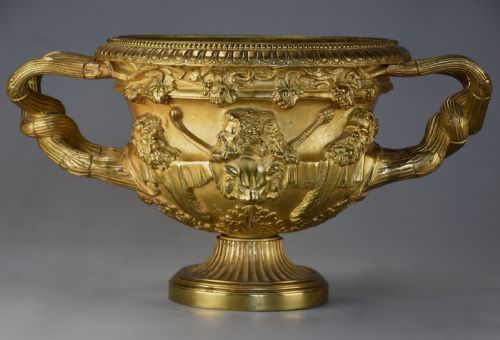
A Warwick Vase reduction is a smaller scale copy of the monumental ancient Roman marble vase discovered at Hadrian's Villa. Nineteenth-century founders cast these famous antiquities in bronze for collectors.
They capture the distinctive Bacchic mask handles and vine-wreath friezes of the original.