
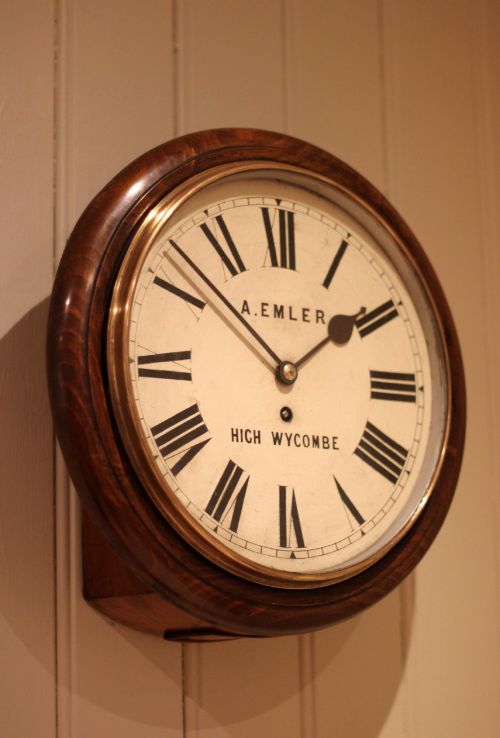
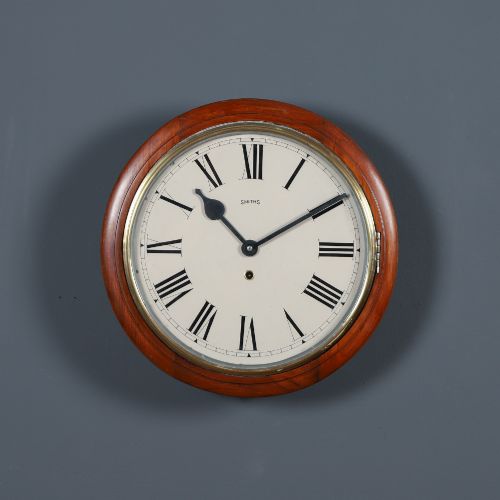


Framed Wall Clock
These framed wall clock examples combine domestic timekeeping with decorative framing, offering functional historical interest for any room.
Framed Wall Clock
A framed wall clock brings together traditional timekeeping mechanisms and decorative surrounds, spanning periods from the Georgian era through the Victorian period and into the twentieth century. These pieces encompass diverse regional styles, including English fusee dials, French picture frame models, and American painted panel designs.
The selection ranges from simple oak and beech railway station dials to elaborate ebonised wood cases inlaid with mother of pearl and metal wire. Buyers frequently encounter nineteenth century French examples alongside robust oak and mahogany workshop or factory timepieces.
Materials and construction
Clockmakers utilised sturdy timbers such as oak, mahogany, beech, and ebonised wood to build the supporting frames and cases, often incorporating glass lenses to protect the dial. Dial faces typically featured painted paper, enamel, or brass numerals paired with specialised movements like the fusee or eight day striking mechanisms.
Decorative detailing on French and English pieces involved mother of pearl inlay, metal wire work, and convex glass construction. These methods joined practical timekeeping mechanics with cabinet making traditions of the nineteenth century and earlier periods.
Listings feature clocks spanning the Georgian era, the nineteenth century, and up to nineteen thirty, constructed in oak, mahogany, beech, and ebonised wood.
Distinctions in quality
The Framed Wall Clock Glossary
- Fusee
- A conical pulley used in older clock movements to maintain an even pull as the mainspring unwinds. This mechanism helps ensure more accurate timekeeping across the duration of the wind.
- Ebonised
- Wood treated with a dark finish to imitate expensive ebony. Makers frequently utilised this technique during the Victorian period to create high contrast backgrounds for metal inlay.
- Enamel
- A glassy substance fused to a metal base to form a durable dial face. Enamel dials provide a smooth, wipeable surface that resists yellowing over decades.
- Automaton
- Moving mechanical figures or parts integrated into a clock face or picture. These decorative additions create animated scenes alongside standard timekeeping functions.
Framed Wall Clock: Frequently Asked Questions
How do I wind a fusee wall clock?
Winding requires inserting a key into the dial aperture and turning it gently until resistance is felt. Care must be taken not to overwind the mechanism.
Most eight day movements require winding once a week to maintain accurate timekeeping and protect the inner spring tension.
Where should I hang a heavy wall clock?
Heavy timepieces require secure fixing directly into wall studs or masonry using appropriate weight rated fixings. Hanging them from standard plasterboard hooks risks structural failure.
Placement should avoid damp areas and locations subject to extreme temperature fluctuations that might affect the wooden case and movement.
How do I date a Victorian wall clock?
Dating relies on examining the case timber, the materials used for the dial, and the construction style of the movement behind the face. Victorian pieces often combine robust mahogany or oak frames with painted paper or enamel dials.
Comparing the specific framing details and hardware with documented examples from the mid to late nineteenth century helps narrow down the production period.
Are these clocks suitable for daily use?
Many historical timepieces remain fully operational and capable of keeping accurate time when properly maintained and serviced by a professional horologist. Regular maintenance ensures the mechanical gears experience minimal wear over time.
Some collectors prefer to keep them running continuously, while others enjoy them primarily as decorative wall art with historical significance.