






Framed Stream Painting
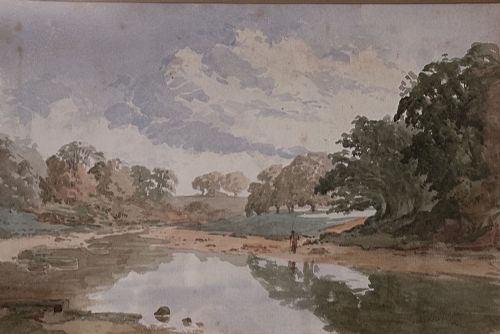
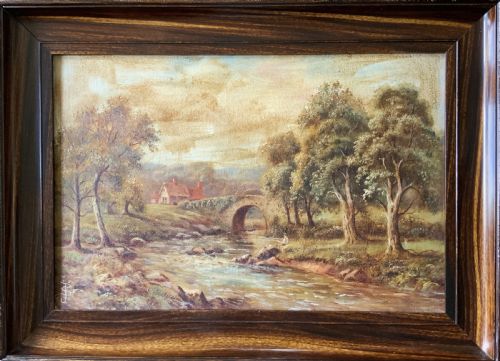
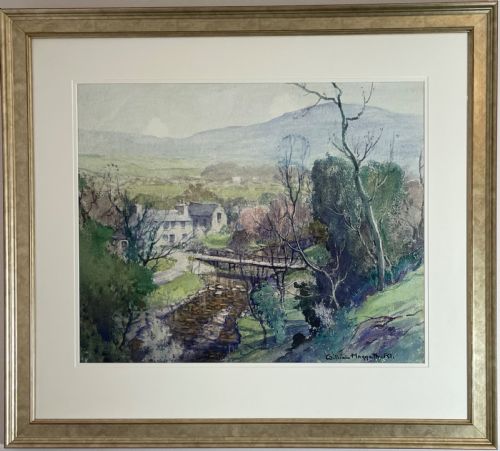
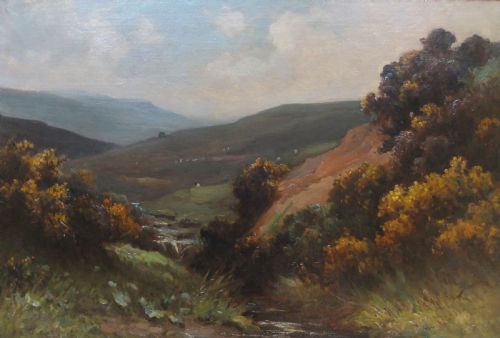
A framed stream painting captures moving water in oil or watercolour, bringing British and European landscapes indoors.
Framed Stream Painting
A framed stream painting brings moving water and pastoral scenery into interior spaces through oil and watercolour mediums. Collectors often encounter Victorian and Edwardian works depicting Highland cattle, rural cottages, and wooded valleys alongside these moving waters.
The selections span the nineteenth century through the mid-twentieth century, capturing British Impressionism, Victorian Realism, and English Country House aesthetics. Most examples utilise traditional canvas, wood, and paper supports housed in period frames.
Materials and technique
Artists painted primarily with oil paint on canvas or board, and watercolour pigment on paper, applying colour to capture natural light upon water. Giltwood and gesso frames provide the traditional border structure for these works.
The technique relies on brushwork ranging from detailed nineteenth-century realism to looser twentieth-century impressionism. Supporting wooden stretchers and frames secure the canvas or paper against environmental shifts.
Subject matter centres on British and European landscapes, featuring Highland cattle, rural cottages, and mountain streams.
Quality variations
Quality rests upon the artist's ability to render the movement of water and atmospheric light convincingly across the composition. Stronger pieces display confident brushwork and balanced perspective within the landscape.
The harmony between the artwork and its original or period frame influences the overall integrity of the piece. Well-preserved surfaces retain their pigment depth without excessive intervention or destabilisation of the ground.
Sydney Yates Johnson·William George Tennick·John Grenville Fennell·Henry John Yeend King·William Hoggatt·Robert Watson·David Watts·Sidney James Beer·Harry Sylvester Stannard·John Hobson Nicholson·Ernest Higgins Rigg·Alfred Banner·Noel Harry Leaver·William Sidney Cooper·Benjamin Callow·William Greaves·John Pedder·Clarence Roe
The Framed Stream Painting Glossary
- Canvas
- A heavy woven fabric stretched across a wooden frame to serve as a support for oil paint. It provides a textured surface that holds layered pigments securely over centuries.
- Gesso
- A plaster mixture applied to wood or canvas to prepare a smooth surface for painting. It seals the support and receives the final layers of oil or watercolour.
- Giltwood
- Wood carved and coated with a thin layer of gold leaf or metallic powder. It forms the decorative outer boundary of traditional picture frames.
- Watercolour pigment
- Finely ground colour suspended in a water-soluble binder applied to paper. It creates luminous, translucent washes characteristic of landscape studies.
- Victorian Realism
- An artistic approach focusing on unidealised depictions of everyday rural life and nature. It values accurate representation of light, texture, and topographic detail.
Framed Stream Painting: Frequently Asked Questions
What periods do these paintings span?
The available works range from the nineteenth century through the Edwardian era and into the mid-twentieth century.
Victorian and early twentieth-century pieces form the core of the selection.
Are these works signed by the artists?
Many examples feature signatures or inscriptions identifying the creator or the specific geographic location depicted.
Documentation varies depending on the specific period and the artist's practice.
What materials support these artworks?
Painters utilised oil paint on canvas, panel, and board, alongside watercolour pigment on paper.
Wood and gesso frames enclose these primary supports to protect the edges.
How do I care for a framed painting?
Keep the artwork away from direct sunlight and areas subject to sudden humidity fluctuations.
Dust the frame gently with a dry cloth and avoid applying liquid cleaners to the painted surface.