




Framed Moorland Landscape
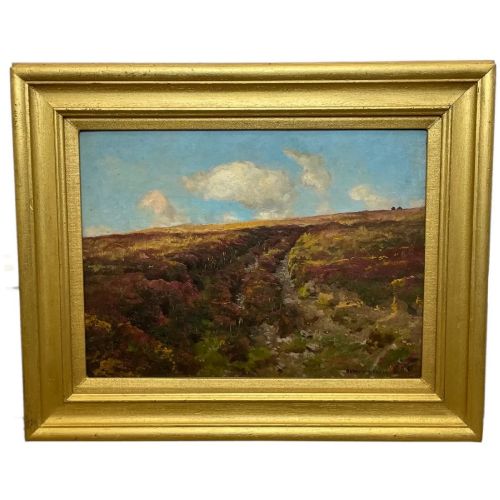
A framed moorland landscape captures the wild expanses and open skies of Britain's high ground, bringing a sense of remote terrain into the home.
Framed Moorland Landscape
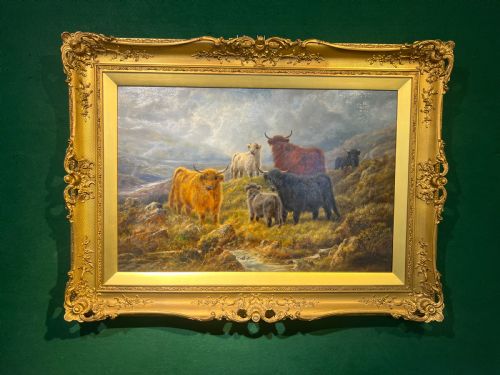
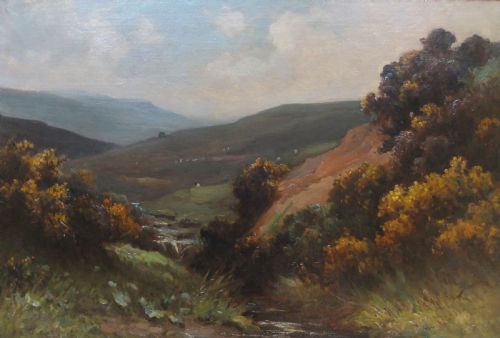
A framed moorland landscape depicts expansive British high ground, featuring locales such as Exmoor, Dartmoor, and Yorkshire. These works span the Victorian and Edwardian eras through to the mid-twentieth century, capturing rural life, livestock, and untamed terrain.
Buyers encounter oil paintings on canvas or board, alongside watercolours, pastels, and gouache. The compositions range from quiet pastoral scenes with sheep and figures to dramatic depictions of sporting dogs and hunting scenes.
The framing is integral to these pieces, typically consisting of wood, often gilt, paired with protective glass for works on paper. Most examples date from the nineteenth and early twentieth centuries, reflecting the British School and British Impressionism.
Materials and Techniques
Artists working on these scenes utilised oil paints on canvas or board, layering pigments to capture atmospheric weather and changing light over open ground. Watercolours and gouache on paper were equally common, offering immediacy and fine detail.
Traditional framing involved carved or moulded wood, frequently finished with gilt to complement the artwork. Protective glass is standard for watercolours and pastels, preserving the delicate pigments from environmental damage.
Several moorland scenes include stray sporting dogs and wandering sheep that seemingly refused to stay out of the foreground.
Factors of Quality
Quality rests upon the artist's ability to render light, atmosphere, and scale within an expansive composition. Works by established named painters command greater attention through confident brushwork and precise anatomical depiction of animals or figures.
The integrity of the original framing and the preservation of the medium itself dictate the standing of a piece. Unfaded watercolours under clear glass and stable oil canvases without extensive retouching represent the upper tier.
Arthur Wardle·Robert Watson·Joseph Knight·F.J. Snell·Charles Walter Simpson·Owen Bowen·John A. Houston·Colin Graeme Roe·Joseph Farquharson·John Charles Tunnard·Edmund Morris Wimperis·Ernest Higgins Rigg·Peter Jackson·Arthur H Enock·Charles James Adams·Robert Cleminson·Alfred Graham·Fred Lawson·John Bates Noel·Peter Ghent
The Framed Moorland Landscape Glossary
- Gouache
- An opaque watercolour paint that dries to a matte finish, allowing artists to build dense highlights in landscape details.
- British Impressionism
- A painting style influenced by the French movement, focusing on natural light and loose brushwork within British rural settings.
- Pastel
- A dry drawing medium made of powdered pigment and a binder, frequently used to capture the soft textures of moorland skies and foliage.
- Gilt Wood
- Wood that has been coated with a thin layer of gold leaf or gold paint, standard for framing traditional paintings.
- British School
- A loose categorization for artists trained and working within Britain across various centuries, sharing stylistic traditions.
Framed Moorland Landscape: Frequently Asked Questions
What subjects appear in these paintings?
These works typically depict open terrain, including Dartmoor, Exmoor, and Yorkshire dales. Common secondary elements feature sheep, ponies, sporting dogs, and figures traversing the countryside.
Scenes often capture specific weather conditions, ranging from bright daylight over heather to overcast skies above remote streams and valleys.
How do I date a framed landscape?
Dating relies on stylistic clues, framing materials, and artist documentation. Victorian and Edwardian works often feature specific framing styles and distinct painterly conventions.
Signatures, inscriptions on the reverse, and artist biography dates provide the most reliable chronological markers for these pieces.
Are watercolours framed differently from oils?
Watercolours require protective glass and mount boards to prevent the paper from touching the glazing. This setup preserves the delicate pigments from moisture and light.
Oil paintings on canvas or board are typically framed open to the air, allowing the paint surface to breathe without a glass barrier.
Where should I hang a landscape?
These works suit rooms with stable humidity and indirect natural light to protect both the canvas or paper and the wooden frame. Placing them away from direct heat sources ensures the materials remain stable.
Their varied scale allows them to anchor larger wall spaces or sit comfortably above furniture in domestic interiors.