
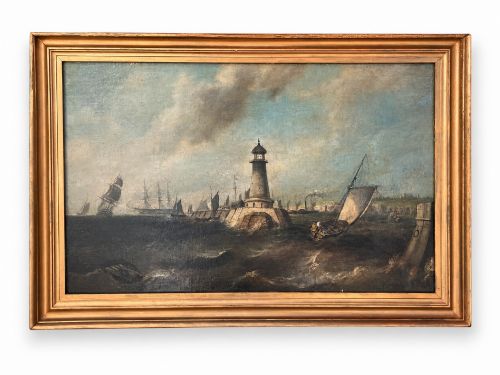


Framed Lighthouse Painting
A framed lighthouse painting captures coastal isolation and maritime history, bringing historic marine architecture and turbulent seas straight to your wall.
Framed Lighthouse Painting
When you search for a framed lighthouse painting, you encounter maritime artworks spanning the Victorian era, the Edwardian period, and the mid-twentieth century. These pieces record coastal beacons, stormy seascapes, and working harbours in mediums ranging from oil on canvas to delicate watercolours. The selection includes works by named marine artists alongside British folk art expressions and anonymous watercolours.
You are most likely to meet nineteenth-century oil paintings and Edwardian maritime watercolours on this page. These works frequently pair coastal architecture like Plymouth Breakwater, Leasowe, or Eddystone lighthouses with contemporary shipping, ranging from Royal Navy vessels to fishing trawlers and clippers.
How they were made
Artists utilise oil paint on canvas or board to build depth and texture, particularly when capturing churning waves and stormy skies around coastal beacons. Watercolours on paper offer a lighter touch, frequently employed in Edwardian marine scenes to depict clear coastal light and distant shorelines.
The supporting frames themselves form an integral part of the piece, utilising wood often enhanced with gold leaf or gilding. These traditional frames protect the canvas or paper while complementing the maritime subject matter through period mouldings.
Listings feature works spanning the nineteenth century, the Edwardian era, and the 1960s, executed in oil paint, watercolour, and gold leaf.
What varies in quality
The sophistication of the maritime drafting and the handling of atmospheric light separate accomplished marine art from simpler folk depictions. Works by documented painters demonstrate a rigorous understanding of vessel rigging, coastal topography, and maritime perspective.
Material preservation dictates the standing of individual pieces, distinguishing untouched period canvases and stable watercolours from those altered by historic restoration. The integration between the artwork and its original gilded wood frame also influences the overall integrity of the piece.
Nicholas Condy·Arthur Wilde Parsons·Joseph Heard·Walter Holmes·William Daniel Penny
The Framed Lighthouse Painting Glossary
- Maritime realism
- A style of painting that depicts ships, seascapes, and coastal structures with strict attention to nautical accuracy. This approach values correct vessel rigging and precise topographical detail.
- Oil on canvas
- A traditional painting medium where pigmented oils are applied to stretched fabric. This combination allows for rich colour blending and textured brushwork suited to stormy seas.
- Gilded wood
- Timber finished with a thin layer of gold leaf or metallic paint. This technique creates a luminous border that enhances the framed artwork.
- Folk art
- Artistic work created within a popular tradition by self-taught makers. These pieces often prioritise expressive character over strict academic perspective.
Framed Lighthouse Painting: Frequently Asked Questions
How do I date a lighthouse painting?
You date these artworks by examining the clothing of figures, the rigging of depicted ships, and the framing style used. Victorian and Edwardian works often carry signatures, dates, or canvas stamps that place them in a specific decade.
Material analysis of the wood frame and the canvas preparation also provides clues to the era of creation, supported by stylistic traits typical of nineteenth-century maritime art.
Where were most marine paintings created?
Many British maritime pieces originate from coastal art communities and ports where artists had direct access to shipping traffic and lighthouses. Painters frequently worked along the English coastline to capture accurate details of vessels and coastal beacons.
Continental European artists also contributed to the genre, recording French beaches and lighthouses using similar oil and canvas techniques.
How should I display maritime art?
Display these framed paintings away from direct sunlight and excessive moisture to protect the oil paint, canvas, or paper watercolours. Stable indoor humidity prevents the wooden frames and canvas supports from warping over time.
Consider the weight of large oil paintings on gilded wood when selecting wall fixings to ensure secure placement.
What is the difference between oils and watercolours here?
Oil paintings utilise heavy pigment suspended in oil on canvas or board, creating a textured surface capable of rich colour depth for stormy seas. Watercolours employ pigment suspended in water on paper, offering a translucent quality suited to lighter coastal scenes.
Watercolours require glass protection within their frames, whereas oil paintings on canvas remain open to the air.