

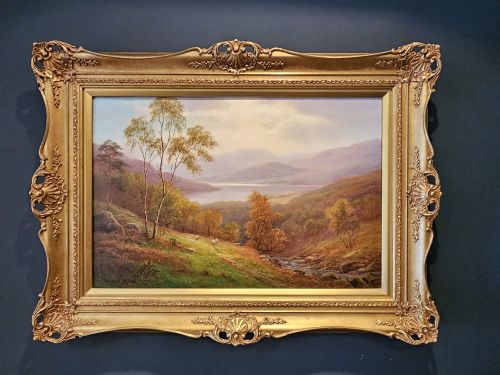


Framed Lake View Artwork
Framed lake view artwork brings water and mountain scenery inside through period watercolours and oil paintings housed in antique timber frames.
Framed Lake View Artwork
When you search for framed lake view artwork, you encounter nineteenth-century and early twentieth-century paintings depicting British and continental waters. These pieces range from Victorian Scottish highlands to Italian lakes like Como and Garda.
The most common examples on this page are oil paintings and watercolours set behind glass within gilt wood or ornate frames. They capture mountainous lake views, alpine scenes, and quiet Cumbrian waters painted by named artists and anonymous hands.
Subjects stretch across romanticism, impressionism, and post-impressionism, documenting scenes from the Italian school to domestic Lakeland beauty. Each piece records a distinct nineteenth-century or Edwardian perspective on open water and high peaks.
How they were made
Makers applied oil paint to canvas or watercolour pigments to paper, capturing the changing light across mountain lakes and valleys. Artists worked en plein air or in studios using established nineteenth-century techniques to build depth in sky and water.
Works are typically enclosed in giltwood or gilt wood frames that complement the painting style of the period. Glass protects the delicate surface of paper watercolours while open canvases display the direct texture of oil paint.
Framed Lake View Artwork Retail Price Guide 2026
Typical asking prices for framed lake view artwork among the pieces listed under this phrase on Sellingantiques today, from the lower quarter to the upper quarter. They describe what is for sale here now, not the wider market.
Listings feature works spanning the Victorian era through the 1950s, utilising canvas, paper, and gilt wood.
What varies in quality
Quality rests in the handling of light on water and the depth achieved in mountain ranges. Stronger works demonstrate confident brushwork and accurate atmospheric perspective rather than flat colour washes.
The calibre of the framing also defines the piece, with original gilt wood frames adding substantial visual weight and historical context to the canvas or paper within.
Robert George Talbot Kelly·Alfred de Breanski·Gustave De Breanski·William Mellor
The Framed Lake View Artwork Glossary
- Watercolour painting
- A work created using water-soluble pigments on paper, often showing transparent washes of colour that catch the light through glass.
- Gilt wood
- Carved timber finished with a thin layer of gold leaf or metallic gilt, commonly used to frame nineteenth-century landscapes.
- Oil paint
- Pigment suspended in a drying oil applied to canvas, allowing for rich texture and deep colour saturation in landscape scenes.
- Romanticism
- An artistic movement focusing on emotion, nature, and the sublime power of mountainous scenery and vast open lakes.
Framed Lake View Artwork: Frequently Asked Questions
How do I hang a heavy oil painting?
Heavy oil paintings require secure wall anchors or direct fixing into wall studs to support the weight of the timber frame and canvas.
Ensure the hanging wire and D-rings on the reverse are robust enough for the size of the artwork before mounting.
Should I keep antique watercolours out of sunlight?
Watercolours on paper are sensitive to direct sunlight and ultraviolet rays can cause the pigments to fade over time.
Position these pieces on walls that receive indirect light to preserve the integrity of the original colours.
How do I clean an antique gilt frame?
Dust gilt wood frames gently with a dry, soft brush to remove surface particles without disturbing the delicate gold leaf finish.
Avoid using water, chemical cleaners, or damp cloths, which can strip the gilding from the carved wood beneath.
How can I tell a watercolour from an oil painting?
Watercolour paintings are executed on paper and sit behind protective glass to prevent environmental damage to the delicate medium.
Oil paintings utilise canvas surfaces with visible brush texture and do not require glass protection over the paint layer.