

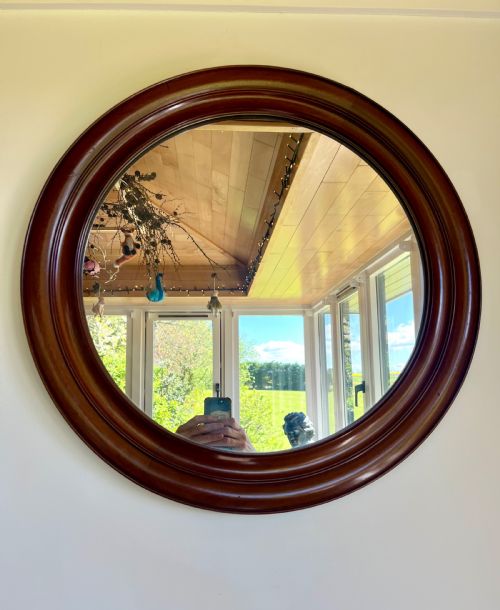

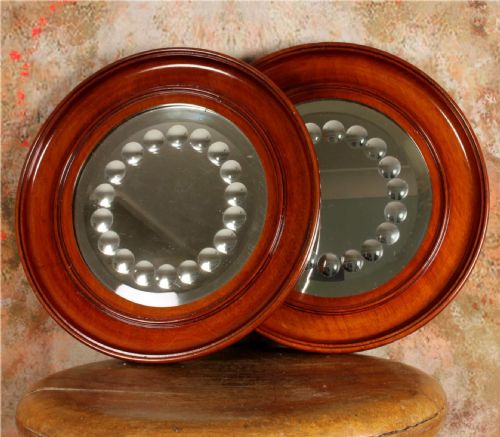


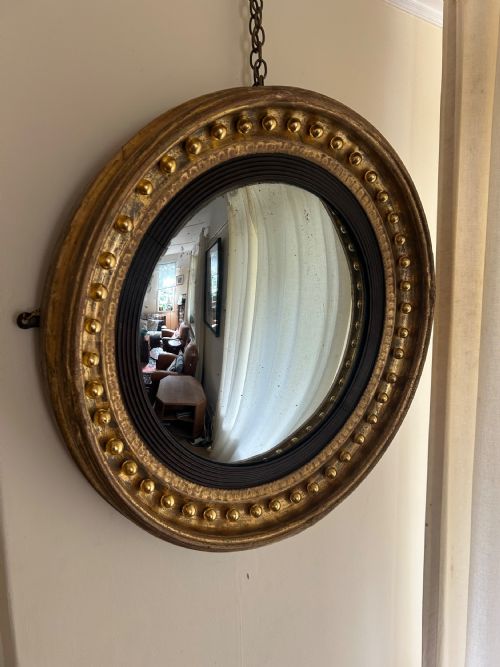


Framed Convex Glass Mirror
A framed convex glass mirror bends the light of a room, and the examples gathered here offer both Regency grandeur and Victorian character.
Framed Convex Glass Mirror
A framed convex glass mirror is a wall mirror designed to reflect a wide, curved view of an interior space. When you search for a framed convex glass mirror, you encounter wall mirrors shaped in round or oval forms, often known historically as sorcerer or witch's mirrors. These objects appear in periods ranging from the Regency era through to the Victorian period, 1880, 1890, 1910, and 1930.
The versions most commonly met on this page include gilded wooden frames from the Regency style and grand Regency traditions, alongside Victorian velvet-mounted multi-convex pieces and mid-century fairground or circus mirrors. They serve as striking focal points in a room, capturing light across a curved plate of glass.
How they were made
The construction of these mirrors relies on carved wood, gesso, and giltwood to build the heavy decorative frames that hold the curved glass plate. Many pieces utilise ebonised wood or mahogany, whilst others incorporate velvet inserts to frame the reflective surface.
The glass itself is blown or formed into a convex plate, creating the characteristic distortion that sweeps the room into the glass. Frames are finished with applied gesso and gold leaf or metallic paint, particularly in the Regency style and revival pieces.
Circus mirrors distort your reflection so thoroughly that even a straightforward Tuesday morning glance turns into a funhouse adventure.
What varies in quality
The distinction between standard and superior pieces rests on the depth of the carving in the giltwood frame and the clarity of the convex mirror plate. Early Regency examples demonstrate finer hand-carved detail in the wood and gesso, whereas later revival pieces show simpler mouldings.
The integrity of the original mercury or silver backing on the glass plate also separates the exceptional finds from later replacements. Balance in the proportions of the frame relative to the convex lens determines the visual weight of the mirror on the wall.
The Framed Convex Glass Mirror Glossary
- Convex glass
- A curved glass plate that bulges outward toward the viewer, creating a wide-angle reflection of the surrounding space. This curved form captures the entire room in a single glance.
- Giltwood
- Timber coated with a thin layer of gold leaf or gold paint over a prepared gesso base. This material gives Regency and Victorian frames their luminous metallic finish.
- Gesso
- A plaster-like mixture applied to wooden frames and carved to create raised ornamental details before gilding. It allows for crisp decorative moulding.
- Sorcerer's mirror
- A traditional alternative name for a convex mirror, derived from their historical association with scrying and optics. They are also frequently called witch's mirrors.
- Ebonised wood
- Timber treated to resemble ebony through staining or painting, providing a dark, contrasting border around the glass plate. This finish appears on several Victorian examples.
Framed Convex Glass Mirror: Frequently Asked Questions
What is a convex mirror used for?
A convex mirror is traditionally hung in a principal room to reflect light and provide a wide-angle view of the interior.
In historical domestic settings, they allowed occupants to monitor activity across a large space from a single vantage point.
How do I date a convex mirror?
Dating relies on examining the construction of the wooden frame, the materials used in the gesso, and the characteristics of the glass plate.
Regency frames often display distinct neoclassical motifs and heavy gilding, whereas Victorian and later 1930s pieces show variations in the framing materials and backboards.
Why are they called witch's mirrors?
The term stems from folk history and their spherical distortion, which superstitious traditions once linked to scrying and warding off evil.
Over time, the name became interchangeable with sorcerer's mirrors and convex wall mirrors.
How do I hang a heavy convex mirror?
Due to the substantial weight of the giltwood frame and glass, these mirrors require secure fixing directly into wall studs or heavy-duty masonry anchors.
Checking the stability of the original hanging rings on the back of the frame is an essential step before mounting.