
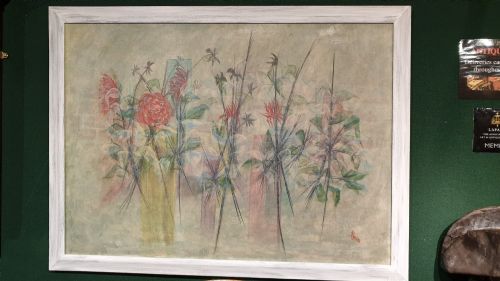
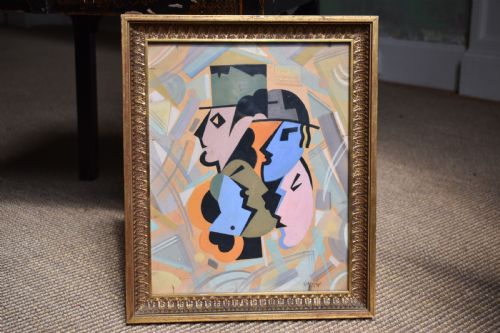


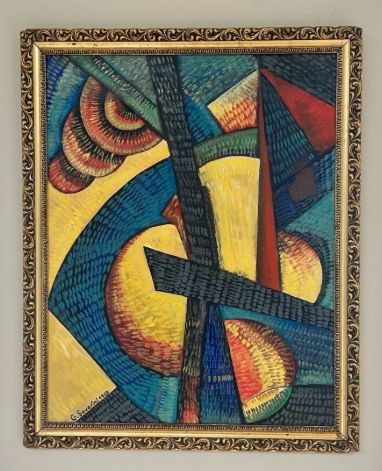


Framed Abstract Wall Painting
These framed abstract wall painting selections deliver mid-century modernism and abstract expressionism straight to domestic interiors through mid-century canvas, board and paper works.
Framed Abstract Wall Painting
A framed abstract wall painting brings mid-century modernism, cubism and abstract expressionism into contemporary spaces. These pieces span the 1920s to the 1960s, capturing the shift towards non-representational forms and bold palettes.
Most examples encountered here date from the 1950s and 1960s, reflecting the post-war surge in modern art production. Works range from modest watercolours and gouache on paper to large oil paintings on canvas and board.
Subjects stretch from abstracted still lifes and cityscapes to pure geometric compositions and figurative studies. Each piece arrives ready to hang within its original or period-appropriate frame.
Materials and construction methods
Artists painted primarily with oil or acrylic on stretched canvas or wooden board, occasionally utilising impasto techniques to build thick, textured surfaces. Works on paper typically employ gouache or watercolour, mounted beneath glass within wooden frames.
Support materials reflect mid-century availability, using standard commercial canvases and hardboard panels alongside heavyweight artist papers. Frames are constructed from timber, often painted or moulded to complement the modernist aesthetic.
Listings feature works executed in oil, gouache, and watercolour across wood, canvas, and paper supports.
Distinguishing quality across the selection
Quality rests upon the strength of the composition, the handling of medium, and the fidelity of the framing to the period. Bold brushwork and confident use of colour elevate a canvas, while weaker pieces rely on hesitant lines or derivative forms.
Provenance and documentation mark the upper tier of works, particularly those tied to identifiable schools or established exhibiting artists. The integration between the artwork and its frame also dictates overall integrity.
Tony Giles·Denis Mitchell·Barbara Hepworth·Gino Severini·William Littlejohn·Edward Carter Preston·Derek Latimer Sayer·William McCance·Adrian Heath·Lester Epstein·Antonio Ferri·Leon Kossoff·Richards Rubin·William Ernst Burwell
The Framed Abstract Wall Painting Glossary
- Impasto
- Paint applied thickly to a canvas or board, standing out in relief from the surface so that the marks of the brush or palette knife remain visible. This technique adds tactile depth and physical presence to mid-century compositions.
- Gouache
- An opaque water-based paint that dries to a matte finish, frequently utilised on paper during the mid-century period for vibrant, flat areas of colour. It allows for sharp geometric divisions common in cubist works.
- St Ives School
- A group of artists based in Cornwall associated with the development of British modernism and abstract art from the mid-twentieth century onwards. Painters connected to this circle often explored coastal light and abstracted landscapes.
- Cubism
- An early twentieth-century avant-garde art style that revolutionised European painting by breaking down subjects into geometric planes and multiple viewpoints. This approach heavily influenced later mid-century abstract compositions.
- Board
- A rigid substrate such as hardboard or masonite used by artists as an alternative to stretched canvas. It provides a flat, stable surface that frequently appears in post-century oil and mixed media works.
Framed Abstract Wall Painting: Frequently Asked Questions
What periods do these paintings cover?
The works span the 1920s through to the 1960s, capturing the evolution from early cubist experiments to mid-century modernism and abstract expressionism.
Most pieces concentrate in the 1950s and 1960s, reflecting post-century artistic output across Britain and Europe.
Are all the artworks framed?
Every piece listed under this category comes with a frame, which is often original to the period or selected to suit the mid-century aesthetic.
Frames incorporate wood and glass where works are on paper, while canvas and board pieces utilise fitted timber mouldings.
What mediums were used by the artists?
Artists utilised oil paint, acrylic, gouache, and watercolour across supports of canvas, wood board, and paper.
Some compositions incorporate mixed media or heavy impasto texture built up across the surface.
How do I identify a St Ives School piece?
Works connected to this movement reflect the Cornish artistic community's engagement with landscape, abstraction, and modernist principles during the mid-twentieth century.
Signatures, exhibition histories, and documented associations with key figures help verify these origins.
How should I care for a mid-century abstract painting?
Keep works out of direct sunlight to prevent fading on canvases, watercolours, and gouache pigments.
Maintain stable indoor humidity and dust wooden frames gently with a dry cloth.