
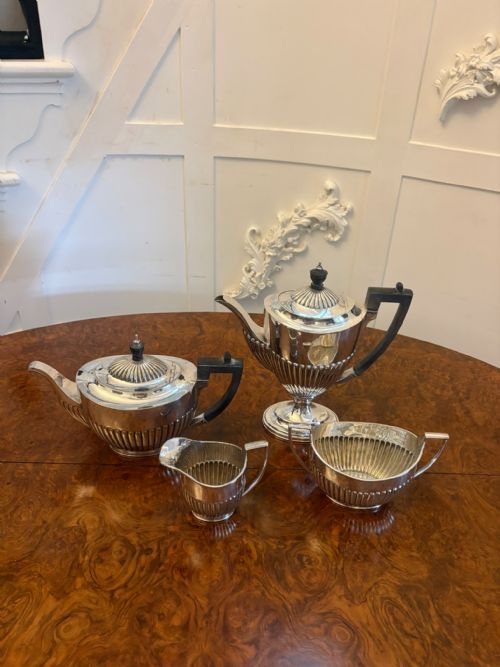
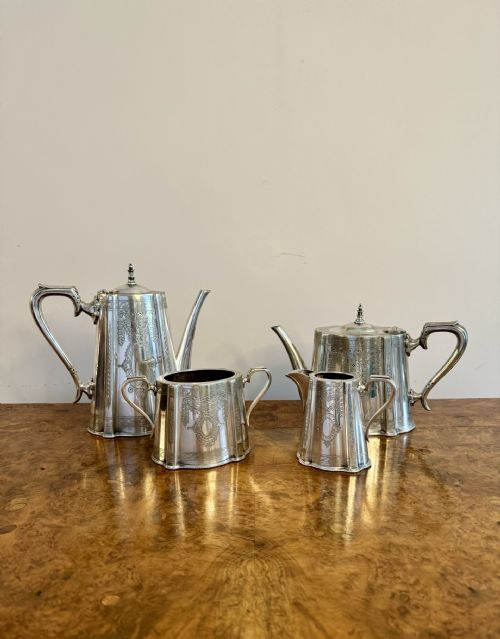


Four Piece Silver Service
A four piece silver service delivers complete tea and coffee hospitality in matching style, bringing period elegance directly to the table.
Four Piece Silver Service
A four piece silver service comprises matching vessels for tea and coffee, usually pairing a teapot and coffee pot with a milk jug and sugar basin. These matching sets span from late Victorian and Edwardian periods through to Art Deco designs of the nineteen thirties.
The evidence shows both solid silver and silver plate versions, often accompanied by ebonised wood handles and finials. Pieces emerge from English makers and regional assay offices, reflecting distinct stylistic shifts from ornate revivalism to geometric modernism.
Materials and construction methods
Silversmiths formed solid sterling silver bodies through hammering and spinning, whilst plated alternatives utilised electroplated nickel silver or standard silver plate over base metals. Heavy-gauge silver services required substantial metal weight to achieve rigidity and balance across all four vessels.
Insulating spacers made from ebonised wood or ebony were fitted to handle mounts to prevent heat transfer during use. Cast decorative elements like feet, spouts and handles were soldered onto the main bodies, then chased and polished by hand.
Some Edwardian sets arrived with ebonised wooden handles so convincingly turned they fooled guests into thinking the pots grew organic timber tails.
Judging service quality
Quality rests upon gauge thickness and metal weight, separating lightweight plated sets from heavy-gauge solid silver services. Superior examples maintain balanced proportions across all four matching vessels without thinning at stress points.
Casting crispness defines the decorative merit, where finely chased foliage or clean Art Deco lines indicate skilled craftsmanship. Maker attribution and complete matching components elevate a service above anonymous or assembled sets.
Walker and Hall
The Four Piece Silver Service Glossary
- Silver plate
- A thin layer of silver fused or electroplated onto a base metal core such as copper or nickel silver. This technique offered the visual appeal of solid silver at a lower cost.
- Electroplated nickel silver
- Often abbreviated as EPNS, this composite material served as the standard base for plated wares from the mid-nineteenth century onwards. It provides a durable foundation for silver deposition.
- Solid silver
- Objects constructed entirely from sterling silver rather than plated metal. These pieces carry hallmarks indicating purity and origin.
- Heavy-gauge
- A descriptor for items manufactured with thicker sheet metal than standard production pieces. This imparts greater durability and a reassuring weight to the touch.
- Ebonised wood
- Timber treated to imitate ebony, commonly utilised for handles and finials on tea and coffee pots. The dark material contrasts with the bright silver surface while insulating against heat.
Four Piece Silver Service: Frequently Asked Questions
What pieces comprise a four piece service?
A standard service includes a teapot, a coffee pot, a milk jug and a sugar basin. Together they provide the necessary vessels for serving both hot beverages.
Some sets omit the coffee pot in favour of hot water jugs, whilst others expand into larger five piece configurations with matching trays.
How do I clean tarnished silver plate?
Gentle polishing with a dedicated silver cloth removes daily tarnish without damaging the underlying plate or sterling surface. Avoid abrasive dips that strip away delicate plating over time.
Store pieces in dry, anti-tarnish environments when not in regular use to preserve the polished finish.
Are these services suitable for daily use?
Solid silver and robust silver plate services remain entirely functional for serving hot drinks. The insulated handles protect hands from heat during pouring.
Hand washing with mild detergent preserves the ebonised wood components and prevents structural damage from modern dishwashers.
How do I distinguish Edwardian from Victorian sets?
Victorian sets frequently display ornate Rococo revival styling with heavy chasing and bulbous bodies. Edwardian examples often lean towards lighter proportions and neoclassical or revival motifs.
Art Deco sets from later decades introduce geometric lines and stepped profiles that break entirely from nineteenth-century ornamentation.