



Four Fold Folding Screen
A four fold folding screen divides a room, frames a corner, or warms a hearth with flexible, architectural presence.
Four Fold Folding Screen
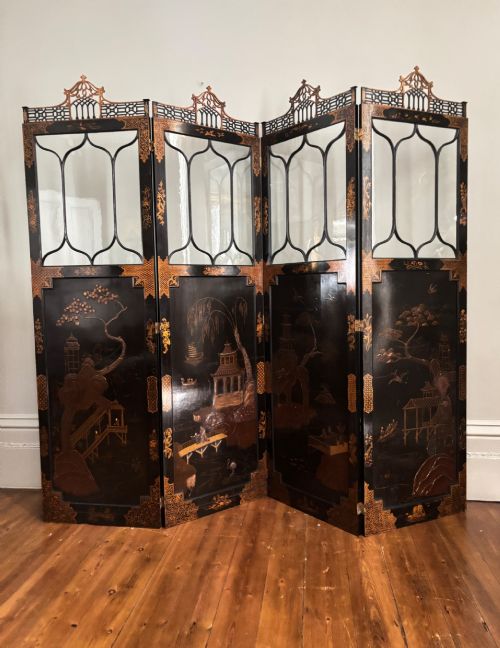
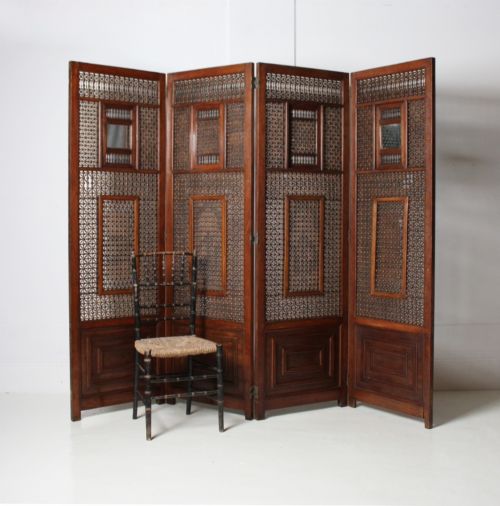
A four fold folding screen acts as a portable partition, dividing large rooms or creating private dressing spaces with four hinged panels. The form ranges from tall Victorian canvas and leather dividers to smaller Japanese lacquer panels and freestanding brass fire screens.
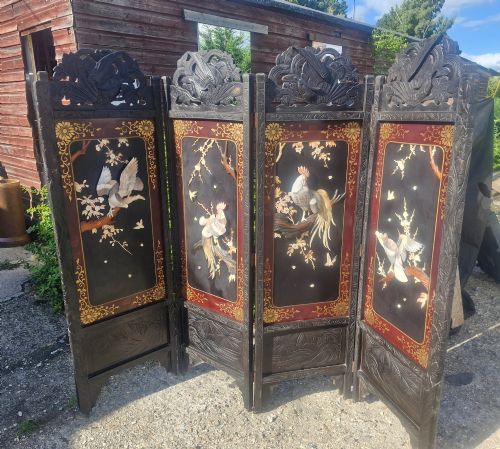
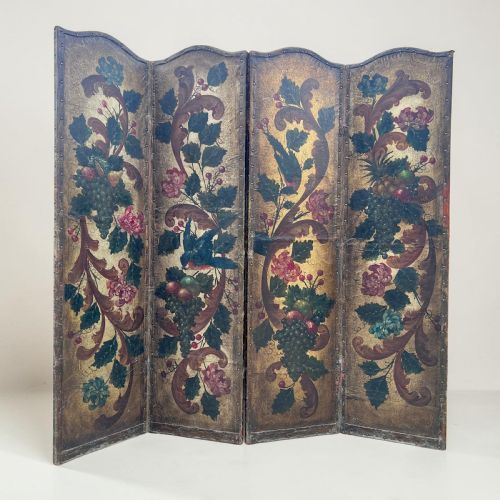
Victorian and early twentieth-century examples dominate, often decorated with Chinoiserie lacquer, hand-painted leather, scrap work, or needlepoint. Many pieces stand over six feet tall, serving as substantial interior partitions or photographic props.
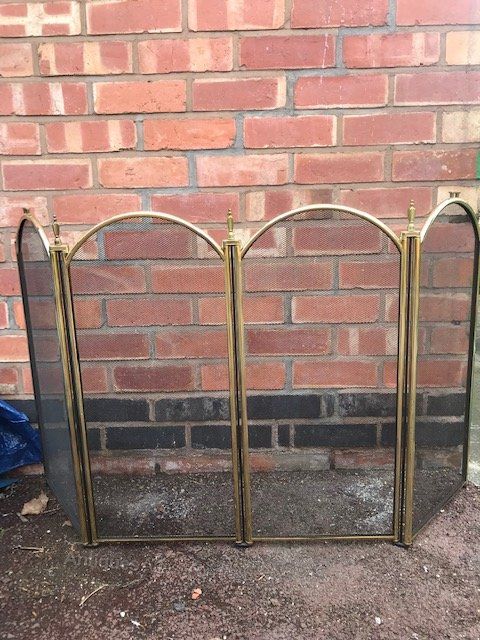
Lower hearth screens and folding fireguards also appear, constructed with four brass or iron sections. These smaller variations protect a room from sparks while offering the same articulated multi-panel geometry.
Materials and construction
Makers built frames from timber such as oak, mahogany, walnut, and ebonised hardwood, joined by hinges that allow panels to fold in both directions. Heavier screens rely on solid wooden battens to support dense infills of leather, canvas, or carved wood.
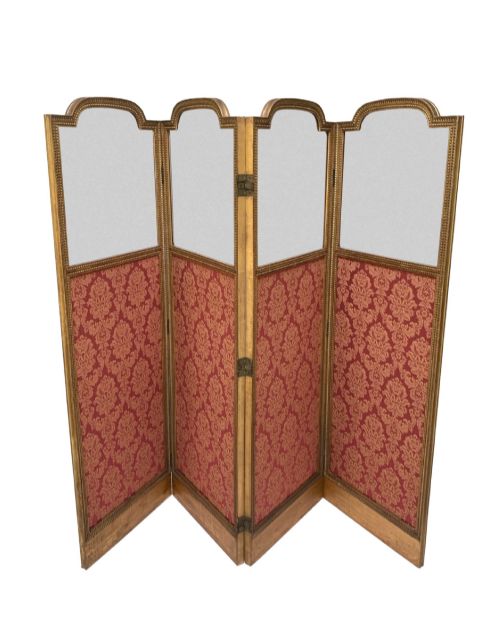
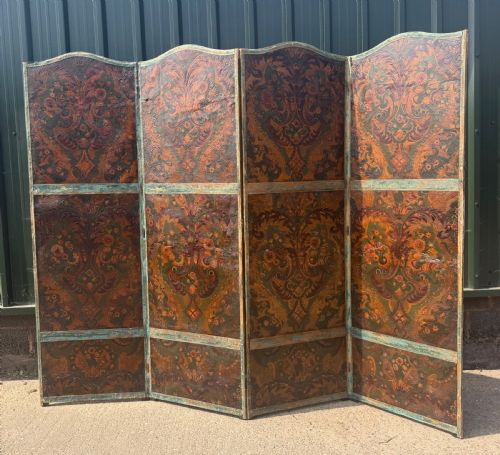
Surface decoration involved diverse specialist techniques, including hand-painted oils on leather, gilt embossing, deep-carving on bone and lacquer, and textile panels of silk, needlepoint, and pasted scrap work.
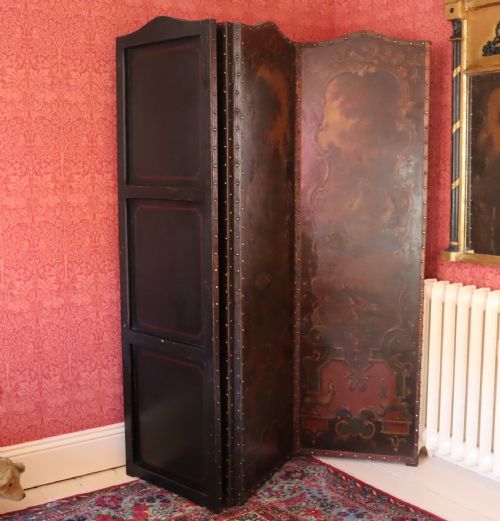
The selection spans from eighteenth-century Cordoban leather and nineteenth-century canvas to early twentieth-century Japanese lacquer and brass fire guards.
Distinctions in quality
Quality rests in the integrity of the hinges and the weight of the frame, which must support four tall panels without sagging. Superior examples maintain rigid stability across each joint while folding smoothly.
Surface execution distinguishes finer screens, from the depth of carving in bone and wood to the crispness of hand-painted lacquer and gilt tooling on leather. Original textiles and undamaged needlework elevate textile-inlaid pieces.
Paul Sormani·Liberty and Co·William Morris
The Four Fold Folding Screen Glossary
- Chinoiserie
- European decorative style reflecting Chinese artistic traditions. It appears frequently on black lacquered dressing screens and painted panels.
- Coromandel
- Dense dark timber or a style of Chinese carved lacquer work. Pieces utilising this technique show intricate detailing carved through layers of dark finish.
- Mashrabiya
- Traditional wooden turning technique forming intricate lattice screens. These panels filter light while dividing interior spaces.
- Scrap work
- Decorative technique utilising pasted paper cutouts or decoupage. Victorian screens often feature dense collages applied to canvas or wood.
- Cordoban leather
- Embossed and gilt-painted leather originating from Spain. Historic examples provide rich, textured surfaces for large room dividers.
Four Fold Folding Screen: Frequently Asked Questions
How do I place a four fold folding screen?
Angle the four panels to create a stable zigzag shape that supports its own weight on a flat floor.
Position the screen across an empty corner, behind a desk, or to screen a doorway to alter the proportions of a room.
How do I care for leather and lacquer panels?
Keep painted lacquer and leather away from direct sunlight and excessive heat to prevent cracking or warping.
Dust gently with a dry, soft cloth and avoid chemical cleaning agents that damage historic finishes.
What is the difference between room and fire screens?
Room dividers stand tall, often exceeding six feet, and use heavy materials like wood, leather, and fabric to partition space.
Fire screens are lower folding brass or iron guards designed to sit hearthside rather than divide a room.