


Foo Dog Porcelain Vases
These foo dog porcelain vases bring symbolic guardian lions and vibrant hand-painted enamels directly into your room, offering both decorative presence and historical depth.
Foo Dog Porcelain Vases
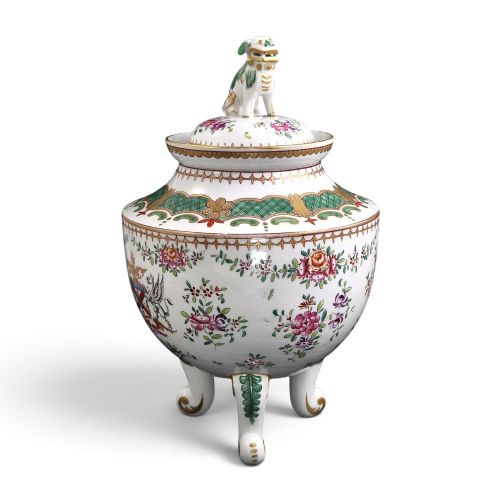
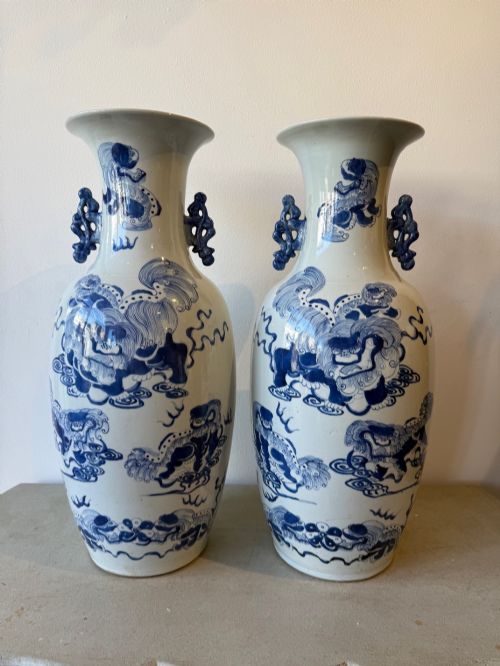
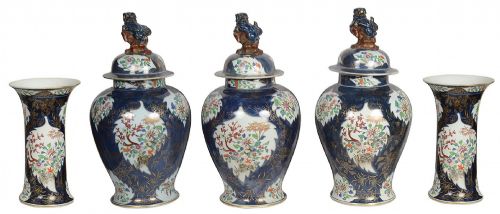
When searching for foo dog porcelain vases, you encounter a selection spanning the seventeenth century through to the early twentieth century, encompassing Chinese Qing Dynasty pieces, Japanese Imari wares, and European interpretations. These objects take the form of baluster vases, lidded jars, and garnitures, frequently featuring hand-painted mythical guardians.
The assortment on this page includes nineteenth-century Cantonese and Japanese examples alongside earlier Transitional style jars. European makers also contributed to this tradition, producing armorial chinoiserie vases and ironstone garnitures during the Victorian era.
How they were made
The pieces rely on hard-paste porcelain and ceramic bodies shaped into pots, baluster vases, and jars. Cobalt glaze provides the foundational blue and white decoration seen across numerous Chinese and Japanese works.
Makers layered enamel, gold leaf, and gilding over the fired ceramic bodies to create polychrome schemes. Hand-painted details incorporate green, iron red, and famille rose palettes alongside intricate underglaze blue.
Listings feature hard-paste porcelain, ceramic, and ironstone bodies decorated with cobalt glaze, enamel, and gold leaf.
What varies in quality
Quality rests in the precision of the hand-painted brushwork and the complexity of the enamel or cobalt application. Pieces displaying crisp rendering on guardian figures and controlled glazing distinguish themselves from simpler productions.
The depth and preservation of gilding and gold leaf also separate examples. Finer items maintain intact enamel pigments and well-defined forms across lids, covers, and main bodies.
Samson Paris·Mason’s Ironstone China
The Foo Dog Porcelain Vases Glossary
- Hard-Paste Porcelain
- A dense, vitrified ceramic material composed of kaolin and petuntse fired at high temperatures. It forms the durable white body of traditional Asian and European vases.
- Famille Rose
- A palette of opaque enamel colours introduced in Chinese ceramics, dominated by pink or rose tones mixed from gold. It appears on nineteenth-century garnitures and baluster vases.
- Garniture
- A set of three or more matching vases and jars designed to be displayed together on a mantelpiece or sideboard. These matched sets often include covers.
- Baluster
- A vase form characterised by a bulbous lower portion that tapers towards a narrow neck and flares slightly at the rim. This shape provides stability and visual balance for large decorative vessels.
- Imari
- A style of Japanese export porcelain featuring underglaze blue combined with iron red, gold, and other enamel colours. European factories frequently imitated these patterns during the nineteenth century.
Foo Dog Porcelain Vases: Frequently Asked Questions
What is a foo dog on these vases?
Foo dogs are traditional Chinese guardian lions depicted in sculptural or painted form on the surface or lid of the vessel. They symbolise protection and prosperity in domestic spaces.
These mythical beasts appear as small figures atop jar covers or as painted motifs integrated into floral and dragon compositions.
How do I style a vase and cover?
Vases and covers work well as symmetrical pairs on sideboards, mantelpieces, or large console tables where their height creates a focal point. Their lidded forms offer distinct silhouettes compared to open vessels.
Keep surrounding objects minimal to let the polychrome enamels and cobalt blue patterns remain the visual centre of the arrangement.
Are these pieces Chinese or Japanese?
The selection includes both Chinese production, such as Qing Dynasty and Transitional wares, and Japanese output including Imari and Kutani styles. European factories also created pieces influenced by these Asian traditions.
Examining the specific enamel colours, blue tones, and potting characteristics helps distinguish between the different regional origins.
How should I clean porcelain with gilding?
Dust these vessels gently with a soft, dry brush to prevent accumulation without disturbing fragile surface enamels or gold leaf. Avoid liquid cleaners and harsh scrubbing.
Water can damage historical glazes and exposed ceramic bodies, so simple dry maintenance preserves the hand-painted decoration safely.