
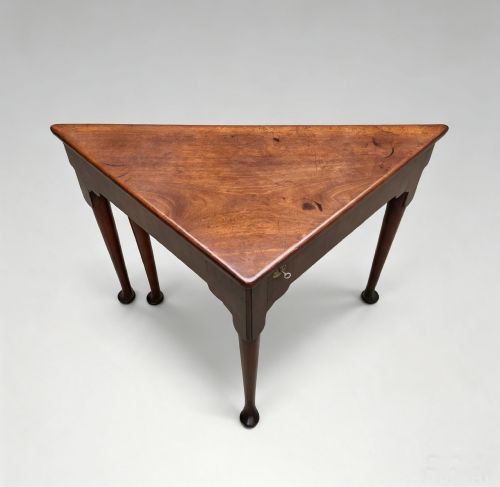
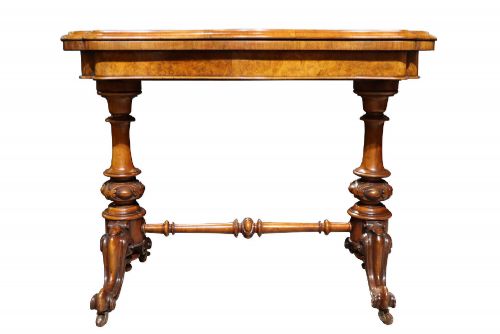


Fold Leaf Games Table
A fold leaf games table gives you a clever surface that opens from a compact console into a playing area for cards or supper.
Fold Leaf Games Table
A fold leaf games table offers a versatile piece of furniture designed for leisure, appearing frequently in Victorian, Georgian, and Regency forms across these listings. You will find these pieces taking shape as card tables, corner tables, and tea tables, often featuring clever mechanisms to double their surface area.
The materials span mahogany, burr walnut, walnut, and oak, reflecting the tastes of 18th century, 19th century, and Edwardian makers. Many examples integrate folding tops, turn over leaves, or rotating surfaces that reveal gaming wells and polished timber beneath.
Makers adapted these tables for multiple uses, combining tea service and card playing within a single compact footprint. The range includes decorative satinwood and marquetry surfaces alongside robust timber frames suitable for everyday drawing room use.
Materials and construction
Cabinet makers utilised dense timbers such as mahogany, walnut, and rosewood to build the structural frames and folding tops. These woods provided the stability needed for hinged leaves and pivoting actions without warping over time.
Craftsmen applied decorative veneers like burr walnut, satinwood, and ebony to the primary surfaces, often enhancing the timber with floral marquetry or hand painted details. Brass hardware frequently secured the folding mechanisms and supported swivelling leaves.
Current listings feature fold leaf games tables spanning the Georgian, Regency, and Victorian periods, constructed from mahogany, burr walnut, and oak.
Distinctions in quality
Superior examples demonstrate precision in the joinery of the folding leaf, ensuring the surface lies completely flat and stable when opened. The smoothness of the pivoting or hinging mechanism marks the difference between basic workshop production and high standard cabinet work.
The choice of primary timber and the execution of secondary decorative elements, such as inlaid satinwood or carved supports, separate standard utility pieces from more ambitious commissions. Grain selection in burr walnut or mahogany veneers also dictates the visual depth of the top.
The Fold Leaf Games Table Glossary
- Turn over leaf
- A hinged table top that folds out to double the surface area for games or dining. This mechanism often rotates on a pivot to rest securely upon the frame.
- Gaming well
- A recessed compartment beneath a folding top designed to store counters, cards, or dice safely when the table is closed.
- Marquetry
- The art of applying decorative pieces of veneer to form intricate geometric or floral patterns on the table surface. This technique was favoured by cabinet makers during the Victorian period.
- Demi lune
- A half moon shape characteristic of tables designed to sit flat against a wall when closed. Opening the top reveals a full circular or serpentine playing surface.
Fold Leaf Games Table: Frequently Asked Questions
Were these tables used only for cards?
Many examples functioned as dual purpose furniture, serving as tea tables, supper tables, or side tables during the day and converting for card games in the evening. The inclusion of combined tea and card tops shows how rooms of the Georgian and Victorian eras required adaptable pieces.
Some variants include built in gaming wells or baize lined surfaces specifically intended for card play, while others prioritise polished wood suitable for general occasional use.
How do I care for polished walnut or mahogany surfaces?
Keep wooden surfaces away from direct sunlight and heat sources to prevent the timber and delicate veneers from drying or splitting. Dust regularly with a dry, soft cloth and apply a quality beeswax periodically to nourish the grain.
Avoid placing wet glasses or hot plates directly onto the antique finish, as polished timber reacts strongly to moisture and heat. Use protective mats if the table serves a dual purpose for daily dining.
How can I tell a Georgian table from a Victorian one?
Georgian pieces generally exhibit restrained lines, solid mahogany construction, and simpler structural forms associated with 18th century design. They often rely on the natural grain of the timber rather than heavy surface decoration.
Victorian versions frequently introduce elaborate marquetry, burr walnut veneers, and varied styling such as the Aesthetic Movement or Rococo Revival. Support structures on Victorian models also tend to feature heavier carving or turned pillars.