
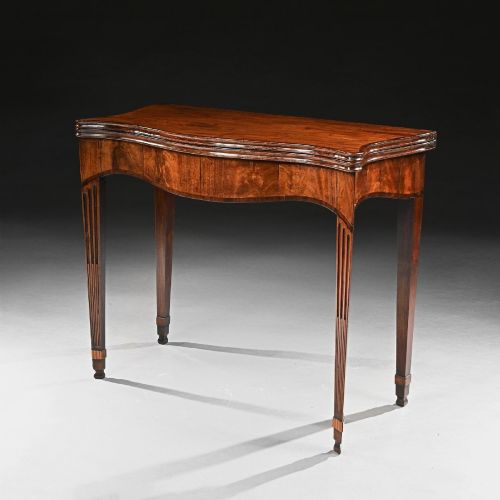
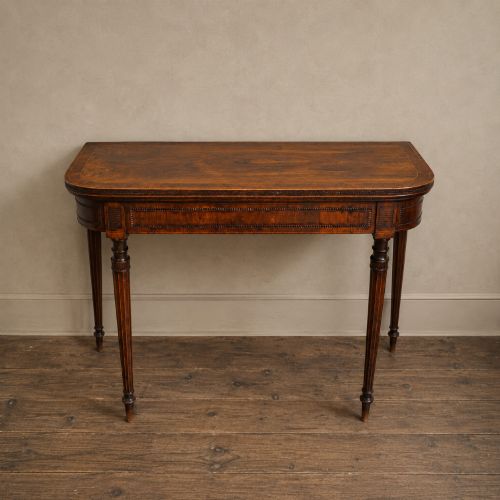
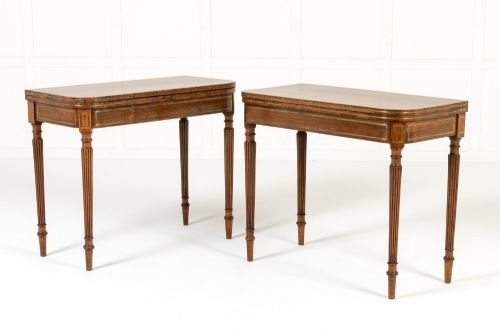


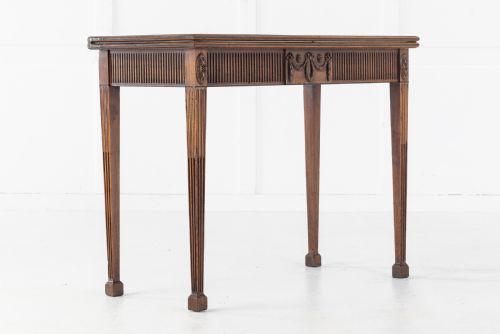

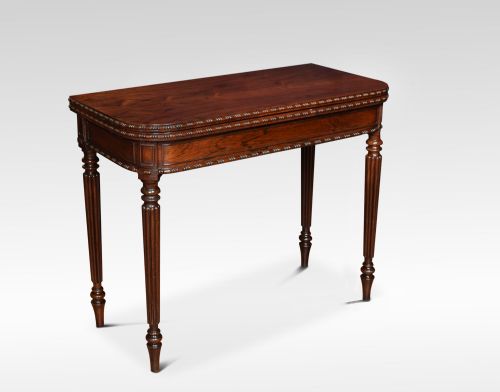

Fluted Leg Games Table
These fluted leg games table examples offer ingenious folding surfaces and refined timber work for the home.
Fluted Leg Games Table
A fluted leg games table combines a clever folding top with refined joinery, serving multiple functions in a traditional interior. These pieces frequently double as tea tables, card tables, or console tables depending on the day's requirements.
The selections span the eighteenth century, Regency period, and Victorian era, capturing styles from George III to Neoclassical Revival. Woods such as mahogany, rosewood, and burr yew dominate the construction.
Most entries function primarily as card tables or tea tables with fold-over tops, offering flexible display and gaming spaces. Their craftsmanship reflects classic British and French design influences, including Louis XVI and French Empire aesthetics.
Materials and Techniques
Makers utilised solid timber and rich wood veneers, notably mahogany and rosewood, often enhanced by burr yew crossbanding. Brass mounts occasionally appear on later pieces to accent the structural lines.
Construction techniques focus on stability and clever hinges for the double fold-over and turn-over tops. The surface timbers are selected for grain pattern and polished to highlight the natural colour of the wood.
Form variations include tea tables, console tables, and card tables with double fold-over mechanisms.
Distinctions in Quality
The fineness of the timber preparation and the precision of the crossbanding set the better examples apart. Selection of burr yew veneers and figured mahogany indicates superior workshop standards.
Proportion and the crispness of decorative carving on the frame reveal the skill of the original maker. The smoothness of the folding mechanism and the stability of the timber over centuries demonstrate foundational joinery expertise.
Gillows
The Fluted Leg Games Table Glossary
- Fold over card table
- A table with a hinged top that opens to double its surface area, revealing a playing surface. This design saves space when not in use.
- Crossbanded
- A border technique where thin strips of veneer are laid perpendicular to the grain of the main surface. It creates a contrasting frame around the tabletop.
- Serpentine
- A gently undulating curved shape seen on the front or edges of furniture tops. This contour requires careful woodworking skill to execute properly.
- Bouillotte table
- A small round card table with a raised gallery edge designed to keep counters from rolling off. They originate from French traditions associated with a specific card game.
- Solid walnut
- Timber milled entirely from walnut trees rather than applied as a veneer. It provides a dense, durable foundation with distinct grain patterns.
Fluted Leg Games Table: Frequently Asked Questions
How do I use a games table daily?
These tables function well as console tables or side tables against a wall when the top remains folded shut.
When guests arrive, the top unfolds to reveal a baize or polished wood surface ready for cards or tea.
What periods do these tables represent?
The pieces span from the eighteenth century through the Regency era and into the nineteenth-century Victorian period.
Styles range from George III mahogany designs to later Neoclassical Revival and French Empire influences.
Are these tables suitable for small rooms?
The fold-over design makes them exceptionally practical for compact spaces because they occupy minimal floor area when closed.
They expand only when needed for entertaining or dining activities.
What woods are most common?
Mahogany and rosewood appear frequently across the listings in solid forms and as decorative veneers.
Selected pieces incorporate burr yew crossbanding and brass mounts for added visual contrast.