
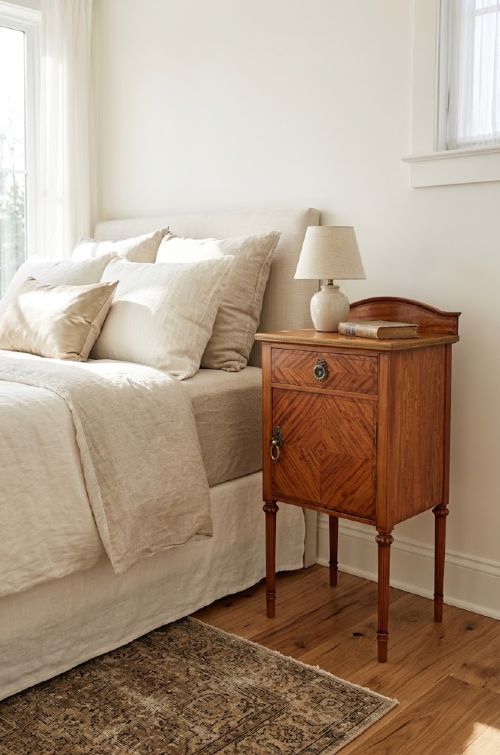
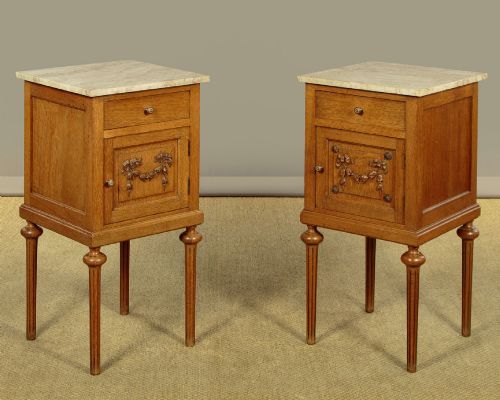


Fluted Leg Bedside Cabinet
A fluted leg bedside cabinet offers practical surface space and enclosed storage, bringing refined period character to a bedroom.
Fluted Leg Bedside Cabinet
A fluted leg bedside cabinet is a compact bedroom piece designed to hold bedside essentials while adding classical architectural detail. The selection on this page spans the Victorian and Edwardian eras, alongside later early twentieth century examples.
Forms include bedside cupboards, nightstands, lamp chests, and demi lune tables alongside boudoir cabinets. Many examples appear as pairs, offering symmetrical placement on either side of a bed.
Origins vary across English, French, and Swedish workshops, embracing styles such as Louis XVI, Sheraton Revival, and Georgian style. Buyers will encounter both timber finishes and painted surfaces within the current selection.
How they were made
Cabinetmakers utilised dense hardwoods such as mahogany, walnut, and satinwood, often pairing them with inlaid stringing or painted decoration. Oak also provides a sturdy structural carcass for several period examples.
Marble frequently tops French and Victorian iterations, providing a durable and cool surface resistant to spills. Brass hardware, including handles and mounts, fastens doors and drawers while adding metallic contrast to the timber.
Current listings feature pieces spanning the Victorian and Edwardian eras, alongside items from nineteen hundred to nineteen thirty.
What varies in quality
The refinement of the carving defines the upper tier of these pieces, particularly the crispness and depth of the vertical fluting on the legs. Superior examples show thoughtful proportion and balanced timber grain across the visible panels.
The selection of materials creates a clear hierarchy, where matching marble slabs, finely figured satinwood veneers, and original brass fittings elevate a piece above simpler painted or utilitarian constructions.
The Fluted Leg Bedside Cabinet Glossary
- Fluting
- Vertical parallel grooves carved into a column or furniture leg. This classical architectural detail draws the eye downward and creates a sense of formal elegance.
- Demi lune
- A half moon shape in furniture design. Tables and cabinets of this form sit flush against a wall while projecting a curved front.
- Satinwood
- A lustrous timber native to India and Sri Lanka known for its golden yellow colour and reflective sheen. It gained high favour during the late eighteenth and Edwardian revival periods.
- Nightstand
- A small low table or cabinet placed beside a bed. These pieces evolved to hold chamber lighting, books, and personal items.
- Boudoir cabinet
- An ornate small cabinet traditionally kept in a private sitting room or bedroom. They often house precious personal belongings and display delicate decorative work.
Fluted Leg Bedside Cabinet: Frequently Asked Questions
How were these cabinets used historically?
Historically, bedside cabinets served to keep intimate items out of sight while offering a convenient platform for a chamber candlestick or glass of water. In grander homes, they matched the broader bedroom suite and reflected the prevailing neoclassical tastes.
French and Swedish examples often included marble tops to handle damp vessels safely, while English satinwood and mahogany versions prioritised polished timber surfaces.
Do bedside cabinets usually come in pairs?
Many listings for bedside cabinets feature matching pairs to flank a larger double bed symmetrically. Single cabinets also appear frequently, often intended for smaller guest rooms or spaces where a single bedside surface suffices.
Matching pairs share identical wood grains, hardware, and leg carving, though centuries of separate life mean minor variations can occasionally occur between partners.
How do I care for antique timber and marble?
Antique timber surfaces benefit from regular dusting with a soft, dry cloth and occasional application of traditional beeswax to nourish the wood. Avoid placing solid wood cabinets in direct sunlight or near heat sources to prevent timber splitting.
Marble tops require prompt wiping of acidic liquids like citrus or wine to protect the polished stone from etching. Use coasters and mats to preserve both the stone and the timber finishes.