

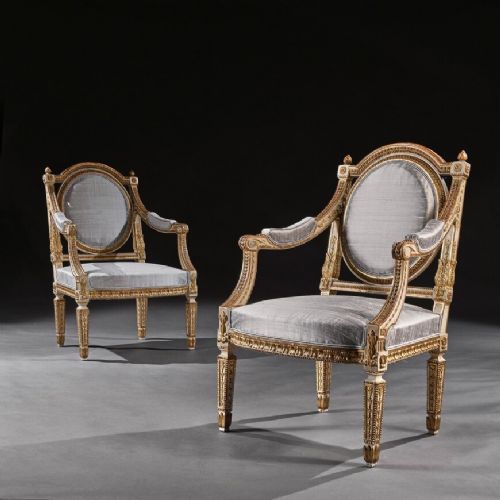
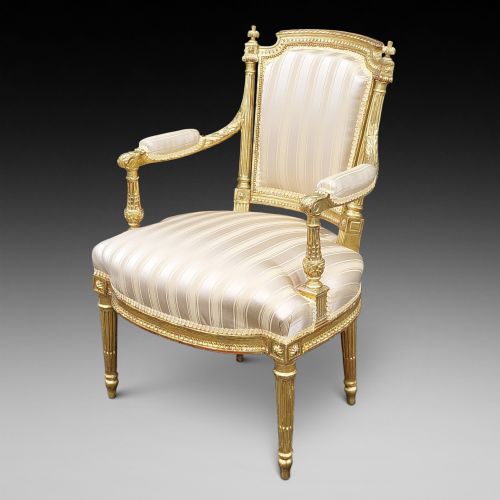
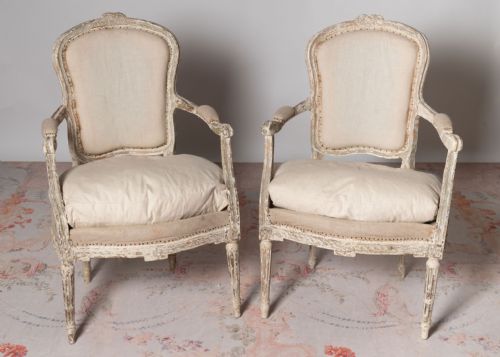


Fluted Leg Accent Chairs
Fluted leg accent chairs are seating designed with carved vertical grooves along the supports, offering both structural elegance and classic decorative presence.
Fluted Leg Accent Chairs
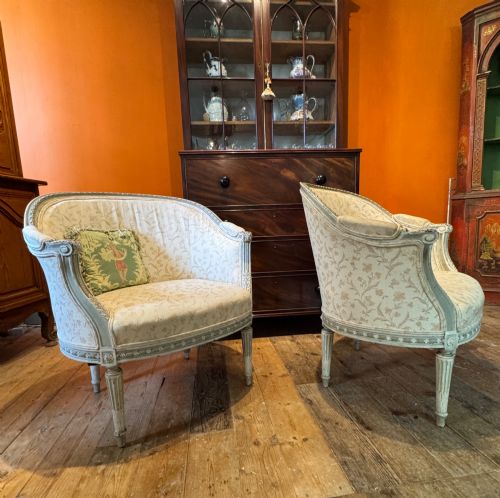
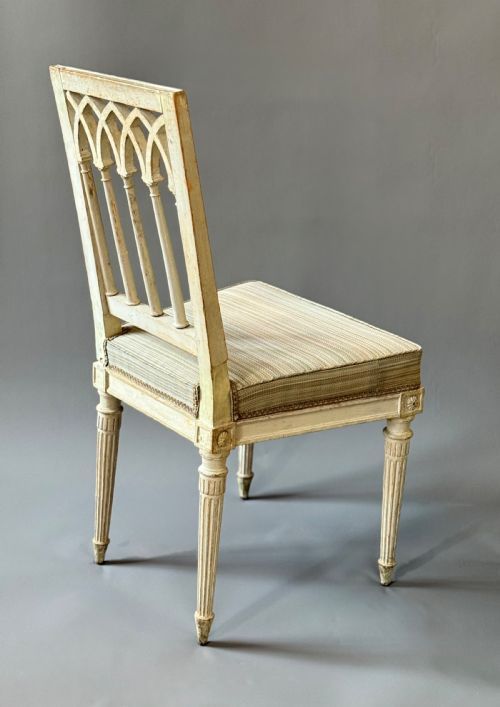
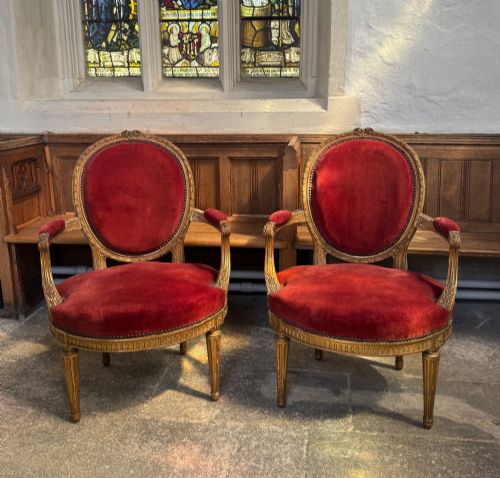
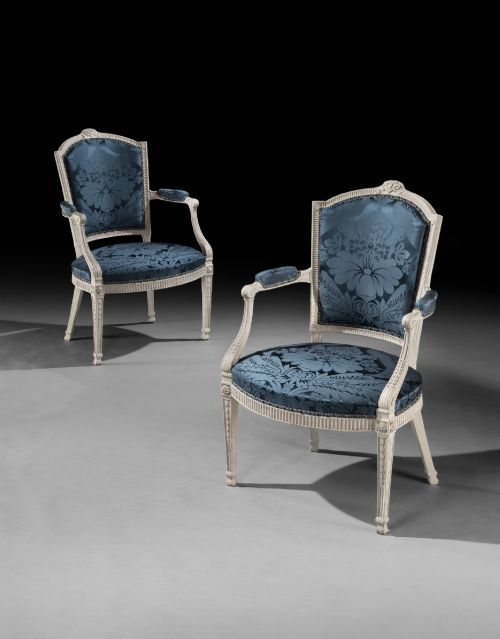
When you search for fluted leg accent chairs, you encounter a selection of seating forms spanning the eighteenth, nineteenth, and early twentieth centuries. The inventory includes armchairs, side chairs, hall chairs, and salon chairs originating from French, English, and Italian workshops.
The most common forms on this page are French and English seating sharing Neoclassical and Louis XVI design influences. These encompass giltwood bergères, painted armchairs, and mahogany side chairs featuring characteristic vertical channel carving on the legs.
How they were made
Cabinetmakers constructed the frames using hardwoods such as mahogany, walnut, beech, and various painted woods. Skilled artisans then shaped the supports with precision carving, creating the distinct vertical channels known as fluting.
Surface decoration frequently involved original paint, parcel gilding, or solid giltwood finishes. Upholstery techniques ranged from simple fabric coverings to complex damask and ribbed barrel-back padding.
Listings feature seating spanning the eighteenth century to the early twentieth century, utilising mahogany, beech, walnut, giltwood, and painted timber.
What varies in quality
The standard of carving on the wooden frames distinguishes basic production from superior work. Crisp, deeply cut fluting demonstrates greater hand-working skill than soft or shallow channel details.
Original surface treatments, such as untouched historical paint or period gilding, elevate the integrity of a piece compared to later overpainting. The cohesion between the frame design and the quality of the textile upholstery also defines the grade of the chair.
The Fluted Leg Accent Chairs Glossary
- Fluting
- Shallow, vertical parallel grooves carved into the shaft of a leg or column. This decorative detail derives from classical architecture and defines Neoclassical furniture.
- Bergère
- An enclosed upholstered armchair with wooden framing exposed around the sides and back. These seats often feature cane panels or stuffed upholstery.
- Fauteuil
- An open-armed upholstered armchair with exposed wooden armrests and legs. The style originates from seventeenth and eighteenth-century France.
- Giltwood
- Timber that has been coated with a thin layer of gold leaf. This finish was favoured for formal salon and drawing-room seating.
- Damask
- A reversible figured fabric traditionally woven on a drawloom with patterns in satin and sateen. It appears frequently as period upholstery on formal armchairs.
Fluted Leg Accent Chairs: Frequently Asked Questions
What periods do these chairs come from?
The pieces span from the eighteenth century through the Georgian and Regency eras into the nineteenth and early twentieth centuries.
Neoclassical and Louis XVI revival styles dominate the selection across these different periods.
Where were these chairs made?
Origin points include French, English, and Italian workshops and regional makers. Many items reflect Parisian design aesthetics adapted by British and continental cabinetmakers.
Attributions point towards notable cabinetmaking traditions of the eighteenth and nineteenth centuries.
What woods were used for the frames?
Makers utilised mahogany, walnut, beech, and various timbers intended for painted or gilded finishes. Hardwoods provided the structural strength required for slender carved legs.
Surface applications often concealed the underlying wood beneath layers of historic paint or gold leaf.
How do I identify Louis XVI style?
Louis XVI pieces are characterised by straight vertical lines, rectangular or oval backs, and structural symmetry. The fluted leg is a principal identifier of this classical revival aesthetic.
Ornamentation draws directly on ancient Greek and Roman architectural motifs rather than curving rococo asymmetry.