
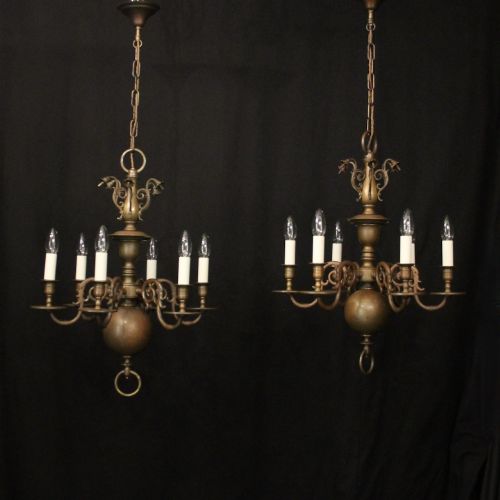
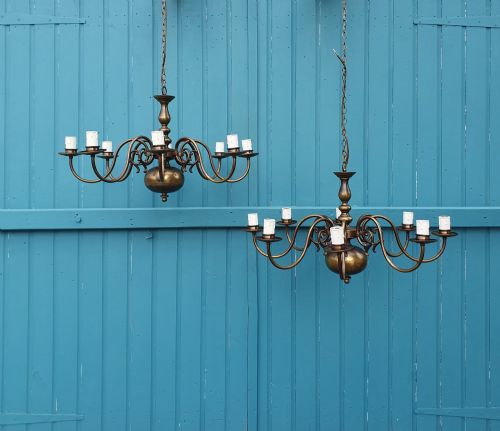
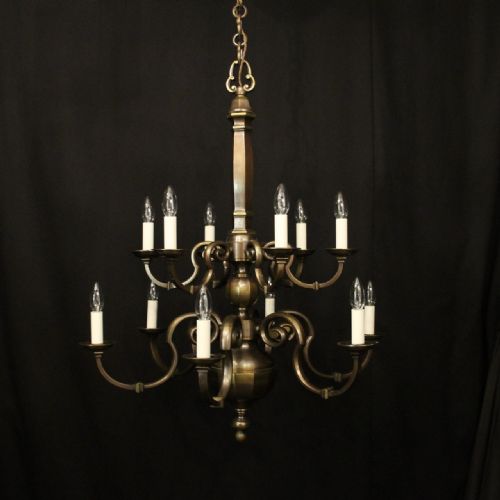
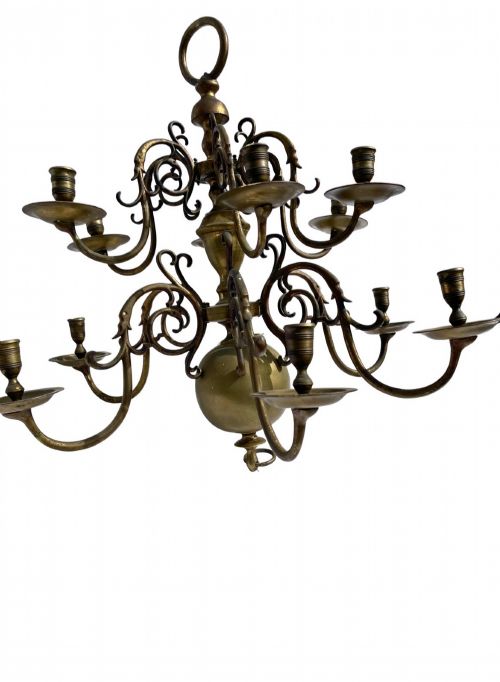


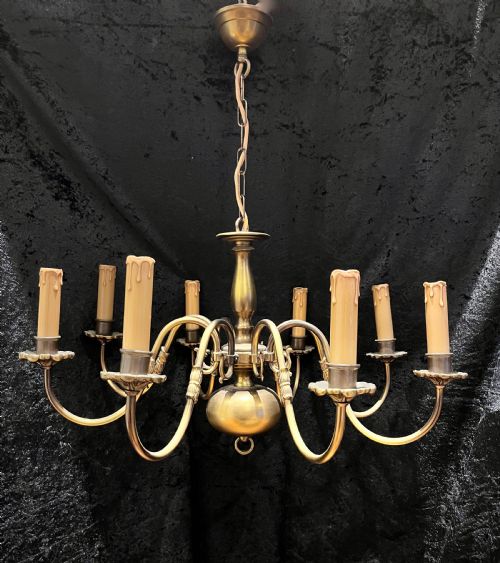
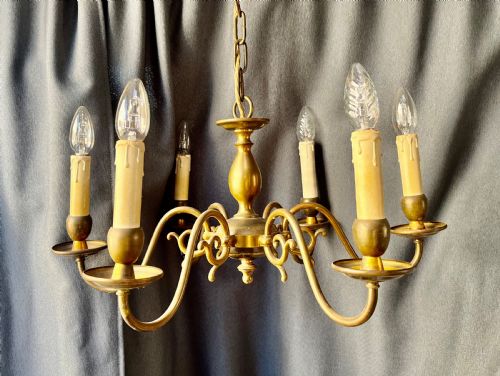
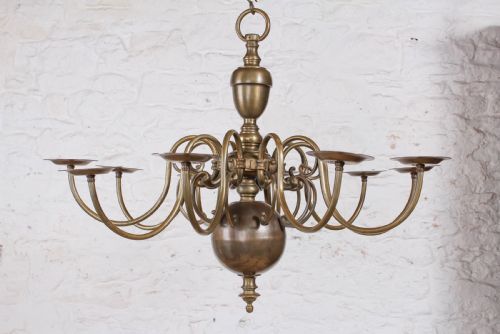


Flemish Style Chandelier
These flemish style chandelier pieces bring heavy, warm metalwork into a room, offering the grand presence of continental lighting.
Flemish Style Chandelier
A flemish style chandelier is a heavy, multi-armed hanging light fixture rooted in continental designs. These pieces draw on historical forms from the eighteenth century up through the nineteen-thirties, spanning Edwardian examples and later revivals.
Most items on this page are constructed with multiple branches radiating from a central stem. They appear in configurations ranging from compact six-light fixtures up to large twelve-branch designs.
How they were made
Makers shaped these fixtures primarily from cast and turned brass, solid brass, and bronze. Some examples utilise silver plate over brass to alter the reflective quality of the metal arms.
The construction relies on sturdy metal casting for the central stems and branching arms, often paired with glass elements. Individual branches are securely fitted to central hubs to support multiple lights.
Materials recorded across these listings include solid brass, bronze, glass, and silver plate.
What varies in quality
Quality rests in the weight and crispness of the metal casting. Earlier eighteenth-century examples display greater hand-finishing in the turning and shaping of the brass components compared to twentieth-century production.
The scale and complexity of the arm configuration also dictate the character of the piece. Larger twelve-branch fixtures demonstrate more ambitious scale than standard six or eight-arm versions.
The Flemish Style Chandelier Glossary
- Brass
- An alloy of copper and zinc used extensively for the body and arms of these fixtures. It develops a rich warm tone over time.
- Bronze
- A copper alloy heavier than brass, utilised for darker, robust antique light fixtures. It provides exceptional structural rigidity.
- Arm
- One of the branching members extending from the central column to hold a light source. These often curve outward in scrolling patterns.
- Pendant
- A light fixture suspended from the ceiling by a chain, cord, or rod rather than mounted flat. Most fixtures here share this hanging format.
- Revival
- A design movement that reinterprets historical styles from earlier centuries, such as Dutch and Flemish Baroque forms.
Flemish Style Chandelier: Frequently Asked Questions
How do I hang a heavy brass chandelier safely?
These fixtures require direct attachment to a ceiling joist or heavy-duty structural brace rather than a standard electrical box. The substantial weight of solid brass and bronze demands proper hardware.
Consult a qualified electrician to ensure the ceiling support can bear the load of multi-arm fixtures safely.
What rooms suit a multi-arm brass chandelier?
Dining rooms, entryways, and high-ceilinged living spaces provide the ideal environment for fixtures with wide arm spans. Their substantial visual weight anchors large architectural spaces effectively.
Ensure you measure the ceiling height and clearance below the fixture before installation.
How do I clean an antique brass light?
Dust the metal surfaces gently with a soft, dry cloth to prevent dirt accumulation. Avoid harsh chemical polishes that strip the historic patina.
Preserving the aged surface maintains the character developed over decades of exposure.
How do I tell an earlier fixture from a later revival?
Earlier eighteenth-century pieces typically show hand-turned detailing and heavier casting variations in the central stem. Twentieth-century revivals often display more uniform machine finishing.
Examining construction marks and fastening methods helps clarify the production era.