
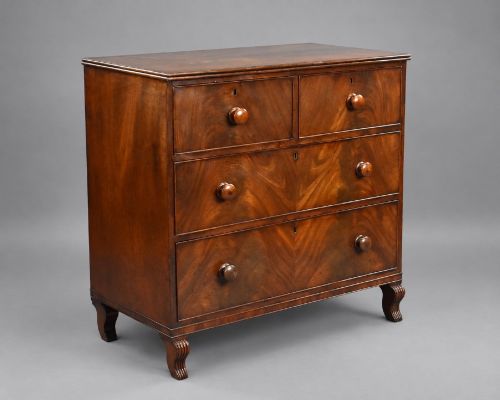
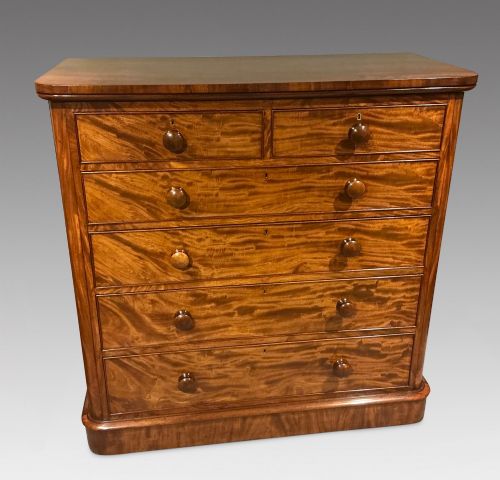
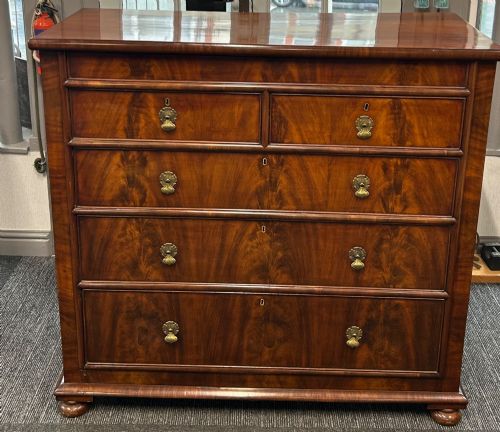


Flame Veneer Chest Drawers
These flame veneer chest drawers bring dramatic figuring to a room, offering practical storage wrapped in striking timber grain.
Flame Veneer Chest Drawers
A flame veneer chest drawers is a storage piece defined by highly figured timber applied to its primary surfaces. When you search for flame veneer chest drawers, you encounter examples spanning the Regency and Victorian periods, along with continental Biedermeier pieces.
The form typically presents as a chest of drawers, though compactum chests and cabinets appear in the selection. These pieces originate from British and continental workshops, showing varied drawer configurations from simple stacks to tall five-drawer builds.
You are most likely to meet Victorian and 19th-century mahogany pieces on this page, often showing deep reddish-brown tones. Alongside these, Swedish Biedermeier examples introduce distinct continental proportions and paler birch highlights.
How they were made
Cabinetmakers utilised flame mahogany veneer sliced from the junction where branches met the main trunk to achieve symmetrical, fiery grain patterns. This thin timber was then applied to secondary structural woods like solid pine or mahogany.
Construction details include turned wood elements and brass hardware to complement the polished surfaces. Solid wood interiors support the exterior veneering, while traditional joinery secures the carcass and drawer boxes.
Listings feature mahogany, birch, and pine, demonstrating both British cabinetmaking and Swedish Biedermeier craftsmanship from the 19th century.
What varies in quality
Quality rests primarily in the visual impact and symmetry of the timber figuring across the drawer fronts. Finer examples display carefully matched grain patterns that mirror each other horizontally and vertically.
The crispness of the secondary timbers and the integrity of the applied brass details further separate standard builds from superior pieces. Expert matching of the flame veneer indicates a higher grade of workshop production.
R H & J Simpson
The Flame Veneer Chest Drawers Glossary
- Flame veneer
- A thin slice of timber cut from wood with undulating grain that produces a fiery, feather-like pattern. This technique creates the standout visual appeal on the drawer fronts.
- Biedermeier
- A Central European style spanning the 19th century focused on clean lines and rich wood grains without excessive ornamentation. Swedish interpretations often utilise birch alongside mahogany.
- Compactum chest
- A specialised multi-compartment storage form combining drawers and cupboards within a single carcass. It provides versatile organisation beyond a standard chest.
- Regency
- A British design period spanning the early 19th century known for classical restraint and architectural proportions. Pieces from this era often feature refined mahogany surfaces.
Flame Veneer Chest Drawers: Frequently Asked Questions
What periods do these chests come from?
The pieces span the Regency and Victorian eras, alongside 19th-century continental workshops. Dates range from around 1800 through to the late Victorian decades.
British Regency and Victorian pieces sit alongside Swedish Biedermeier examples from the same broad timeframe.
How do I care for flame veneer?
Keep the wood away from direct sunlight and steady heat sources to protect the thin surface timber and polished finish. Use dry dusting and avoid harsh chemical cleaners.
Maintaining stable room humidity prevents the timber beneath from expanding and stressing the delicate veneer.
What wood types are used?
Flame mahogany veneer provides the distinctive exterior figuring, supported by solid mahogany, pine, or birch. Secondary woods form the internal structure and drawer carcases.
Brass hardware and turned wood components frequently finish the design across both British and continental pieces.
How do Biedermeier chests differ?
Biedermeier pieces from the 19th century lean toward minimalist forms that let the natural wood grain act as the primary decoration. They often employ pale birch alongside darker mahogany.
Proportions tend to be streamlined compared to heavier British Victorian designs of the same era.