
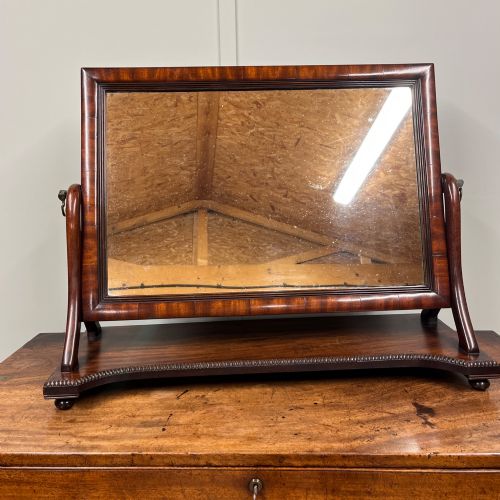


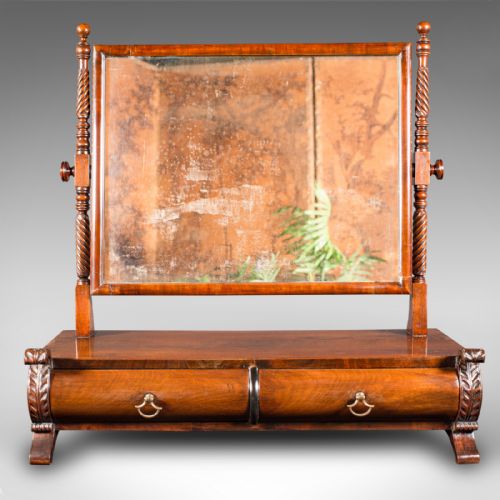

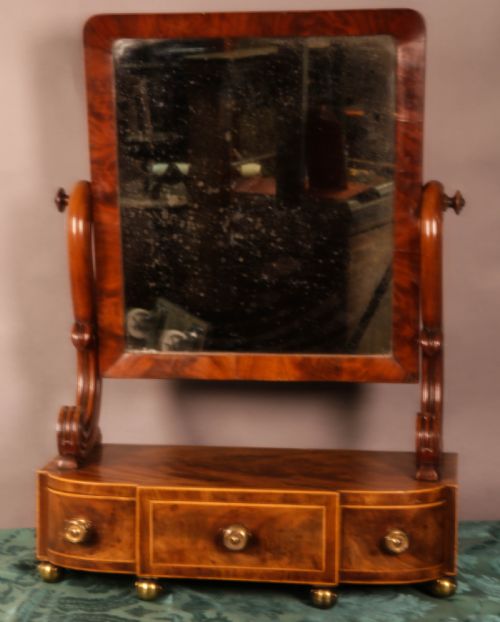


Flame Mahogany Tabletop Mirror
A flame mahogany tabletop mirror brings rich timber movement and functional elegance to a chest or dressing table, offering a traditional glass surface framed by figured grain.
Flame Mahogany Tabletop Mirror
A flame mahogany tabletop mirror is a portable dressing glass designed to sit upon a chest or table, appearing frequently in Victorian, Regency, and Georgian forms. These pieces serve as functional bedroom furnishings while introducing decorative wood figures to an interior.
The selection here encompasses various regional and period interpretations, ranging from bow-fronted and serpentine shapes to barrel-fronted designs. Most examples date from the nineteenth century, including early Victorian and Regency iterations alongside eighteenth-century Georgian forms.
Makers constructed these mirrors as pivoting or swing glasses, often mounting them on scrolled supports or box bases fitted with small drawers. The overarching purpose remains the same across the periods: to provide a stable, adjustable reflection using rich timbers.
How they were made
Craftsmen utilised solid mahogany and applied flame mahogany veneer to structural carcases, aligning the dramatic grain patterns to create symmetrical fire-like ripples across the surfaces. This thin layer of figured timber was meticulously laid over secondary woods to achieve a decorative effect without excessive weight.
Mirror glass was set into rebated frames and supported by pivoting wooden arms, allowing the user to tilt the angle of reflection. Brass fittings, including screw caps, pivots, and small handles, frequently secured the moving parts and added metallic contrast to the dark timber.
Bases often incorporated multiple small drawers constructed with traditional joinery, supported by feet such as squashed bun feet. Carved shaped supports and curved fronts required precise woodworking skills to shape the solid mahogany and veneer.
Squashed bun feet anchor many of these mirrors, offering a reassuringly plump foundation to centuries of daily routines.
What varies in quality
The intensity and symmetry of the flame mahogany veneer dictate much of the visual appeal, with highly figured timber commanding greater attention than plain grain. Master craftsmen selected veneers that matched across the drawer fronts and mirror frames, creating a harmonious pattern.
Structural complexity also separates standard examples from finer productions, particularly in the shaping of serpentine, bow-fronted, or barrel-fronted bases. Elaborate carved supports and well-executed drawer construction indicate a higher standard of workshop output.
Proportion and the preservation of original brass hardware and mirror glass influence the integrity of each piece. Subtle details, such as the execution of squashed bun feet and crisp mouldings, reflect the original maker's investment of time and skill.
The Flame Mahogany Tabletop Mirror Glossary
- Flame mahogany
- A veneer cut from the fork of the mahogany tree, producing a distinctive, rippling flame-like pattern. This timber was highly prized for decorative furniture fronts.
- Swing mirror
- A glass plate hung on pivots within a frame that tilts back and forth between upright supports. This mechanism allows the user to adjust the viewing angle.
- Toilet mirror
- A traditional term for a small dressing table mirror designed to sit on a chest or dressing stand. These pieces date predominantly from the Georgian and Victorian eras.
- Serpentine
- A furniture front or edge shaped with a concave centre flanked by two convex curves. The undulating line adds movement and sophistication to the piece.
- Squashed bun foot
- A flattened, spherical wooden foot commonly found on Victorian bases. It provides a stable foundation while lifting the carcase slightly off the tabletop.
Flame Mahogany Tabletop Mirror: Frequently Asked Questions
What is a flame mahogany tabletop mirror?
A flame mahogany tabletop mirror is a portable dressing glass featuring highly figured veneer, designed to sit on a surface for grooming.
These pieces typically feature a swiveling glass frame mounted on a supportive base, which often includes small drawers for storage.
How do I date a Victorian dressing mirror?
Dating relies on observing stylistic markers, timber characteristics, and construction methods associated with the period between the early and late nineteenth century.
Early Victorian examples often display robust proportions and rich flame veneers, while later pieces may show different foot styles and moulding profiles.
Where should I place a tabletop mirror?
These mirrors sit comfortably on dressing tables, chests of drawers, or sideboards in bedrooms and hallways.
Because they are portable, they require only a stable flat surface with adequate natural or artificial light for reflection.