


Flame Mahogany Pot Cupboard
A flame mahogany pot cupboard brings rich grain and compact storage to a bedside, spanning Georgian elegance to Victorian utility.
Flame Mahogany Pot Cupboard
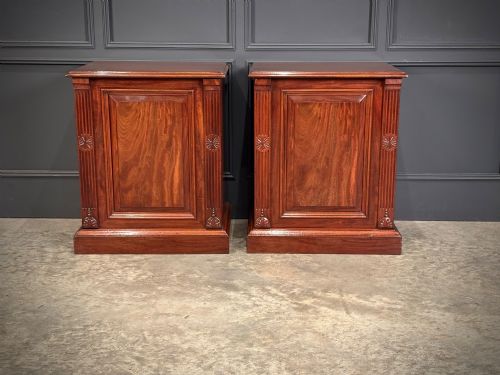
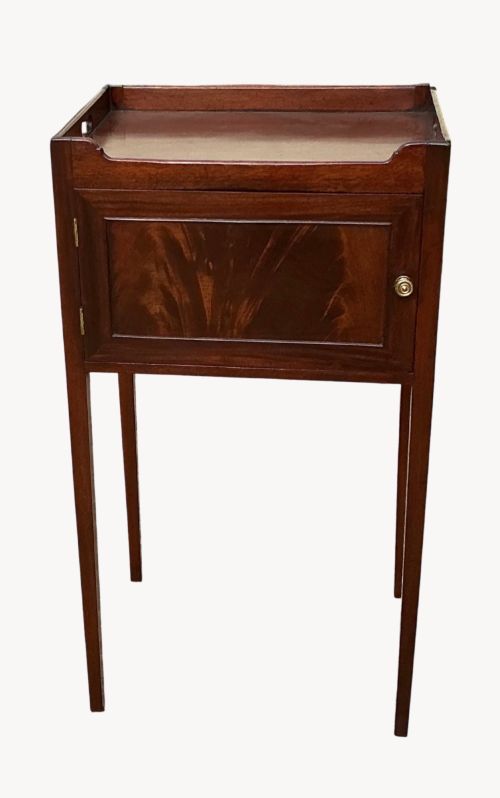
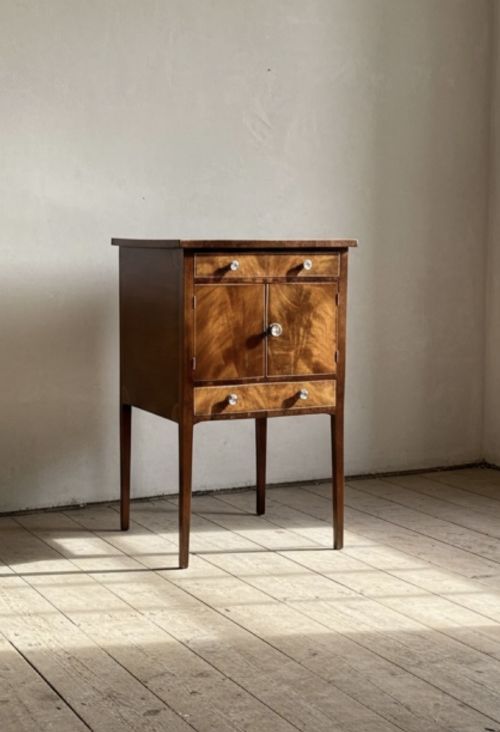
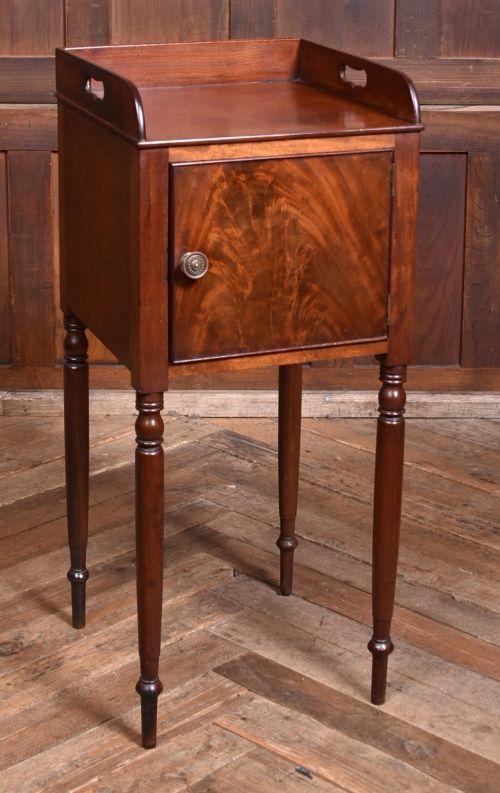
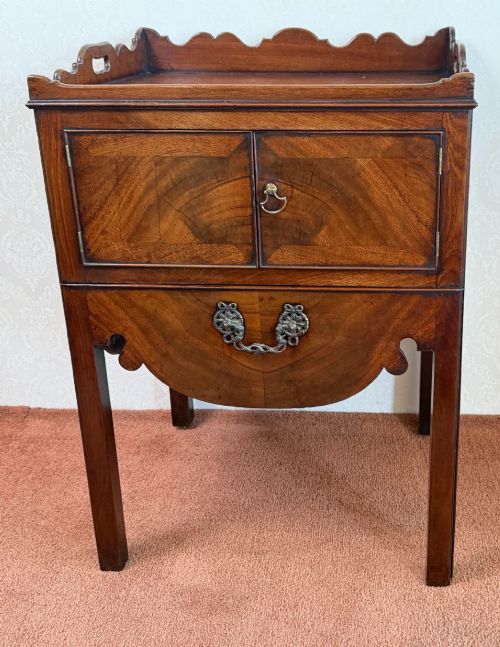
A flame mahogany pot cupboard is a compact bedside or pedestal piece designed for private chambers, appearing in forms such as cylindrical bodies, tray tops, and bow fronts. These cabinets date from the 18th century through the Edwardian period, with Georgian, Regency, and Victorian examples forming the core of the selection.
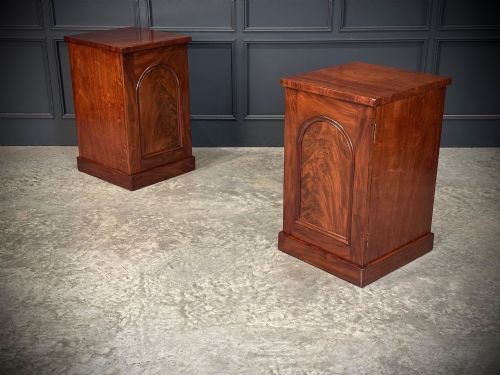
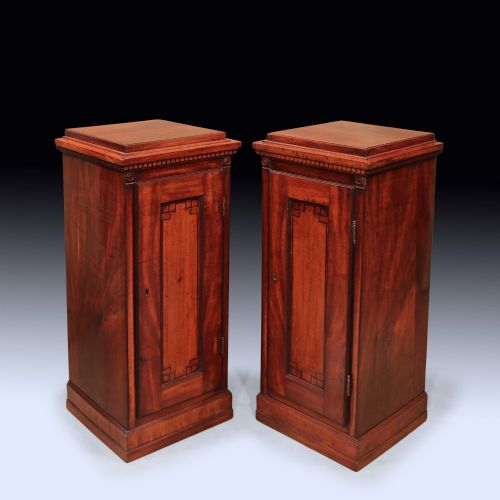
Buyers encounter single cupboards as well as matched pairs, sometimes featuring marble tops or inset ceramic components. The primary function remains discrete storage beside a bed, housing chambers or small personal items within a single door enclosure.
Materials and construction methods
Cabinet makers utilised solid mahogany and applied flame mahogany veneer to primary surfaces, creating the characteristic swirling wood patterns. Secondary woods like pine appear in internal framing and drawer linings, whilst brass handles, boxwood stringing, and marble slabs provide structural and decorative contrast.
Construction techniques include curved cylinder doors, dovetailed drawer joints, and precision veneering over stable carcases. Joinery traditions from the Sheraton and Chippendale idioms govern the proportions and detailing of the earlier pieces.
Even when repurposed far from their original chamber pot duties, these loyal little cylinders still guard nighttime secrets with absolute discretion.
Distinctions in craftsmanship
Quality rests in the intensity and book-matching of the flame mahogany veneer across curved or flat doors. Superior pieces display seamless grain continuity and restrained use of boxwood inlay or brass mounts.
Structural integrity of cylindrical bodies and the crispness of moulded tray tops separate standard utility items from high-end cabinet work. Original hardware and sound internal secondary timbers elevate a piece considerably.
Gillows
The Flame Mahogany Pot Cupboard Glossary
- Flame mahogany veneer
- A figured wood veneer sliced from the point where branches join the main tree trunk, producing a distinctive rippled pattern resembling flickering flames. This material defines the visual appeal of these cabinets.
- Pot cupboard
- A small bedside cabinet originally constructed to house a chamber pot behind a single door. Later iterations evolved into general bedside storage units.
- Tray top
- A raised rim encircling the upper surface of a table or cabinet to prevent items from rolling off. This feature is common on mid-18th century and Georgian examples.
- Pedestal cupboard
- A freestanding, column-like cabinet with a single door enclosing shelving or storage space. They are frequently found in matched pairs from the Regency and Victorian periods.
- Bow front
- A convex, curved cabinet front that projects outward in an arc. This shaping requires specialised woodworking skill to apply veneers smoothly.
Flame Mahogany Pot Cupboard: Frequently Asked Questions
What is a flame mahogany pot cupboard?
A flame mahogany pot cupboard is a small bedside cabinet featuring highly figured wood veneer, designed historically to conceal a chamber pot.
Today, these pieces serve as bedside tables or accent cabinets offering enclosed storage within a compact footprint.
How do I date a pot cupboard?
Dating relies on architectural styles, carcase construction, and timber characteristics, spanning from Georgian tray-top designs to Victorian cylindrical forms.
Earlier pieces often exhibit Sheraton or Chippendale influences, whilst mid-19th century examples favour cylindrical shapes and marble tops.
Were these cabinets made in pairs?
Yes, many cabinets were produced as matching pairs for symmetrical placement on either side of a bed.
Pairs are particularly prevalent among Regency and Victorian pedestal models, though single survivors remain common.
How do I care for flame mahogany?
Maintenance requires keeping the wood away from direct sunlight and extreme humidity to protect the delicate veneer and polish.
Regular dusting with a soft, dry cloth preserves the natural lustre of the mahogany surface without building up chemical residues.