
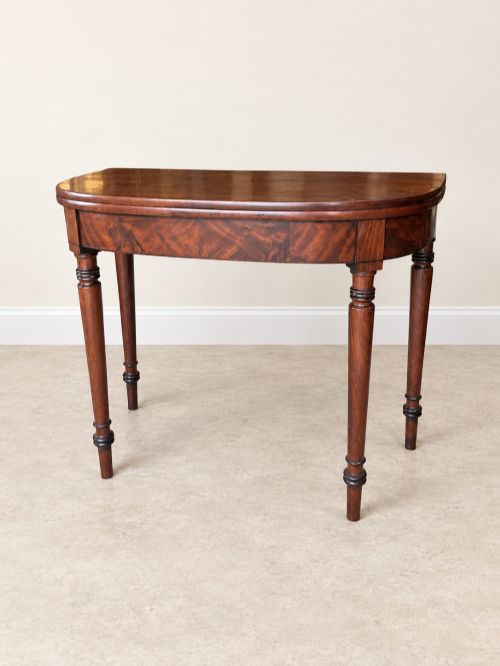
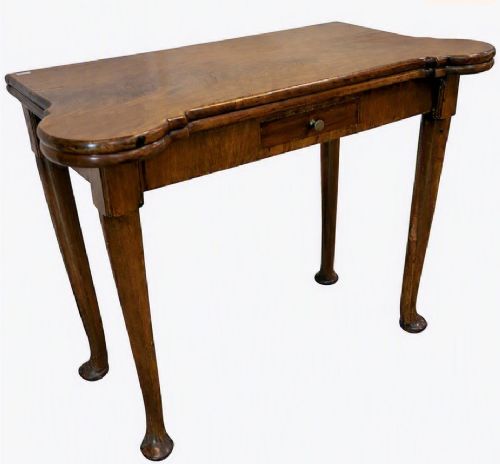
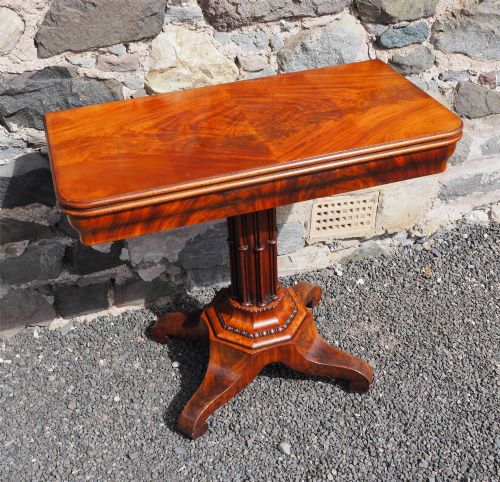
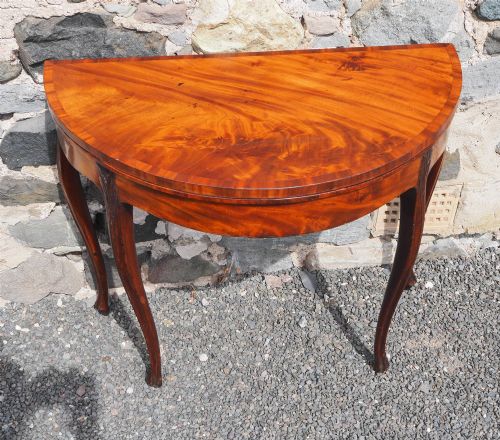
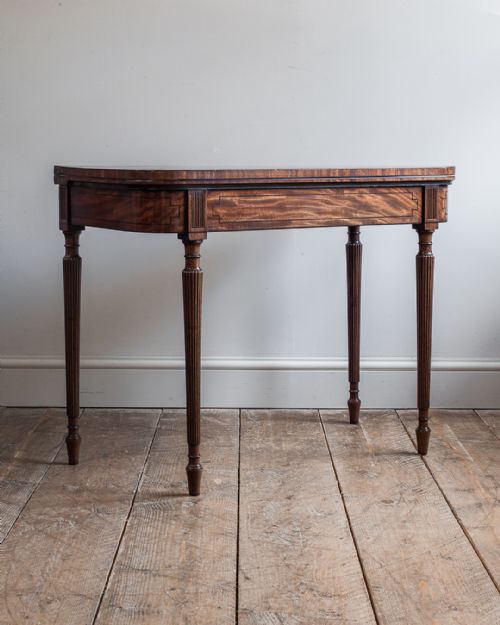
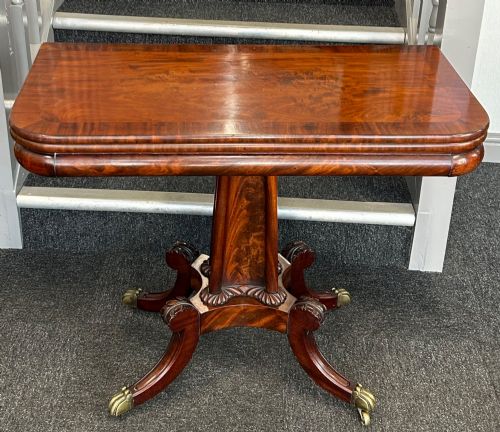


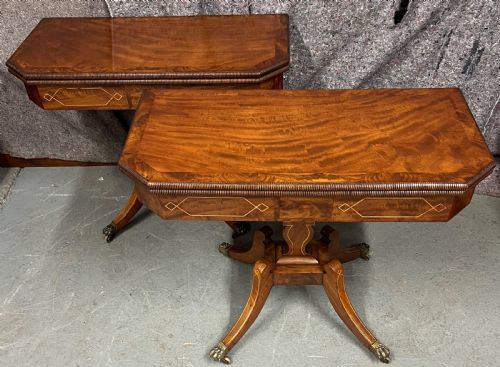


Flame Mahogany Card Table
A flame mahogany card table brings the rich, figured grain of high-end timber straight into the drawing room.
Flame Mahogany Card Table
A flame mahogany card table is a versatile piece designed for social evenings, featuring a fold-over top that reveals a playing surface when opened. These tables appear across the Georgian, Regency, William IV, and Victorian periods, often taking D-shaped, demi-lune, or rectangular forms.
The pieces listed on this page span the eighteenth and nineteenth centuries, capturing the shift from George III elegance to robust Victorian craftsmanship. Alongside dedicated card and games tables, the selection includes related forms such as tea tables, console tables, and side tables.
Most examples rely on a fold-over mechanism, transforming from a compact side or console table into a full games surface. Makers utilised figured veneers to create striking visual appeal on the primary surfaces while maintaining sturdy structural timbers underneath.
What Varies in Quality
Quality rests significantly on the selection and matching of the veneer, with top-tier examples displaying intense, well-figured flame patterns across the entire top. The symmetry and book-matching of the grain show the cabinet maker's skill in handling expensive materials.
Structural integrity of the folding mechanism and the stability of the pedestal or leg assembly also define the grade of the piece. Finer items maintain crispness in their carved details, tight joints, and original brass fittings without excessive timber shrinkage.
Listings feature mahogany, brass, and boxwood across periods ranging from the 18th century through to the Victorian era.
The Flame Mahogany Card Table Glossary
- Flame mahogany
- A veneer cut from the branch junctions of the mahogany tree, producing a distinctive, flickering grain pattern resembling flames. This figuring was highly prized for principal display surfaces on fine furniture.
- Demi-lune
- Half-moon shaped, describing tables with a straight back edge and a curved front. These fit neatly against walls when closed.
- Fold over
- A hinged top design that opens out to double the surface area for card playing or dining. It usually swings on pivots or swivels to reveal a small hidden well.
- Stringing
- Thin inlay lines of a contrasting wood, such as boxwood, embedded into the surface to create decorative borders. It defines the geometric panels of table tops and drawer fronts.
- Figured mahogany
- Timber showing varied, decorative grain patterns caused by growth irregularities. Cabinet makers selected these boards for maximum visual impact on prominent panels.
Flame Mahogany Card Table: Frequently Asked Questions
How do you open the top safely?
The hinged top typically unfolds on brass pivots or swivels on the frame to reveal a baize-lined playing surface.
Care should be taken to support the pivoting leaf properly to avoid straining the internal wooden hinges and framing.
Where were these tables placed originally?
They stood against the walls of formal drawing rooms, parlours, and halls when not in use for evening entertainment.
Pulling them into the centre of the room provided a stable surface for card games and social pastimes.
How do you distinguish a Regency table from a Georgian one?
Georgian examples often feature straight tapering legs and restrained classical stringing in line with Hepplewhite and Sheraton designs.
Regency and William IV pieces lean towards bolder architectural forms, featuring heavier pedestal bases, brass paw feet, and pronounced classical revival motifs.