

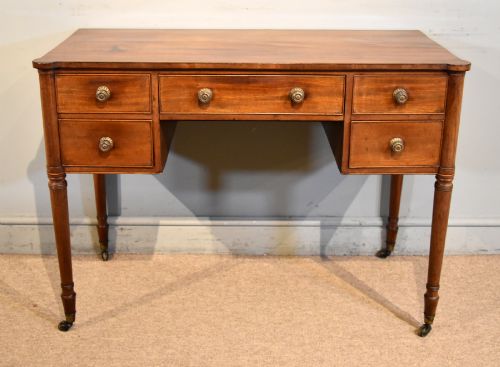
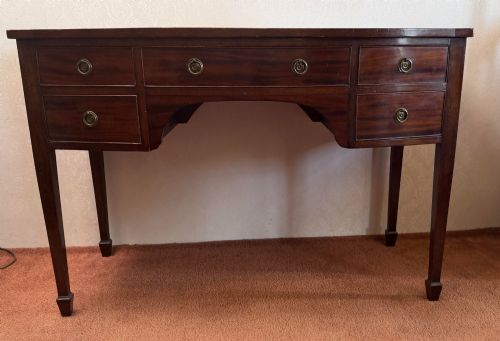
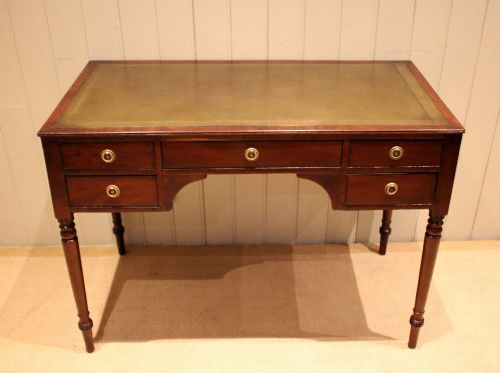
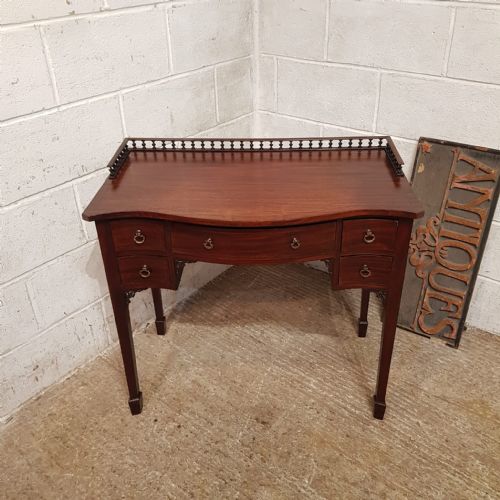


Five Drawer Writing Table
A five drawer writing table brings a generous run of drawers and a dedicated writing surface together.
Five Drawer Writing Table
A five drawer writing table offers a practical arrangement for sorting correspondence and papers while keeping a neat surface for writing. These pieces appear across several periods, including the Georgian, Regency, Victorian, and Edwardian eras.
Makers adapted these desks to suit various interiors, producing forms from serpentine fronts and bowfronts to simpler kneehole dressing tables and side tables. The evidence shows styles ranging from plain English country pieces to revival designs like Chippendale, Queen Anne, and Georgian.
How they were made
Cabinet makers relied primarily on solid mahogany and mahogany veneers applied to secondary woods, often finished with polished wooden surfaces or inset leather tops. Brass hardware, such as swing handles and escutcheons, provides functional detailing across the drawers.
Construction techniques involve traditional joinery suited to the period, with finely turned or carved legs supporting the desk body. Decorative touches include painted highlights, shaped tops, and figured burr walnut grain.
Five Drawer Writing Table Retail Price Guide 2026
Typical asking prices for five drawer writing table among the pieces listed under this phrase on Sellingantiques today, from the lower quarter to the upper quarter. They describe what is for sale here now, not the wider market.
Some tables hide their five-drawer count behind deceptive serpentine and bowfront curves that trick the eye.
What varies in quality
Quality rests on the choice of timber and the precision of the cabinet work, particularly in the selection of figured mahogany or burr walnut veneers. Superior examples display thoughtful proportions, balanced drawer arrangements, and well-executed secondary details like carved legs or shaped fronts.
Later revival pieces show differing levels of workshop skill, where older proportions and hand-cut joinery give way to more standardised construction methods.
The Five Drawer Writing Table Glossary
- Kneehole
- A recessed space beneath the central drawers of a desk designed to accommodate the user's legs. This configuration allows for side banks of smaller drawers.
- Bowfront
- A curved front facade that swells outward in the centre. This shape softens the rectangular lines of the table.
- Serpentine
- A gently undulating front edge that curves inward at the centre and outward at the sides. It demands skilled woodworking to follow the continuous sweep.
- Escutcheon
- A protective plate surrounding a keyhole. These are frequently cast in brass to match the drawer pulls.
Five Drawer Writing Table: Frequently Asked Questions
How do I date a five drawer writing table?
Dating relies on combining the timber choice, construction methods, and overall style visible in the piece. Secondary woods and handle styles offer further clues to the exact period of manufacture.
Cabinet making techniques evolved from eighteenth-century hand-cut joints to more mechanised production methods by the Edwardian era.
Were these used as desks or dressing tables?
Many five drawer writing tables served multiple functions depending on the room and the owner's needs. Similar forms functioned as writing desks, side tables, or kneehole dressing tables.
Writing surfaces frequently featured leather inserts, while dressing table variants often paired with mirrors.
What is a kneehole desk?
A kneehole desk incorporates a central open recess beneath the writing surface, flanked by stacks of smaller drawers on either side. This layout provides comfortable legroom while maintaining ample storage capacity.
It remains one of the most practical arrangements for daily writing tasks.
How should I care for a mahogany writing table?
Keep the wood away from direct sunlight and sudden temperature changes to protect the finish and prevent timber movement. Regular dusting with a soft, dry cloth preserves the polish without building up residue.
Leather surfaces benefit from occasional light conditioning to keep the material supple.