

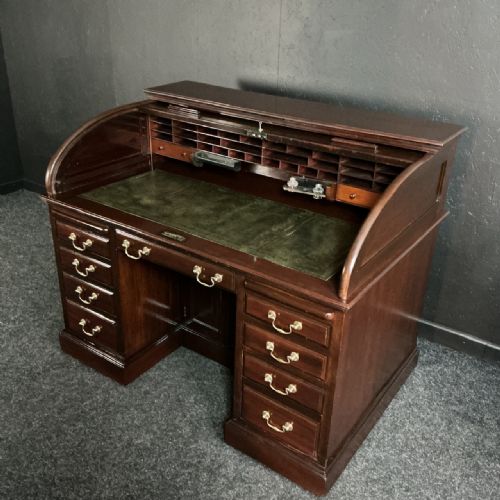


Fitted Interior Office Desk
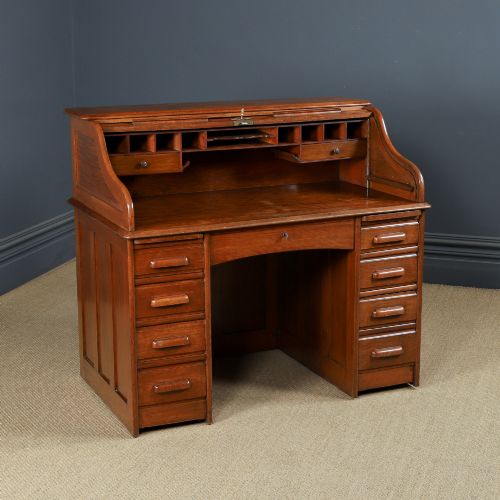
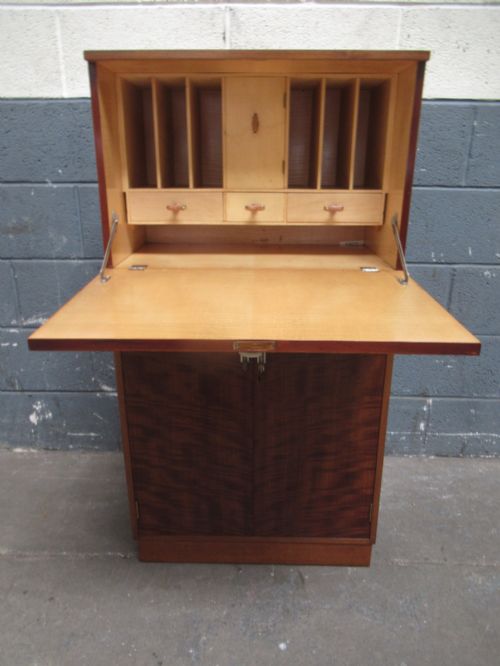
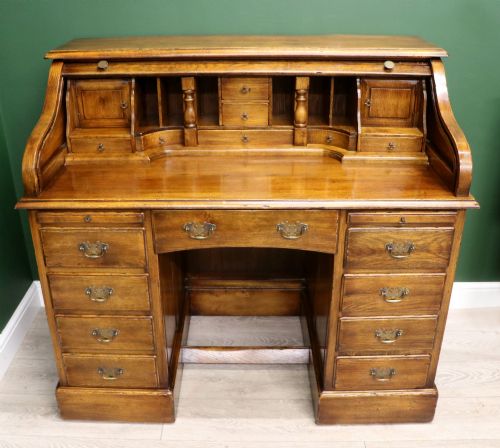
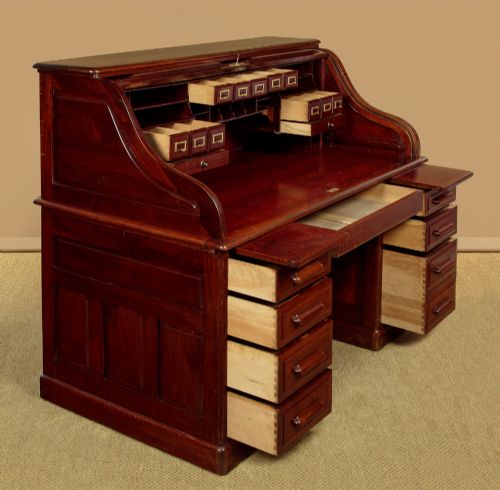
A fitted interior office desk offers pigeonholes, drawers, and compartments behind a tambour or fall front, designed for private, organised work.
Fitted Interior Office Desk
A fitted interior office desk provides a practical workspace with built-in storage compartments, drawers, and pigeonholes concealed beneath a roll top or fall front. Buyers hunting for a fitted interior office desk will find heavy representation from the Edwardian and Victorian periods, alongside later twentieth-century examples.
Most pieces seen here take the form of roll top desks or writing bureaux, constructed to manage paperwork and stationery efficiently in a home study or commercial workspace. Oak and walnut dominate the offerings, matched with mahogany and satinwood for finer finishes.
The styles range from functional Edwardian oak pedestals to Chippendale style mahogany and decorative Art Deco writing bureaux. These pieces combine traditional cabinetmaking with complex internal arrangements designed for sorting correspondence.
How they were made
Makers constructed these desks using solid oak, walnut, and mahogany, often pairing denser timbers with brass hardware and leather inserts for writing surfaces. The tambour shutters of roll top desks relied on narrow slats of wood glued to canvas backing to curve smoothly around a cylindrical track.
Internal compartments required precise joinery, with small pigeonholes and miniature drawers fitted closely together inside the upper superstructure. Exterior surfaces relied on traditional polish and timber selection to display the natural grain of the wood without excessive ornamentation.
Current listings feature oak, walnut, and mahogany timbers across Edwardian, Victorian, and Art Deco periods.
What varies in quality
The distinction between standard commercial pieces and finer cabinetmaking rests on the density of the timber and the complexity of the internal fitments. Superior examples show meticulous attention to the tambour mechanism, ensuring the slatted shutter glides freely without sticking in its tracks.
Hardware choice and secondary wood selection also mark the grade of a piece, with high-quality desks using solid drawer linings rather than thin veneers. The complexity and depth of the fitted interior compartments reflect the ambition of the original workshop.
Boston Chair Company·Maples of London and Paris
The Fitted Interior Office Desk Glossary
- Tambour
- A flexible shutter formed of narrow wooden strips glued to canvas, allowing a desk lid to slide open along a curved track.
- Pedestal desk
- A heavy freestanding desk supported by two banks of drawers reaching down to the floor.
- Bureau
- A sloping writing flap hinged above a chest of drawers or fitted interior.
- Pigeonhole
- A small, open compartment in a desk interior used for sorting letters and papers.
Fitted Interior Office Desk: Frequently Asked Questions
How do I date an Edwardian desk?
Edwardian desks date from the reign of Edward VII between 1901 and 1910, though the style persisted slightly either side of this decade. They are typically constructed from oak or walnut with simpler lines than heavily carved Victorian predecessors.
Makers' stamps, brass drawer pulls, and construction methods such as machine-cut dovetails help confirm the period of manufacture.
How were tambour doors made?
Tambour doors were constructed by joining numerous narrow strips of timber onto a strong canvas backing. This flexible assembly fitted into grooved tracks cut into the sides of the desk cabinet.
When pushed upwards, the slats curved backward over the top of the desk interior into a concealed compartment.
Where were these desks used?
These desks served primarily in professional offices, legal chambers, and private home studies during the late nineteenth and early twentieth centuries. The fitted interior provided dedicated storage for ledgers, correspondence, and writing implements.
Today, they function effectively as practical workstations in modern home offices while retaining period character.