


Fitted Cutlery Box
A fitted cutlery box organises your silver and keeps flatware secure within period wooden chests.
Fitted Cutlery Box
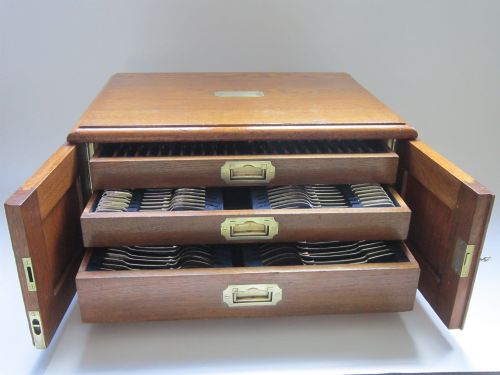
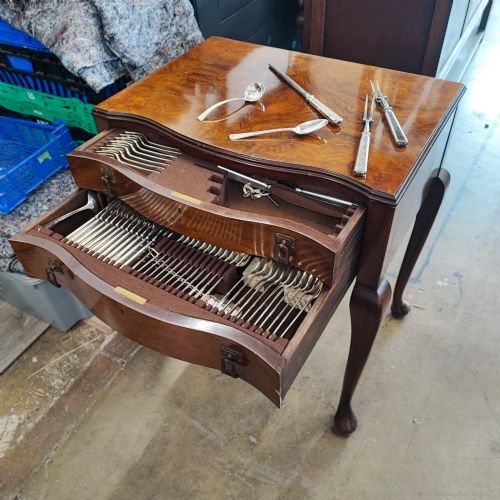
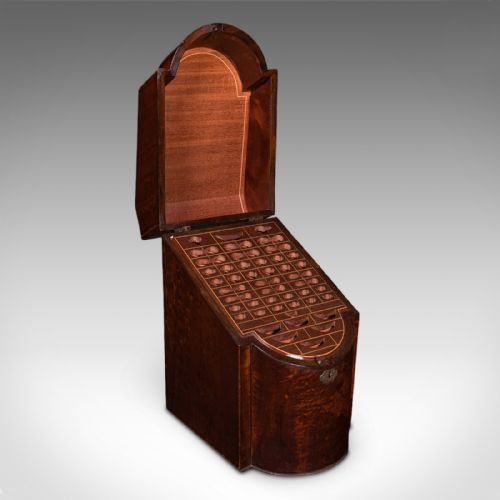
A fitted cutlery box provides dedicated storage for flatware, serving sets and specialised utensils. These pieces appear across Georgian, Victorian and Edwardian periods, taking the form of knife boxes, tabletop canteens and large chests.
You will most commonly encounter oak and mahogany canteens or knife boxes from the Victorian and Edwardian eras. Interiors are typically lined with velvet, silk or leatherette to protect sterling silver and silver plate.
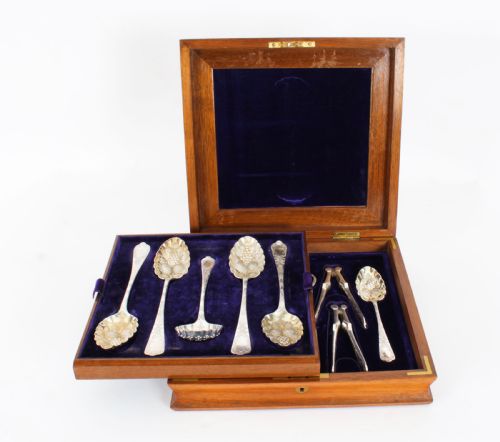
The phrase also covers smaller cased sets, including teaspoon collections, fruit sets and grape scissors in fitted presentation boxes.
How they were made
Cabinetmakers used solid timbers like oak, mahogany and walnut to construct sturdy exterior shells. Brass fittings, including handles, locks and escutcheons, reinforced the corners and hinged lids.
Interiors were custom-built with wooden dividers and slots tailored to specific flatware patterns such as Fiddle pattern. Linings of velvet or silk were then fitted to cushion silver spoons, forks and steel-bladed knives.
Listings feature oak, walnut and mahogany timbers alongside velvet and silk linings.
What varies in quality
Quality rests upon the joinery of the wooden case and the integrity of the fitted interior. Finer boxes utilise substantial timber boards, dovetail joints and original brass hardware.
The execution of the interior layout defines the standard of a canteen, where partitions align precisely with the specific service they hold. Preserved textile linings and working locks with original keys elevate the piece further.
Walker and Hall·Mappin and Webb·Waring and Gillows·Hukin and Heath·Cooper Brothers and Sons
The Fitted Cutlery Box Glossary
- Canteen
- A fitted box, chest or cabinet designed to hold a complete set of cutlery. These range from tabletop chests to large canteens on stands.
- Fiddle Pattern
- A traditional 19th-century flatware handle design featuring a slender stem that broadens near the end into a fiddle shape. It appears frequently in Victorian silver services.
- Escutcheon
- A small brass plate surrounding a keyhole on the exterior of a box. It protects the surrounding wood from wear.
- Serpentine
- A curved shape curving outward at the centre and inward at the sides. Georgian knife boxes frequently employ this profile.
- Flatware
- Dining utensils such as spoons and forks. In these boxes, flatware rests in custom slots.
Fitted Cutlery Box: Frequently Asked Questions
What fits inside a fitted cutlery box?
These boxes contain custom slots for dining implements, including table forks, dessert spoons, soup ladles and carving knives. Many interiors are arranged for specific services like fish sets or teaspoon collections.
Larger canteens accommodate extensive flatware services running to over a hundred pieces, while smaller knife boxes hold upright table knives.
How do I date a cutlery box?
Dating relies on timber choice, construction methods and stylistic markers such as Georgian serpentine curves or Edwardian oak panelling. Hallmarks on accompanying silver items provide precise manufacturing years.
Brass hardware style and interior fabric choices also help narrow down the decade of production.
Are the knives original to the box?
Many canteens retain their matching silver or silver-plated cutlery, often featuring steel blades for knives. Over decades of use, individual pieces may have been replaced or supplemented with similar patterns.
Matching maker marks across the flatware and the fitted case indicate a unified original service.
How should I care for the interior lining?
Original velvet, silk and leatherette linings require protection from direct sunlight and high humidity to prevent fading and textile degradation. Gentle surface dusting with a soft brush preserves the fabric.
Keeping the closed box in a stable climate prevents the wooden carcass from warping and protects the delicate interior partitions.