

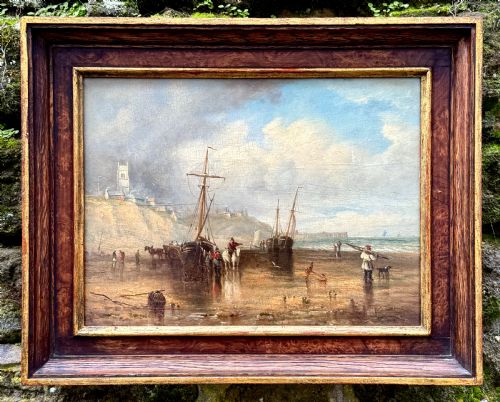
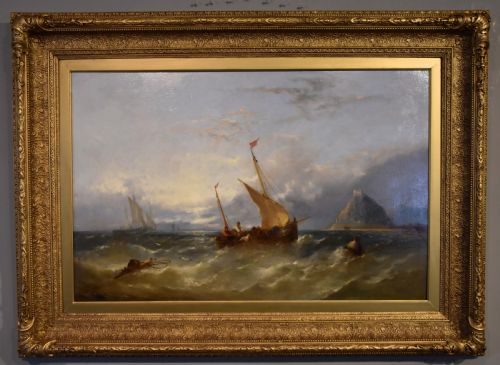
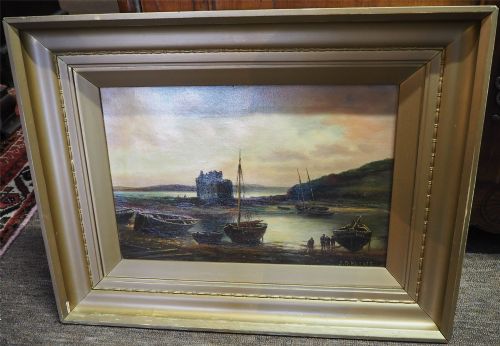
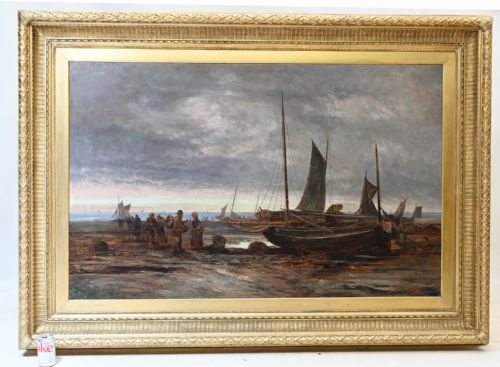


Fishing Boat Canvas
When you search for fishing boat canvas, you are looking at oil paintings capturing maritime life on woven fabric stretched across wooden frames.
Fishing Boat Canvas
A fishing boat canvas brings maritime scenes, coastal harbours, and open seas into domestic interiors through oil paint applied to woven surfaces. These works record coastal life, working vessels, and harbour activities across multiple decades and artistic movements.
You will encounter pieces originating from Victorian Britain, continental Europe, and mid-century modern studios. The selection ranges from detailed nineteenth-century realism to looser post-impressionist interpretations of harbours and shorelines.
Most examples depict working vessels in British and European waters, executed by named artists and regional schools. Subjects span calm estuarine moorings and dramatic coastal runs under brisk winds.
Materials and construction
These works utilise oil paint applied to prepared canvas supports, sometimes mounted on wooden stretchers or boards. Artists built up pigment using brushes and occasionally palette knives to render texture in water and sky.
Many surviving pieces retain period frames fashioned from wood, often finished with giltwood or gold leaf highlights. The combination of durable plant-fiber fabric and slow-drying oil medium accounts for the longevity of these marine views.
Listings feature works from British Impressionism, the 19th Century Dutch School, and Maritime Realism executed in oil paint on canvas.
Assessing quality
Quality rests upon the artist's command of light, atmosphere, and maritime architecture. Stronger examples convey the movement of water and the specific rigging of working craft with accurate proportion and confident brushwork.
The condition of the painted surface and the integrity of the original stretcher or frame influence desirability. Superior works display harmonious colour palettes and clear spatial depth without heavy restoration obscuring the original pigment.
Thomas Creswick·William Henry Williamson·Charles Napier Hemy·Gustave De Bréanski·George Gregory·George Henry Knight·William Edward Webb·Pieter Cornelis Dommersen
The Fishing Boat Canvas Glossary
- Oil on canvas
- A painting medium where pigments suspended in drying oil are applied to woven fabric stretched across a wooden frame. This combination allows for rich blending and textured impasto work.
- Giltwood
- Wood carved and coated with a thin layer of gold leaf or metallic gilt powder. It frequently surrounds period marine paintings to enhance the visual weight of the composition.
- Post-Impressionism
- An art movement following impressionism that extends its use of vivid colour and thick application while emphasising geometric forms and expressive content. Works in this style often use simplified shapes and bold palettes.
- Marine art
- Artistic representation of the sea, ships, beaches, and coastal architecture. This genre encompasses historical naval battles, portraiture of ships, and everyday coastal scenes with fishing boats.
- Stretcher
- The internal wooden framework that holds a canvas taut during and after the painting process. Traditional frames allow adjustment via corner keys to maintain fabric tension.
Fishing Boat Canvas: Frequently Asked Questions
What periods do these paintings cover?
The available selection spans from the Georgian era through Victorian marine art into mid-century post-impressionist works. Most pieces date from the nineteenth and early twentieth centuries.
Artistic approaches shift across these decades from precise topographical realism to looser interpretations of light and harbour atmosphere.
Where were these coastal scenes painted?
Artists recorded harbours, estuaries, and coastal villages around Britain, including Cornwall, Yorkshire, and the Norfolk coast. Continental locations from France, the Netherlands, and the Mediterranean also feature strongly.
These sites reflect major fishing ports and regional art colonies active during the nineteenth and early twentieth centuries.
How should I care for an oil painting on canvas?
Keep the piece away from direct sunlight, high humidity, and rapid temperature fluctuations that can cause the canvas and wood to warp or crack. Dust the surface gently with a soft, dry brush without applying pressure.
Avoid using water or chemical cleaners on the paint layer, and consult a professional conservator for cleaning.
How do I identify the age of a marine painting?
Examine the style of the vessel rigging, artist signatures, framing methods, and the type of canvas or stretcher used. Victorian and Georgian works often exhibit specific academic conventions in rigging and maritime dress.
Examine the back of the canvas for period labels, inscriptions, or stamps left by nineteenth-century colourmen and framers.