




Feline Wall Art
Feline wall art brings historic depictions of cats into domestic spaces through paintings, drawings, and prints.
Feline Wall Art
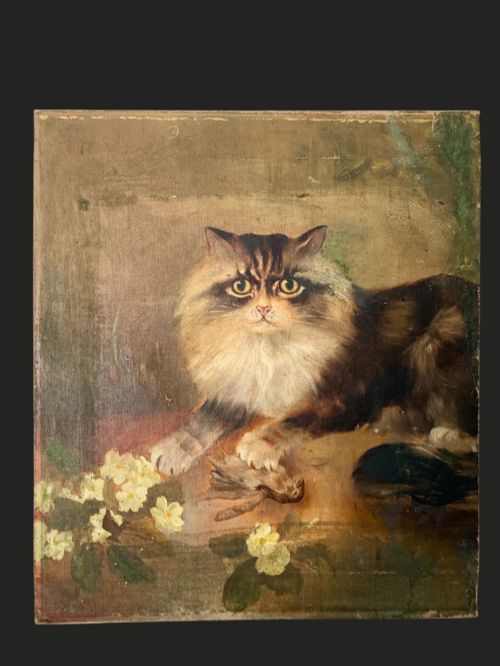
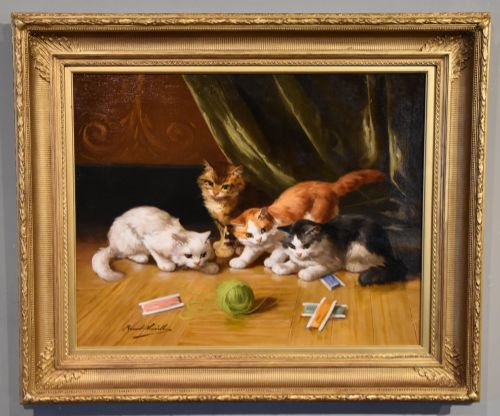
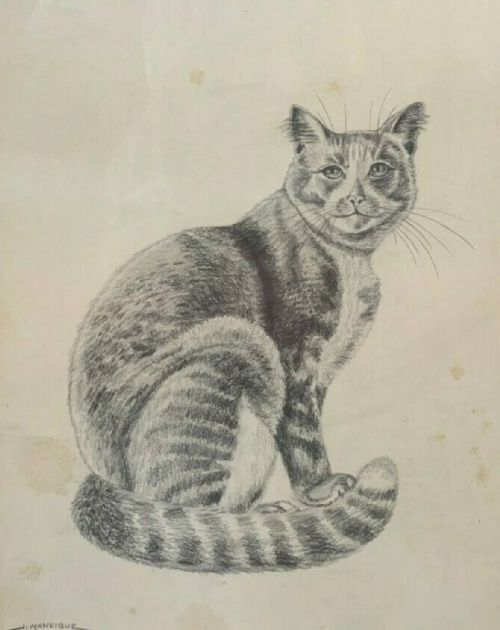
Feline wall art encompasses historical depictions of cats captured through various fine art media, ranging from intimate pencil drawings to large oil paintings. When exploring feline wall art, buyers encounter numerous works created across different eras, capturing the domestic feline in both playful and formal compositions.
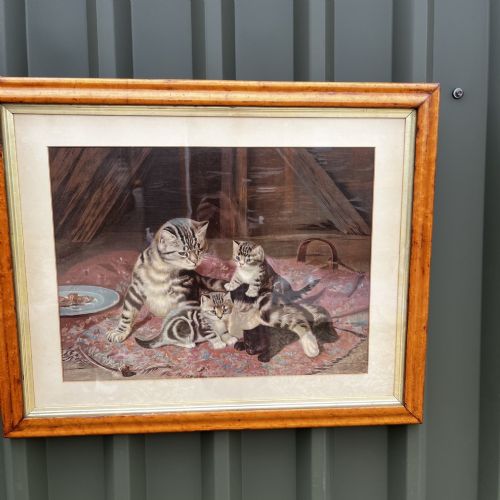
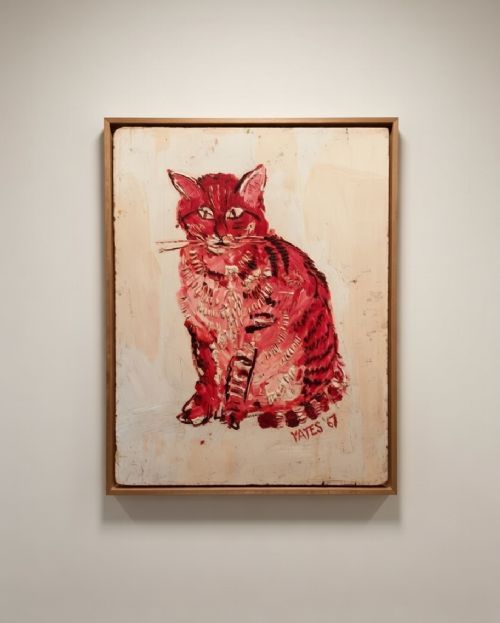
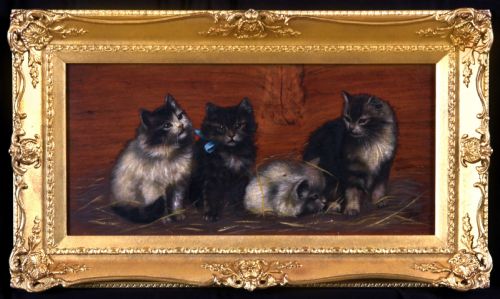
The selection on this page leans heavily towards nineteenth-century academic and naive oil paintings of kittens, alongside early twentieth-century prints and mid-century pastels. Victorian genre scenes and traditional realism dominate the earlier entries, while later decades introduce looser illustrative styles and mid-century interpretations.
Materials and techniques
Artists working on these pieces employed traditional painting supports such as canvas, wood panel, and board, applying oil paint to build texture and depth in the fur and eyes. Pastels and pencil on paper offer a more immediate, delicate line for capturing animal subjects, while chromolithography enabled the reproduction of popular imagery.
Framing forms an integral part of many pieces, utilising gilt wood and gold leaf to complement the painted or printed imagery. These traditional mounting techniques protect the paper and canvas substrates while establishing a formal boundary between the artwork and the wall.
The listings span from the nineteenth century through the 1960s, uniting academic oil paintings, naive school studies, and mid-century pastels under a single aesthetic.
Evaluating quality
Quality in these works rests upon the artist's ability to render the anatomy, texture, and expression of the animal with conviction, distinguishing mechanical reproduction from skilled observation. Finer works demonstrate a sure hand in the handling of light across whiskers and fur, whereas lesser pieces rely on formulaic repetition.
The preservation of the underlying support, whether paper, canvas, or panel, heavily influences the integrity of the piece. Works that retain their original pigment vibrancy without excessive retouching or structural degradation command greater attention from collectors.
Alfred Arthur Brunel de Neuville·Horatio Henry Couldery·Louis Wain·Fred Yates·Agnes Augusta Tallboys·Francisco Jose Domingo y Marques·Bessie Bamber
The Feline Wall Art Glossary
- Chromolithography
- A planographic printing method that uses multiple limestone blocks to produce multicoloured images. This technique allowed Victorian publishers to distribute detailed reproductions of popular animal paintings.
- Naive school
- An artistic classification for works created by self-taught painters who often disregard formal rules of perspective and proportion. These pieces rely on direct observation and charm rather than academic training.
- Genre scene
- A painting or drawing that depicts aspects of everyday life, often featuring domestic animals within household settings. Such works gained immense popularity during the Victorian period.
- Oil on panel
- A technique where oil paint is applied directly to a prepared wooden board rather than stretched canvas. This rigid support provides a smooth, stable surface favoured for detailed animal portraiture.
Feline Wall Art: Frequently Asked Questions
How do I hang antique cat paintings safely?
Support heavy oil paintings on canvas or panel with secure wall fixings suited to the weight of the frame. Ensure the piece hangs away from direct sunlight and excessive moisture to protect the pigment and support.
For works on paper, such as pastels or prints, use UV-filtering glass and acid-free mounts to prevent fading and paper degradation over time.
What periods do these cat artworks come from?
The works span from the nineteenth century through the mid-twentieth century, encompassing Victorian academic painting, Edwardian illustration, and mid-century modernist interpretations.
Stylistic shifts across these decades move from highly finished traditional realism towards looser illustrative approaches and naive compositions.
Are these pieces original artworks or prints?
The selection includes both unique handmade works and period reproductions. Original pieces comprise oil paintings on canvas, board, and panel, alongside hand-drawn pastels and pencil sketches.
Printed works are represented by period chromolithographs and early twentieth-century artist prints, which offered accessible ways to enjoy popular animal imagery.