
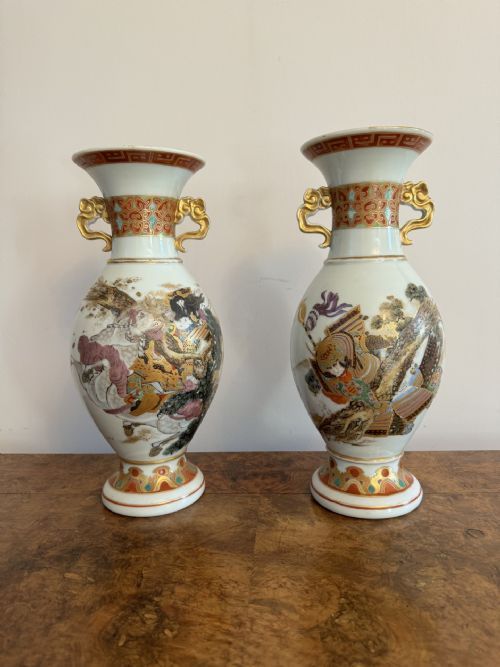
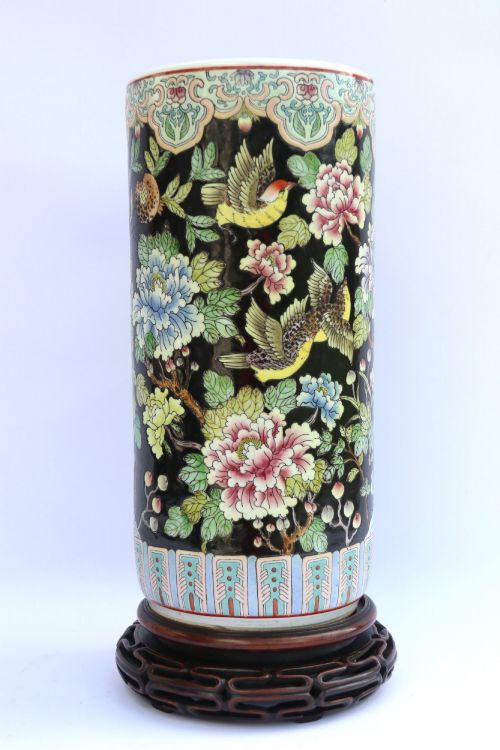
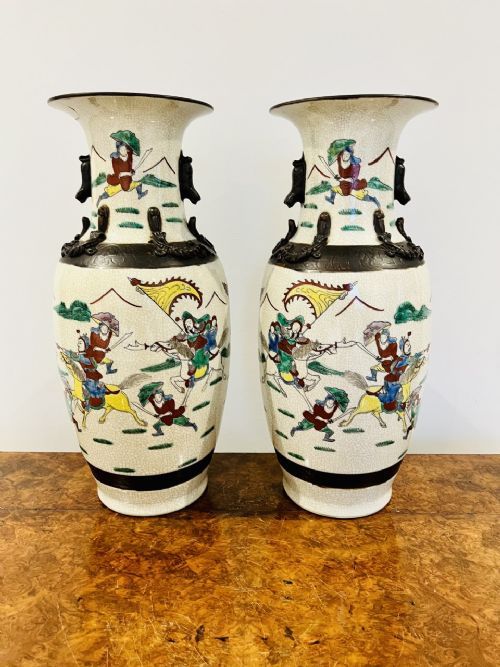


Famille Verte Vase
These famille verte vase pieces bring bright enamelled ceramics into a room, offering the distinct palette of Qing dynasty porcelain.
Famille Verte Vase
A famille verte vase displays green-dominated polychrome enamels painted upon a white porcelain body. These ceramics originate primarily from historical Chinese periods, with nineteenth-century examples and eighteenth-century pieces appearing frequently alongside later export styles.
Buyers encounter standard baluster forms, ginger jars, and square cong vessels, as well as pieces mounted for electricity as table lamps. Many examples retain original hardwood stands or carry gilt bronze mounts added during later European conversions.
Materials and construction
Potters shaped high-fired white porcelain before applying translucent coloured glazes and detailed overglaze enamels. The palette relies heavily on green tones combined with iron red, blue, and yellow pigments fixed through a secondary low-temperature firing.
Many historical vessels underwent later adaptation into lamps, integrating brass fittings, silk shades, and gilt bronze mounts. Wooden elements such as carved hardwood stands accompany specific baluster and ginger jar forms.
Current listings feature porcelain, enamel, brass, fabric, glaze, silk, hardwood, and gilt bronze across eighteenth and nineteenth-century forms.
Factors that distinguish quality
The precision and density of the hand-painted enamels separate standard decorative items from superior works. Finer examples display meticulous brushwork across floral bands, figural scenes, and geometric borders without pigment bleed.
The crispness of the porcelain body and the complexity of the vessel shape dictate overall execution. Superior pieces maintain well-defined foot rims, balanced proportions, and integrated mounts that complement rather than overwhelm the ceramic.
The Famille Verte Vase Glossary
- Famille Verte
- A French term meaning green family, used to describe Chinese porcelain decorated primarily with green overglaze enamels. This palette developed during the Qing dynasty and often incorporates red, blue, and yellow highlights.
- Baluster
- A vase shape characterised by a rounded body that tapers toward the base and swells slightly near the neck. This silhouette provides a stable canvas for wraparound painted scenes.
- Ginger Jar
- A high-shouldered storage jar with a domed cover, originally used for spices. In export porcelain, these jars function purely as decorative ornaments.
- Cong
- A square-tubular ceramic form featuring a cylindrical inner bore and flat corners. This ancient shape imitates ritual jade prototypes.
- Ormulu
- Gilt bronze mounts applied to the base or rim of a ceramic vessel. European makers frequently added these decorative metal fittings during the nineteenth century.
Famille Verte Vase: Frequently Asked Questions
How do I identify a genuine period piece?
Examination of the porcelain body, pigment texture, and baseline wear reveals clues about age. Nineteenth-century and earlier pieces exhibit characteristic craquelure and hand-mixed enamel depths.
Foot rims and base markings provide further context regarding dynasty and kiln origin. Comparing glaze pooling on the interior aids verification against modern reproductions.
Can I use these vases as table lamps safely?
Many examples arrive pre-wired or mounted with brass and gilt bronze for electrical use. These conversions often utilise the central bore or secure exterior brackets without drilling the porcelain.
Qualified electricians should inspect older wiring before daily operation in living spaces. Fabric shades and hardwood bases complete the usual configuration for modern illumination.
What is the difference between famille verte and famille rose?
Famille verte relies predominantly on shades of green accompanied by iron red, yellow, and blue. This palette gained prominence during the seventeenth and eighteenth centuries.
Famille rose introduces an opaque pink enamel derived from colloidal gold, which appeared later in the eighteenth century. Both styles utilise white porcelain bodies but achieve distinctly different visual temperatures.