

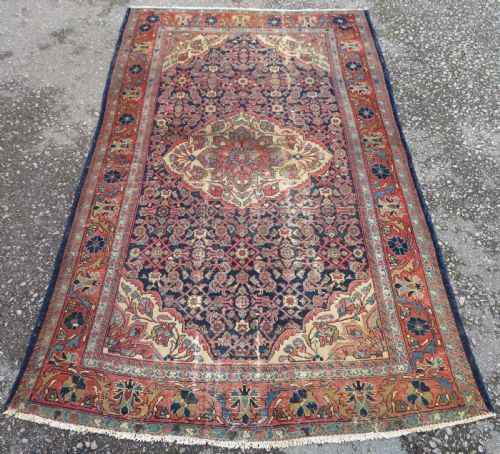



Faded Terracotta Rug
These faded terracotta rugs bring warmth and history to a room through weathered hues and intricate patterns.
Faded Terracotta Rug
A faded terracotta rug delivers muted earthy tones underfoot, stemming from traditions across Anatolia, Persia, and the Caucasus. These pieces include substantial carpets, runner rugs, and area rugs suited to diverse room layouts.
Most examples originate from the late nineteenth century through to the early twentieth century, spanning periods such as 1880, 1890, 1900, 1910, and 1920. Shoppers will encounter numerous Oushak carpets alongside styles from Tabriz, Sarouk, Shirvan, Khotan, and Kashan.
The aesthetic relies upon time-softened wool and cotton foundation structures, presenting a relaxed palette where bright dyes have mellowed into gentle terracotta and pale blue shades.
How they were made
Weavers constructed these carpets using wool pile knotted onto sturdy cotton warps and wefts, occasionally incorporating soft angora wool for added texture. Natural dyes absorbed into these animal and plant fibres over decades, creating the gradual patination seen today.
Production centres such as Ushak, Tabriz, and Istanbul employed traditional hand-knotting techniques by skilled artisans, resulting in resilient floor coverings built to endure heavy use.
Faded Terracotta Rug Retail Price Guide 2026
Typical asking prices for faded terracotta rug among the pieces listed under this phrase on Sellingantiques today, from the lower quarter to the upper quarter. They describe what is for sale here now, not the wider market.
Listings feature pieces dated across the nineteenth century and the early decades of the twentieth century, up to 1920.
What varies in quality
Knot density and structural integrity dictate the distinction between standard domestic floor coverings and finer workshop productions. Tighter knotting allows for sharper pattern definition, even as the pile wears down.
The balance of the remaining pile against the visibility of the foundation threads determines the visual success of the weathering. Balanced wear across the field preserves the integrity of the design without compromising structural strength.
The Faded Terracotta Rug Glossary
- Oushak
- A traditional style originating from the Turkish town of Ushak, known for large-scale floral motifs and soft, luminous wool. These carpets often feature expansive fields with restrained medallion designs.
- Tabriz
- A Persian rug style characterised by intricate geometric or curvilinear patterns woven with high technical precision. These pieces frequently demonstrate refined craftsmanship from north-western workshops.
- Sarouk
- A style originating from a village in central Persia, noted for dense floral sprays and durable construction. They typically employ resilient wool to support deep, rich colour palettes.
- Warp
- The vertical threads stretched tightly on the loom that form the foundational skeleton of the rug. Fringe ends generally consist of these exposed warp threads.
- Angora wool
- A fine, soft fibre utilised in select carpets to yield a lustrous pile and a particularly supple handle. It contributes a distinct tactile quality to nineteenth-century examples.
Faded Terracotta Rug: Frequently Asked Questions
How do I clean an antique rug?
Surface dirt is best managed through gentle suction using a vacuum without a rotating brush bar.
Professional specialist cleaning is recommended for deeper maintenance to protect the historic wool and cotton fibres.
Where should I place a runner rug?
Runners suit narrow spaces such as hallways, corridors, and galley kitchens where foot traffic benefits from soft underfoot padding.
They also function effectively alongside bedside areas or long entryways.
Can these rugs handle heavy foot traffic?
Traditional hand-knotted wool construction provides durable strength suitable for daily domestic use.
Using a quality underlay helps absorb impact and prevents unnecessary sliding on hard floors.
How do I date an old rug?
Dating relies on stylistic markers, dye characteristics, and structural materials recorded across periods like the nineteenth century or the early twentieth century.
Comparing knot structure and design motifs against documented regional examples clarifies the likely decade of production.