
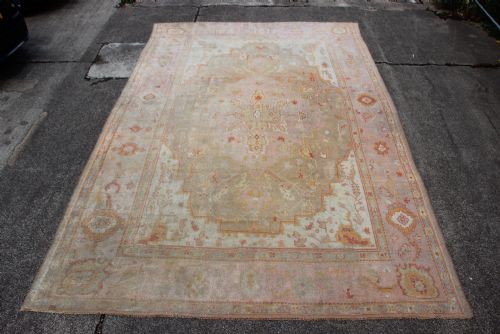



Faded Rug Carpet
These faded antique rug carpet examples bring muted tones and worn textures into a room, offering softened period design.
Faded Rug Carpet
A faded antique rug carpet brings together woven floor coverings from the nineteenth and early twentieth centuries that have softened in tone over decades of use and exposure. Buyers seeking this phrase encounter large carpets, area rugs, long runners, and kilims originating from Persian, Turkish, Anatolian, Caucasian, and Central Asian workshops. The selection on this page leans heavily towards Oushak and Ushak weaves, alongside Sarouk, Kirman, Tabriz, and tribal pieces dating from the eighteen-eighties to the nineteen-twenties.
These textiles range from intimate scatter sizes under two metres to expansive oversize carpets measuring over five metres in length. Regional formats include long narrow runners suited for hallways, broad square carpets for principal rooms, and flatwoven kilims or Suzani strips. Each piece shows the characteristic mellowed palette of aged dyes, shifting from original deep tones into muted pinks, soft blues, and faded reds.
Materials and Construction
The foundation and pile rely predominantly on wool and cotton, with occasional use of fine angora wool found in specific Oushak productions. Weavers knotted these natural fibres by hand onto cotton or wool warp and weft threads, creating dense structures designed to endure generations of foot traffic. Flatwoven kilim examples utilise interlocking or slit-woven tapestry techniques without a raised pile.
Natural dyestuffs interact with sunlight and gentle washing over a century or more, causing the characteristic muted patina seen across these carpets. The interaction between wool pile and cotton foundations produces differential wear as the softer pile lowers gracefully around sturdier structural threads.
The listings show pieces originating from nineteenth-century Turkey, Persia, and the Caucasus, spanning the eighteen-eighties to the nineteen-twenties.
Assessing Quality and Character
The distinction between pieces rests upon the fineness of the knotting, the balance of the surviving design, and the integrity of the remaining pile. A superior carpet retains structural stability and crispness in the drawing of its medallion or all-over pattern, even when the colours have softened significantly.
The harmony of the fading process dictates visual success, where natural age produces a coherent, atmospheric surface rather than uneven thinning. Edge binding, corner preservation, and the proportional balance of borders contribute directly to the visual strength of an antique rug or carpet.
Maples
The Faded Rug Carpet Glossary
- Oushak
- A traditional weaving centre in western Anatolia known for large-scale floral designs and soft pastel wools. Carpets from this region frequently display open fields with subdued geometric or palmette motifs.
- Patina
- The surface sheen and softened colouration acquired by textiles through natural ageing, sunlight exposure, and gentle wear over decades. This quality gives faded antique carpets their characteristic subdued aesthetic.
- Kilim
- A flatwoven rug or carpet produced without a pile by tightly interweaving warp and weft threads. These pieces offer lighter structures and sharp geometric patterning.
- Runner
- A long, narrow carpet format traditionally utilised in corridors, staircases, and narrow hallways. Surviving antique examples often display extended repeating medallions or tribal motifs.
Faded Rug Carpet: Frequently Asked Questions
How do I clean an antique rug?
Gentle surface vacuuming without a beater bar removes loose dirt from the wool pile safely. Professional specialist cleaning remains essential for addressing deeper soil without damaging aged cotton foundations or fugitive natural dyes.
Avoid immersion washing or harsh chemical spot treatments at home, as these methods weaken fragile nineteenth-century fibres. Allowing specialists who understand antique textiles to handle maintenance preserves the structural integrity of the piece.
Where should I place a faded runner?
Long narrow formats suit hallways, corridors, and gallery spaces where floor coverage softens high-traffic areas. Placing them in moderate-traffic zones prevents excessive mechanical strain while displaying the linear pattern effectively.
Using a breathable underlay beneath the carpet prevents slipping on hard floors and reduces friction between the wool fibres and the ground. This support extends the active lifespan of older foundation threads.
Are these carpets suitable for daily use?
Hand-knotted wool and cotton construction provides remarkable durability, allowing these textiles to withstand regular residential foot traffic. The sturdy nature of traditional nomadic and workshop weaving ensures they remain practical floor coverings.
Placing pieces away from continuous direct sunlight and rotating them periodically balances wear and fading evenly across the surface. Living with these textiles involves appreciating their historic resilience rather than treating them as fragile museum exhibits.
How can I tell Oushak carpets apart?
Oushak pieces typically feature looser knotting, softer wool textures, and distinctive pastel colour palettes dominated by warm pinks and pale blues. Their scale often runs larger, with expansive floral or medallion motifs set against open, uncluttered fields.
Other regional styles, such as Sarouk or Tabriz, display tighter knot counts, more intricate curvilinear drawing, and deeper saturated tones. Comparing the suppleness of the handle and the geometry of the border designs clarifies these regional variations.