
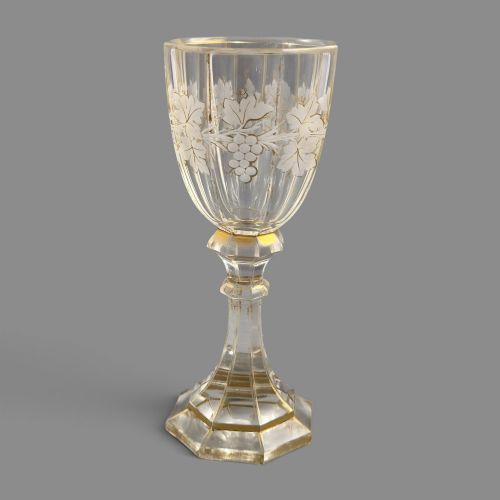
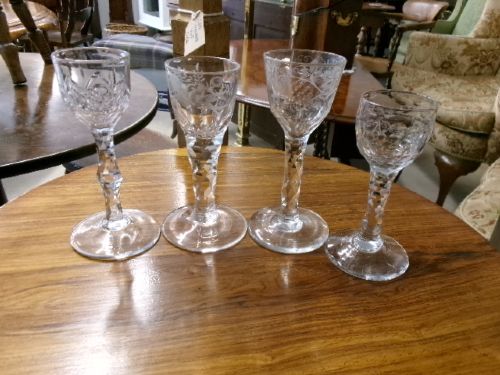
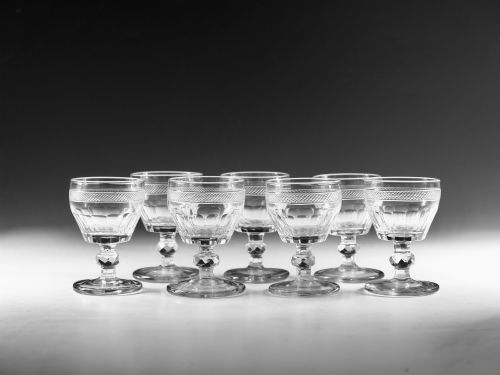


Facet Stem Goblet
These facet stem goblet examples bring eighteenth-century brilliance to the table through crisp geometric cutting.
Facet Stem Goblet
A facet stem goblet is a drinking vessel defined by its geometric stem, appearing most frequently in eighteenth-century English and Georgian forms.
The pieces on this page span Georgian wine glasses and rummers alongside nineteenth-century Bohemian and Victorian drinking vessels.
Collectors generally encounter clear glass or lead crystal specimens featuring wide foot bases and decorated or engraved bowls.
Materials and construction
These items rely on lead crystal and heavy lead glass, which provided the clarity and weight necessary for sharp polishing.
The stems and bowls were shaped by hand before artisans applied wheel-cutting to create the distinctive flat planes and facets.
Certain examples incorporate gilding or delicate engraving directly onto the bowl surface to complement the structured stem.
Certain eighteenth-century glasses feature specialised bowl shapes historically dubbed cockfighting goblets, built to withstand the rigorous toasts of tavern society.
Quality differences
Quality rests on the crispness of the facet edges and the balance of the bowl relative to the cut stem.
Early English and Irish pieces demonstrate superior metal clarity and precision in the geometric cutting compared to later mass production.
Moser Bohemian·James Giles
The Facet Stem Goblet Glossary
- Facet cut
- A surface decorated with multiple flat, polished planes. This technique catches the light and highlights the brilliance of lead glass.
- Rummer
- A large, wide-bowled drinking glass used for heavy wines or spirits. These vessels typically sit on a sturdy foot and feature shorter stems.
- Jacobite engraving
- Decorative motifs including roses, oak leaves, or hidden symbols applied to eighteenth-century glassware. Such designs signified loyalty to the exiled Stuart dynasty.
- Pontil mark
- A rough scar on the underside of the base where the glassblower's rod was snapped off. Its presence indicates traditional hand-blown manufacture.
Facet Stem Goblet: Frequently Asked Questions
How were these goblets used historically?
People used them for serving wine, spirits, or ale during formal dining and social gatherings. Their robust construction suited them for frequent toasts and everyday entertaining.
Larger versions often functioned as rummers or cordial vessels, holding generous portions of strong drink after a meal.
How can I date an antique facet stem glass?
Dating relies on the shape of the bowl, the weight of the metal, and the style of the cutting. Eighteenth-century examples often display lighter, more tapered bowls above slender faceted stems.
Nineteenth-century pieces tend toward heavier proportions, sometimes introducing coloured glass or more elaborate surface engraving.
How do I care for antique crystal glassware?
Wash each piece gently by hand in warm water using a mild detergent, avoiding harsh scrubbers and sudden temperature changes. Soft cotton cloths prevent water spots and keep the lead crystal clear.
Store them upright on a stable surface where the thin rims and wide foot bases will not suffer knocks from other tableware.