




Entryway Mirror Console
An entryway mirror console combines a surface and a reflective glass panel to anchor a hallway, bringing practical utility and light.
Entryway Mirror Console
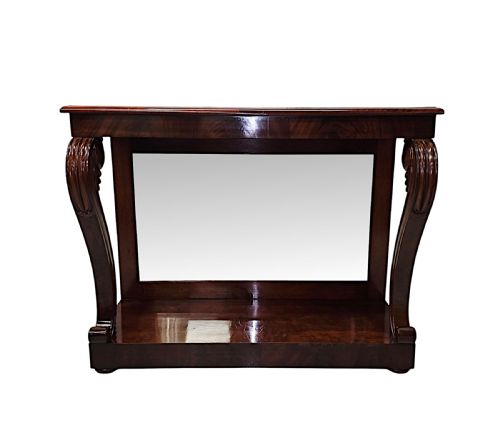
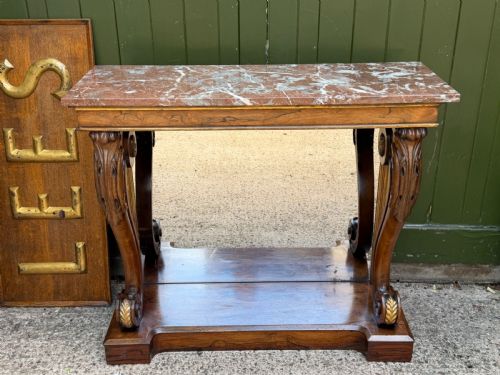
An entryway mirror console encompasses hallway furniture designed to organise entrance spaces, appearing across periods from the early nineteenth century to the early twentieth century. Buyers seeking an entryway mirror console will find paired wall mirrors with console tables, pier tables with inset mirror-backs, and combined oak or mahogany hall stands.
The selections range from imposing Victorian mahogany hall stands and French parcel gilt marble top consoles with matching giltwood mirrors to compact oak wall-hanging cloakroom mirrors with shelves. The nineteenth century yields grand rosewood and flame mahogany examples alongside Irish and William IV formats, while later decades offer Arts and Crafts golden oak iterations.
Materials and construction methods
Cabinetmakers constructed these pieces primarily using timbers such as mahogany, oak, rosewood, masur birch, and giltwood, frequently pairing wooden frames with heavy figured marble tops. Glass forms the central mirror panels, while parcel-gilt details, carving, and wrought iron elements enhance the decorative schemes.
Joinery techniques span the nineteenth and twentieth centuries, uniting sturdy structural carcases with delicate carved wood ornament. Mirror plates are set directly into console backs or mounted above tables and hall stands to maximise reflected light in narrow spaces.
Materials recorded across the inventory include mahogany, oak, rosewood, masur birch, marble, giltwood, and wrought iron.
Distinctions in quality and execution
Quality reveals itself in the selection of timbers, such as highly figured flame mahogany or masur birch, and the weight of the inset marble tops. Finer examples display crisper hand-carved wood ornamentation and superior parcel-gilt detailing rather than heavier, plain execution.
The integration between the console table and its matching mirror separates standard production from exceptional design. Cohesive proportions across the woodwork and the clarity of the original mirror glass indicate superior workshops.
The Entryway Mirror Console Glossary
- Console table
- A table designed to stand against a wall, frequently supported by brackets or front legs. These tables often feature marble tops and form the base for paired wall mirrors.
- Hall stand
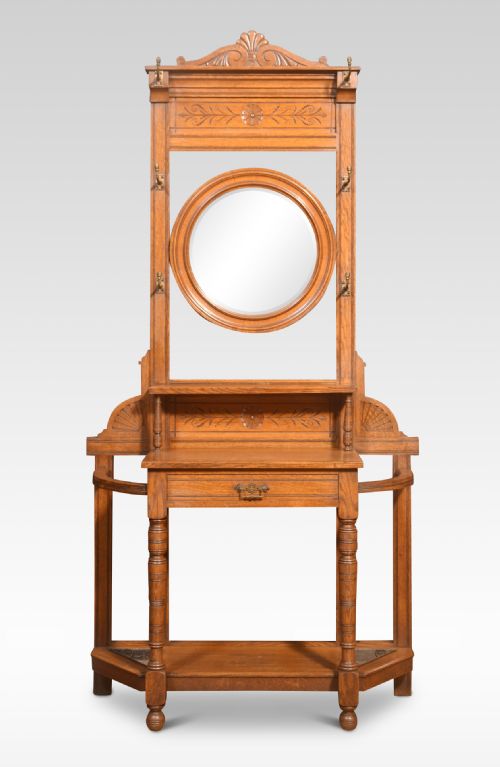
- A piece of hallway furniture incorporating coat hooks, umbrella stands, and an integrated mirror. They are constructed in woods like oak and mahogany.
- Parcel-gilt
- Partially gilded woodwork where gold leaf highlights specific carved details or mouldings against a contrasting timber ground. This technique accentuates structural lines.
- Pier table
- A low table designed to stand against the wall directly beneath a pier glass mirror. They frequently feature mirror-backed panels to reflect interior light.
- Masur birch
- A decorative timber featuring natural dark swirls and patterns within the grain. It appears on distinct nineteenth-century cabinet furniture.
Entryway Mirror Console: Frequently Asked Questions
How do I style an entryway mirror console?
Position the console firmly against the hallway wall to anchor the entrance space, ensuring any paired mirror hangs at a comfortable viewing height. Keep the marble or wooden surface uncluttered with a small tray for daily essentials.
Allow the natural grain of mahogany or oak and the reflective glass to brighten darker corridors without overcrowding the passage.
Where were these console tables placed?
These pieces traditionally stood in entrance halls, corridors, and reception rooms to provide an immediate surface for visiting cards and hats. The integrated mirror allowed people to check their appearance before stepping outside.
Grand country houses utilised large console tables in reception hallways, while smaller homes employed compact wall-hanging versions.
How do I identify Victorian hall stands?
Victorian hall stands typically utilise solid oak or mahogany, incorporating carved wood ornamentation, numerous coat hooks, and a central mirror plate. Their robust construction reflects the heavy use demanded in nineteenth-century domestic entryways.
Look for built-in umbrella wells and structural proportions that match the heavy furniture styles of the period.