
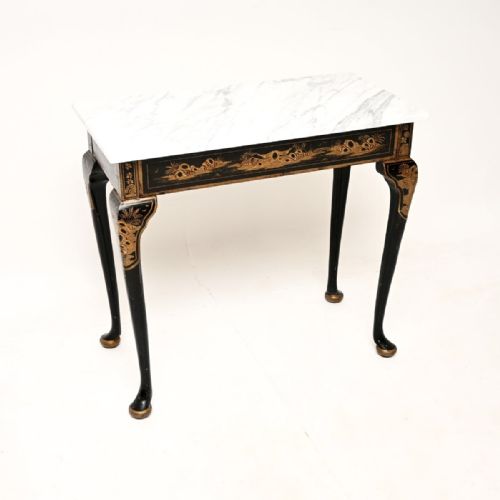
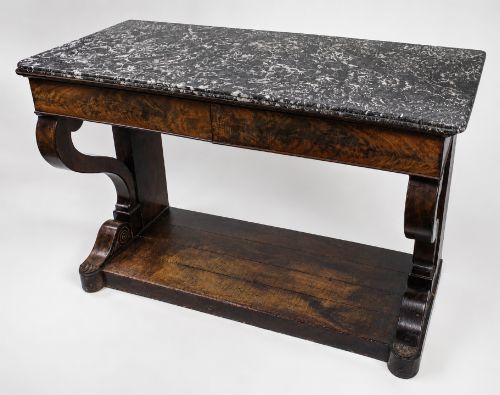


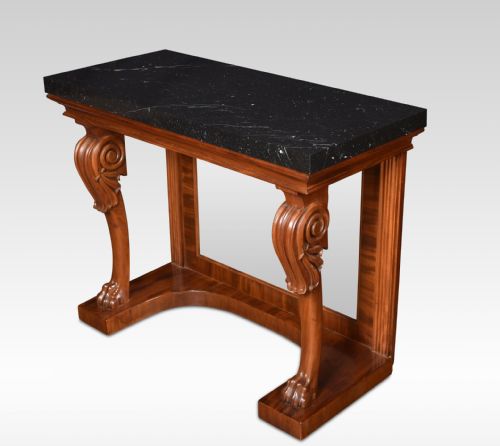


Black Marble Console Table
These black marble console table examples bring striking contrast and surface utility to an interior, built across centuries of European design.
Black Marble Console Table
A black marble console table combines a durable stone top with a supportive timber or metal base, designed to stand flat against a wall in a hallway or principal reception room. You will encounter pieces spanning from the eighteenth century through to the early twentieth century, showing distinct regional tastes across Britain, France, Sweden, and the Netherlands.
The form often crosses paths with side tables, chiffoniers, and specialised pieces like patisserie boucher tables or washstands that share the characteristic stone surface. Makers adopted styles ranging from restrained Regency lines to opulent French Empire, Napoleon III, and Victorian Chinoiserie aesthetics.
Materials and construction methods
Makers paired heavy marble slabs with dense timbers such as mahogany, satinwood, and elm, or formed structural supports from wrought iron, brass, and painted pine. Joinery and carcase work relied on traditional hand-cut techniques appropriate to each period workshop.
Surfaces received specialised finishes including black lacquer, gilt highlights, or polished French polish on flame veneers. Stonework was hand-sawn and polished to create a smooth, resilient top designed to carry decorative objects.
Period styles represented include Regency, French Empire, Charles X, Napoleon III, and Victorian Chinoiserie.
Distinguishing quality in design and execution
Quality rests in the precision of the timber veneers, the depth of the carved or cast details on the base, and the thickness and selection of the marble top. Superior examples demonstrate harmonious proportions and integrated design where the stone and base complement one another seamlessly.
The execution of secondary decorative elements, such as brass mounts, hand-painted Chinoiserie motifs, or wrought iron scrollwork, separates standard workshop production from finer cabinetmaking.
Krieger of Paris·Gillows
The Black Marble Console Table Glossary
- Console table
- A table designed to stand against a wall, traditionally supported by wall brackets or front legs. These tables often served decorative rather than utilitarian purposes in formal rooms.
- Flame mahogany
- A veneer cut from the fork of a mahogany tree where the branches join the trunk. This method produces a distinctive, fiery grain pattern highly prized by period cabinetmakers.
- Napoleon III
- A French design style spanning the mid to late nineteenth century. It is characterised by eclectic revivals, rich surface ornamentation, and dark woods.
- Satinwood
- A durable, lustrous timber native to India and Sri Lanka. It yields a yellowish-gold wood with a satin-like sheen used extensively in high-end Regency and neoclassical furniture.
Black Marble Console Table: Frequently Asked Questions
Where should I place a console table?
These tables sit flat against a wall, making them well-suited for narrow hallways, entrance passages, or anchoring a living room wall beneath a mirror.
Their shallow depth ensures they do not obstruct walkways while providing a useful surface for lamps or decorative objects.
How do I care for a marble top?
Marble requires gentle cleaning with a damp cloth and mild soap to preserve its polished surface. Avoid acidic liquids that can etch the stone over time.
Regular dusting and immediate attention to spills will keep the material stable and maintain its natural sheen.
Are these tables heavy?
The combination of dense timber frames and solid stone tops makes these pieces relatively heavy. The weight varies depending on whether the base is constructed from light pine or dense mahogany and iron.
It is advisable to lift rather than drag them to protect both the floor and the table joinery.
How do I identify a Regency period table?
Regency pieces often display classical restraint, geometric lines, and architectural details inspired by ancient Greece and Rome. Look for restrained use of brass inlay, mahogany veneers, and balanced proportions.
Maker attributions can sometimes be linked to prominent firms like Gillows through construction methods and specific design motifs.