

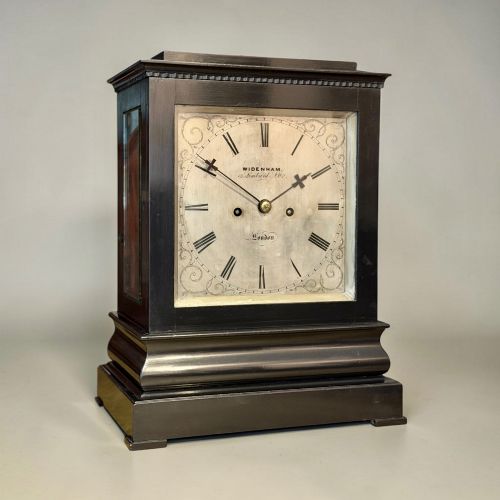


Engraved Silver Dial Clock
These engraved silver dial clock pieces span centuries of horology, offering buyers meticulous timekeeping housed in handsome wood, brass, and glass cases.

Engraved Silver Dial Clock
An engraved silver dial clock brings together precision metalwork and substantial cabinetry across several centuries of British and European horology. Buyers searching for an engraved silver dial clock encounter forms ranging from miniature bracket models to grand library clocks and longcase dials.
The pieces listed on this page originate predominantly from the nineteenth and eighteenth centuries, with notable Victorian and Georgian examples alongside later Art Deco specimens. Makers and retailers such as Dent, Mappin and Webb, and Thomas Cole appear frequently among the bracket, library, and strut clock formats.
Materials and construction
Horologists utilised brass, silvered metal, and glass to construct the intricate dials and movements that power these timepieces. Cabinetmakers housed these complex mechanisms in rich timber cases fashioned from mahogany, rosewood, walnut, and ebonised wood.
Movements incorporate sophisticated engineering such as fusee mechanisms, quarter striking trains, and eight-day durations. Dials received fine hand engraving on silvered brass or metal plates, paired with delicate hand-cut hands.
Engraved Silver Dial Clock Retail Price Guide 2026
Typical asking prices for engraved silver dial clock among the pieces listed under this phrase on Sellingantiques today, from the lower quarter to the upper quarter. They describe what is for sale here now, not the wider market.
One listed mystery clock from the Art Deco era manages to keep time seemingly without any internal connection to the hands.
Judging quality and execution
Superior examples demonstrate crisp, deep hand engraving on the dial plates that remains sharp and legible after generations of use. The quality of the casework, from the figure of the mahogany or rosewood to the precision of the brass fittings, elevates certain pieces above standard production.
Signed movements by renowned makers or retail houses carry greater weight due to the documented standard of their internal mechanics. The integration of complicated movements, such as twin fusee trains or quarter striking systems, marks out the finest items in this category.
Widenham of London·Mappin and Webb·Dent·Howell and James·Ganthony of London·Thomas Cole·James Cole·Hunt and Roskell·Smiths Clocks·H Marks·John Massey·L Donne
The Engraved Silver Dial Clock Glossary
- Fusee
- A conical pulley used in spring-driven clocks to maintain equal power as the mainspring unwinds. This mechanism ensures consistent timekeeping across the duration of the wind.
- Bracket clock
- A portable household clock originally designed to sit on a bracket on the wall. Later examples sit securely on tables, mantelpieces, or desks.
- Strut clock
- A small timepiece supported by a hinged prop or leg at the back, designed to stand upright on a desk or dressing table. Thomas Cole popularised this decorative form during the Victorian era.
- Silvered brass
- A brass plate treated with a mixture of silver powder, salt, and tartar to produce a bright white metallic surface. Engraved markings are typically filled with black wax to stand out clearly.
- Longcase clock dial
- The visible faceplate of a tallcase clock, carrying the hours and minutes alongside the maker's signature. These brass plates often feature elaborate corner spandrels and engraved centres.
Engraved Silver Dial Clock: Frequently Asked Questions
How do I wind an 8 day clock?
Insert the appropriate winding key into the designated winding hole on the dial face. Turn the key gently clockwise until resistance indicates the mainspring is fully tensioned.
Take care not to overwind the movement, as this can strain the internal spring mechanism. Ensure you support the clock case firmly with your free hand during the process.
What is a fusee movement?
A fusee movement uses a conical drum connected to the mainspring by a fine chain or gut line. As the spring unwinds, the chain pulls higher up the cone's wider radius to compensate for the decreasing power.
This clever mechanical arrangement delivers uniform force to the escapement throughout the running period. It represents a hallmark of higher quality British clockmaking.
How should I clean a brass dial?
Dust silvered and brass dials regularly with a very soft, dry artist's brush to remove loose particles. Avoid applying liquid polish or chemical cleaners directly onto engraved silvered surfaces, as this strips the delicate finish.
Professional horological cleaning is recommended if tarnish obscures the engraved details. Aggressive rubbing will permanently damage the silvered layer.
Where should I place a library clock?
Position your library clock on a stable, level surface away from direct sunlight, heating vents, and damp areas. Wooden cases and delicate internal mechanisms react poorly to drastic temperature fluctuations and humidity.
Select a quiet room where you can appreciate the mechanical ticking and striking train. Ensure the furniture supporting the clock does not suffer from vibrations that could disrupt the pendulum or balance wheel.