




Engraved Gilt Travel Timepiece
An engraved gilt travel timepiece brings precision mechanics and ornate metalwork together, offering both portable timekeeping and refined nineteenth-century design.
Engraved Gilt Travel Timepiece
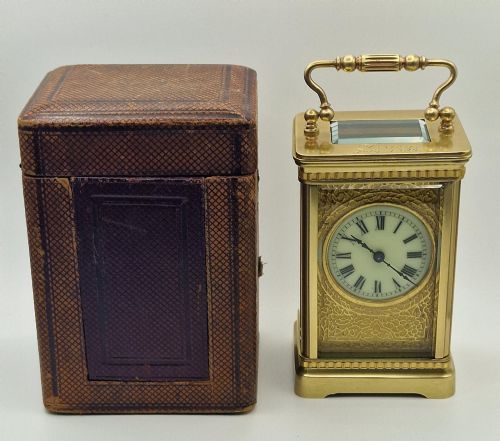
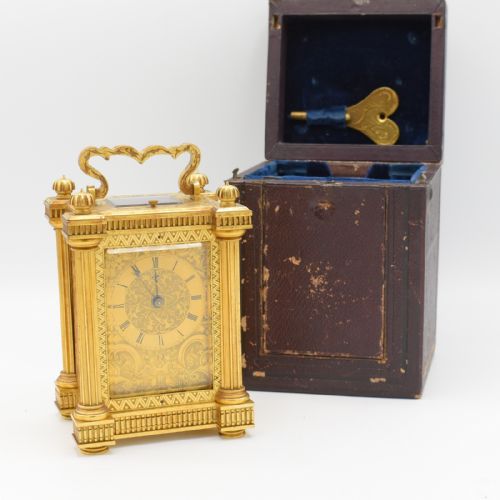
An engraved gilt travel timepiece is primarily represented here by carriage clocks and miniature travel clocks dating through the nineteenth century. These items combine durable metal frames with portable glass-panelled housings designed for journeys.
Most examples originate from French workshops and London retailers, spanning periods from eighteen fifty to nineteen hundred. Buyers encounter various sizes, from giant gorge cases down to miniature editions.
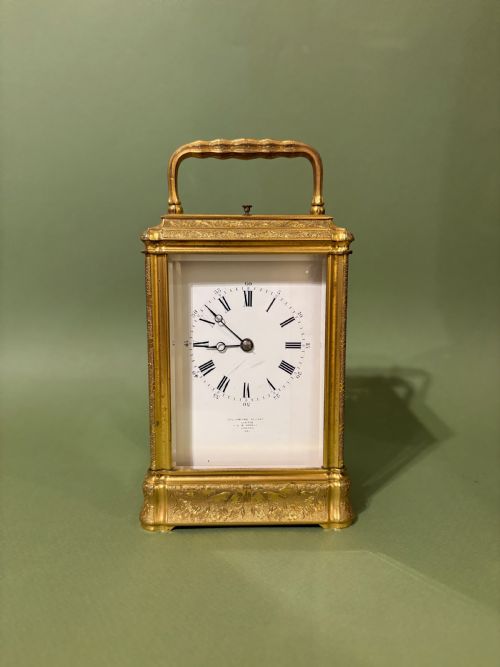
The aesthetic centres on detailed surface engraving across gilt brass and bronze cases. Many incorporate repeating mechanisms, alarms, and white enamel dials behind bevelled glass panes.
Materials and construction
The primary structure relies on gilt brass or gilt bronze castings, providing a robust metal foundation for intricate surface engraving. Heavy bevelled glass panels fit snugly into the housing to protect the delicate internal movement.
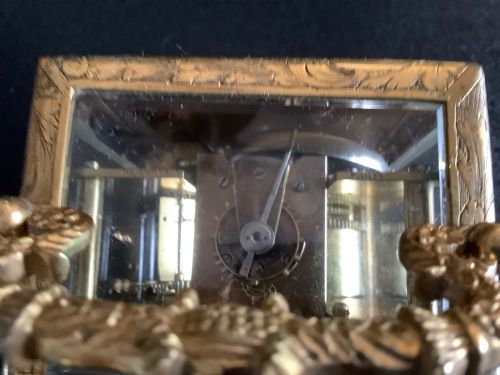
Makers integrated white enamel dials featuring Roman numerals, often accompanied by subsidiary masks and blued steel hands. Complex inner mechanisms utilise brass gear trains, platform escapements, and sometimes striking components mounted on steel bells.
Listings feature nineteenth-century French and Victorian designs, incorporating materials such as gilt brass, bronze, enamel, leather, and bevelled glass.
Quality differences
The depth and crispness of the case engraving set basic examples apart from exceptional work. Profuse hand-chiselled decoration across all sides requires considerable skill and elevates the visual weight of the piece.
Complexity of the internal movement dictates functional merit. Simpler timepieces contrast with sophisticated mechanisms featuring repeaters, alarms, single fusee setups, or platform escapements.
Henri Jacot·Howell And James·Gontard And Bolviller·Mappin And Webb·Thomas Cole·James Cole·Hunt And Roskell·Drocourt·Holingue·Tiffany
The Engraved Gilt Travel Timepiece Glossary
- Carriage clock
- A portable spring-driven timepiece originally built for travel during the nineteenth century. These usually feature a rectangular brass case with glass panels and a handle on top.
- Gorge case
- A distinct rectangular carriage clock case style with moulded upper and lower cornices and a swinging carrying handle. The name derives from the stepped moulding profile.
- Platform escapement
- The tiny self-contained regulating assembly mounted on the upper plate of the movement. This innovation allowed portable clocks to keep accurate time regardless of orientation.
- Repeater mechanism
- A complication that strikes the hours and quarters on demand when a button or lever is pressed. Such movements require intricate gear arrangements inside the gilt case.
- Fusee
- A conical pulley used in mechanical clocks to maintain even drive force as the mainspring unwinds. This mechanism ensures consistent energy delivery to the escapement.
Engraved Gilt Travel Timepiece: Frequently Asked Questions
How do I wind a carriage clock?
Most travel timepieces use a matching double-ended key fitted to arbors on the backplate. Turn the key gently until resistance signals the mainspring is fully tensioned.
Avoid over-winding to protect the internal springs. Ensure the key matches the square arbors properly before applying turning force.
What is a gorge case?
A gorge case refers to a specific rectangular carriage clock housing featuring curved or stepped mouldings around the top and bottom. This style provides a sturdy frame for bevelled glass panels.
Originating in nineteenth-century France, the design balances architectural presence with portability.
How do repeating mechanisms work?
A repeating mechanism sounds the last elapsed hour and quarter-hours when a plunger on the case is depressed. This complex train operates independently of the running gear.
Collectors prize these mechanical additions for the intricate engineering required to coordinate hammers, gongs, and racks within a compact gilt brass body.
Where should I place a travel timepiece at home?
Position your clock on a stable, level surface away from direct sunlight, draughts, and sudden temperature shifts. Mantelpieces, desks, and secure cabinets provide suitable environments.
Keep the timepiece clear of heavy vibrations that might disrupt the delicate platform escapement and alter the running speed.