
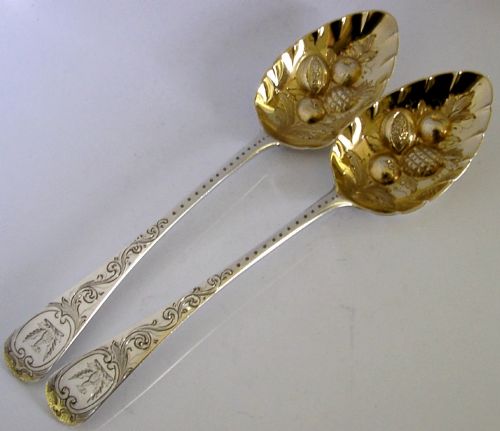


Engraved Fruit Serving Spoon
An engraved fruit serving spoon brings table service from the Georgian and Victorian eras right into modern use.
Engraved Fruit Serving Spoon
When you search for an engraved fruit serving spoon, you find specialised cutlery designed to serve fruit during formal meals. The listings here consist largely of Victorian and Georgian pieces, often found as pairs rather than single items.
Many examples date from the nineteenth century, spanning George III up to Edwardian times. These objects take the form of berry spoons and naturalistic leaf designs, frequently accompanied by fitted presentation boxes lined in velvet or silk.
How they were made
Makers shaped these serving pieces from sterling silver and silver plate, frequently applying a gold wash or silver gilt finish to the bowl interior. Handles received detailed hand engraving and ornate patterning.
Specialist silversmiths utilised traditional techniques to produce leaf forms and fruit motifs on the bowls and stems. Storage cases utilise materials like leatherette, silk and velvet to protect the metalwork.
Storage options recorded across the inventory feature velvet, silk, leatherette, and custom presentation boxes designed for pairs.
What varies in quality
Quality depends upon the crispness of the hand engraving on the handle and the depth of the ornamentation across the bowl. Finer examples retain their original gold wash and display deliberate craftsmanship in naturalistic leaf or berry designs.
The presence of a fitted presentation box adds another layer of distinction to the set. Pieces by recorded makers command attention through superior weight and balanced proportions.
William Chawner II·Sebastian Crespell
The Engraved Fruit Serving Spoon Glossary
- Sterling silver
- A standard alloy consisting of high-purity silver used for durable tableware. This material provides the primary substance for the majority of these serving spoons.
- Silver gilt
- Silver covered with a thin layer of gold, also known as vermeil. This technique adds warmth to the bowl interior.
- Berry spoon
- A large serving spoon adapted for fruit with fruit and foliage motifs embossed or engraved onto the bowl. These pieces date predominantly from the Georgian and Victorian periods.
- Naturalistic
- A style reflecting organic forms such as leaves and stems. This design approach appears in Victorian pieces shaped like foliage.
Engraved Fruit Serving Spoon: Frequently Asked Questions
What were engraved fruit serving spoons used for?
These spoons served soft fruits and berries at the dining table during formal dessert courses. Their large bowls accommodated generous portions.
They formed part of larger fruit and nut dining services in wealthy households during the Georgian and Victorian periods.
How do I identify a Georgian fruit spoon?
Georgian spoons typically display hallmarks corresponding to the late eighteenth or early nineteenth century. Stylistic markers include crisp engraving and traditional forms.
Makers such as William Chawner II worked during this era, producing silver pieces with distinct period characteristics.
What is a silver gilt finish?
Silver gilt involves coating solid silver with a layer of gold. This process creates a rich two-tone appearance inside the bowl.
Many Victorian fruit spoons feature this treatment to enhance the decorative appeal of the silver.
How should I store antique serving spoons?
Original fitted boxes lined with velvet, silk or leatherette offer ideal protection against tarnish and scratches. These fitted cases keep pairs secure.
If a box is absent, store the silver in a tarnish-resistant cloth away from direct moisture.