
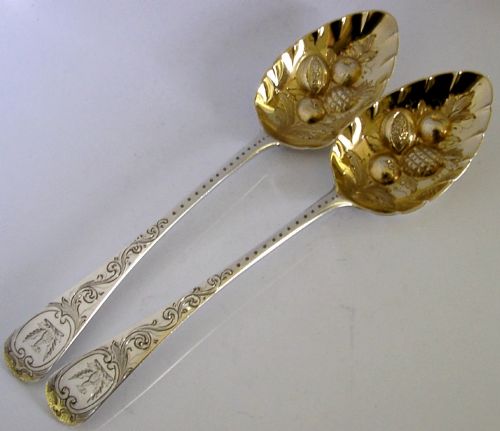


Engraved Silver Berry Spoon
These engraved silver berry spoon examples combine fruit motifs with historic hallmarked silver, offering a distinct table service piece for collectors.
Engraved Silver Berry Spoon
An engraved silver berry spoon typically takes the form of a large serving implement designed for fruit and dessert service. These pieces frequently appear as matched pairs or within fitted presentation boxes alongside fruit sets.
The evidence shows origins spanning the Georgian and Victorian eras, alongside Edwardian and later twentieth-century variations. Makers utilised sterling silver, silver gilt, and silver plate to fashion these large serving utensils.
Most specimens feature elaborate surface work upon the bowl and handle, aligning with Victorian naturalistic and Georgian design preferences. Collectors encounter family crests, embossed fruit motifs, and intricate handle engraving across the available forms.
Materials and methods of construction
Silversmiths shaped these serving spoons from sterling silver and silver plate, frequently applying a gold wash or silver gilt finish to the bowl interior. This gilt layer protected the silver from the acidic juices of fresh fruit during service.
Craftsmen decorated the implements using chasing, embossing, and engraving techniques to apply detailed botanical motifs and family crests onto the metal. Silk and velvet often lined the custom presentation boxes housing these matched sets.
Several spoons feature foliage so aggressively naturalistic that holding the handle feels like shaking hands with an exceptionally shiny shrub.
Distinctions in craftsmanship and condition
Quality separates standard production items from master silversmith work through the crispness of the chased fruit details and the depth of the handle engraving. Pieces attributed to recorded makers display superior balance and more substantial gauge silver.
The presence of original velvet or silk lined boxes influences the completeness of a set. Preservation of the gold wash inside the silver gilt bowls indicates the frequency of past use and subsequent polishing.
William Chawner II·Sebastian Crespell·George Smith III
The Engraved Silver Berry Spoon Glossary
- Berry spoon
- A large serving spoon with an embossed and engraved bowl, retrofitted or originally manufactured for fruit service. These pieces usually date from the Georgian or Victorian periods.
- Silver gilt
- Sterling silver that has been coated with a thin layer of gold. This treatment prevented fruit acids from tarnishing the bowl of the spoon.
- Chasing
- A metalworking technique where the silversmith punches and hammers the metal from the front to push design details inward. This creates raised relief patterns of fruit and foliage on the spoon bowl.
- Crest
- An heraldic device engraved onto the handle of the spoon to denote family lineage. Such armorial bearings appear frequently on eighteenth and nineteenth-century silver.
- Naturalistic
- A design style mimicking organic forms such as leaves, vines, and branches. Victorian examples often adopt this aesthetic for serving cutlery handles.
Engraved Silver Berry Spoon: Frequently Asked Questions
What were engraved silver berry spoons used for?
These large serving spoons were utilised at the dining table for portioning soft fruits and berries from central bowls onto individual plates. The wide bowl accommodated bulk fruit service during formal nineteenth-century meals.
Over time, many of these utensils became ornamental display pieces housed within dedicated presentation boxes alongside fruit knives and forks.
How do I distinguish Georgian from Victorian examples?
Georgian pieces generally exhibit simpler handle lines paired with later decorative fruit embossing added to the bowl. Victorian versions frequently embrace naturalistic leaf forms and heavier overall engraving.
Examining the assay office marks and date letters stamped on the reverse of the handle provides the exact year of manufacture.
Why do some spoons have gold inside the bowl?
The golden interior results from a gold wash or silver gilt application over the sterling silver base. Silversmiths added this layer to protect the metal from the corrosive acids found in fresh berries and fruit.
This protective coating also provided a decorative contrast against the bright polished silver exterior of the handle.
How should I care for antique silver serving spoons?
Store these pieces in tarnish-resistant cloth or their original fitted velvet and silk boxes when not on display. Avoid harsh chemical dips that can strip away delicate gilt layers and historical engraving.
Wash them gently by hand in warm soapy water using a soft cloth, drying them thoroughly immediately afterward.