






English Victorian Barometer
An English Victorian barometer brings domestic science and rich timber into a hall, offering a reliable read on the weather.
English Victorian Barometer
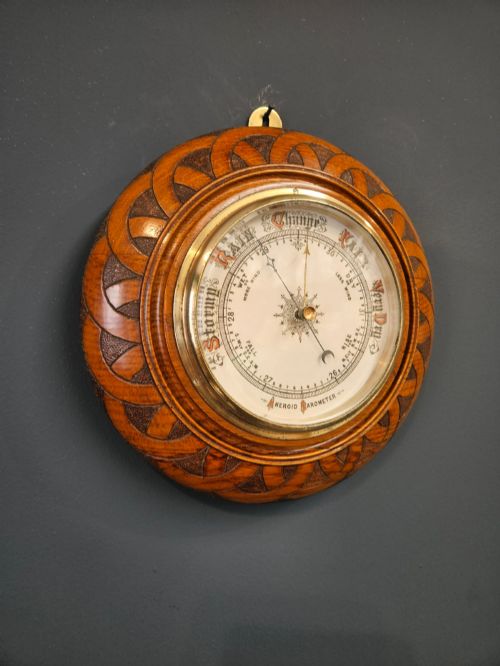
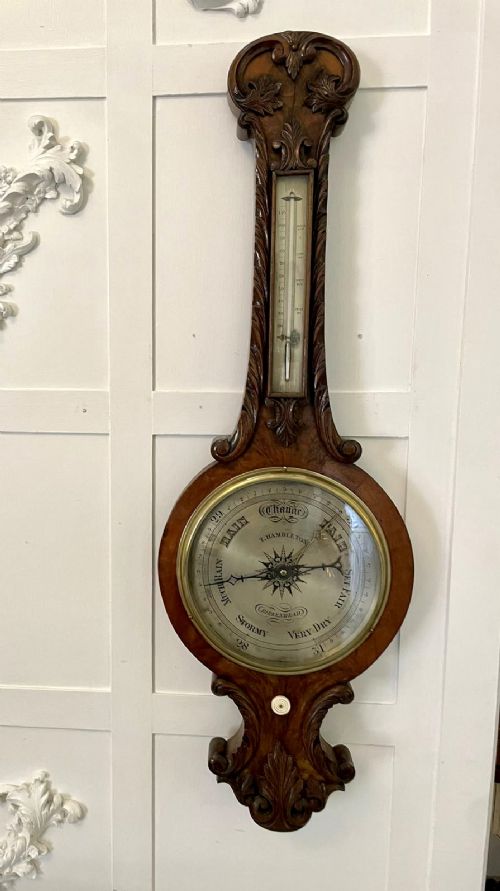
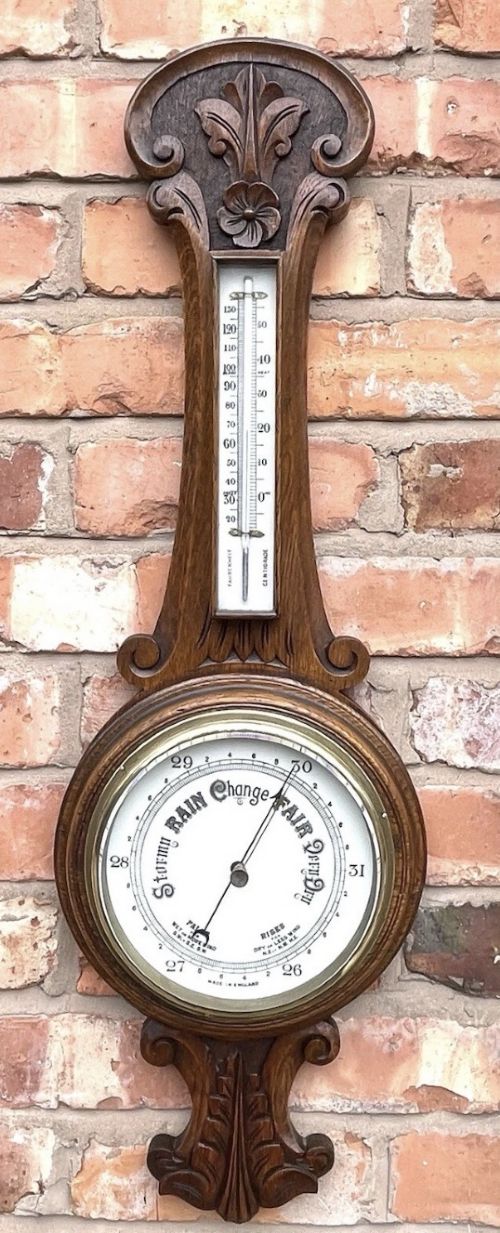
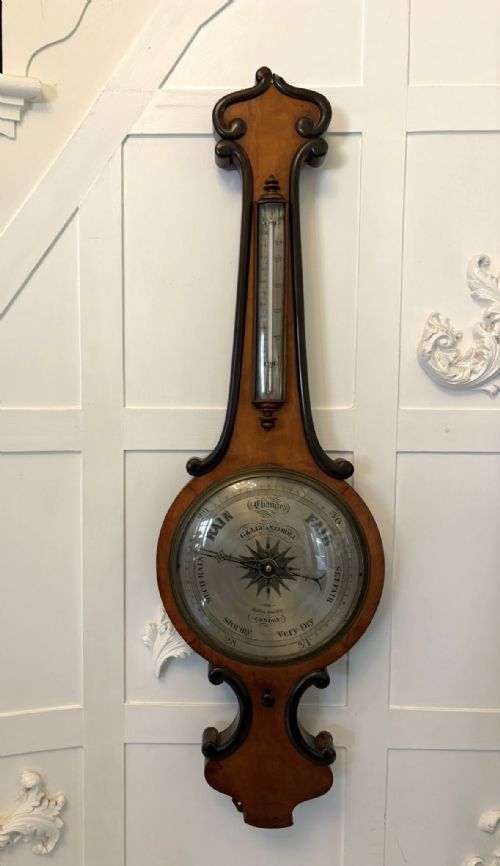
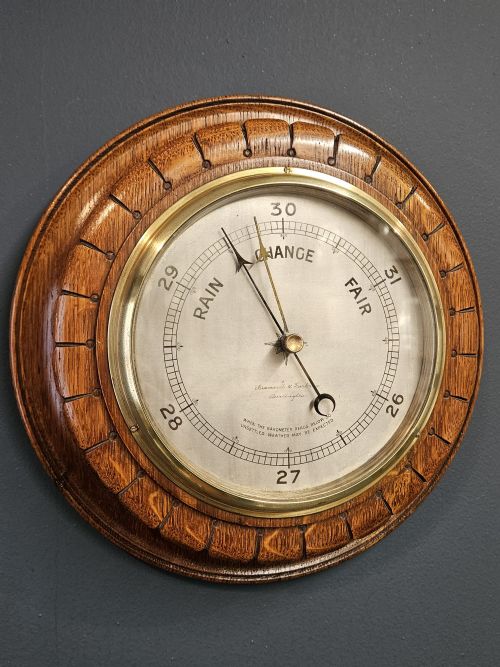
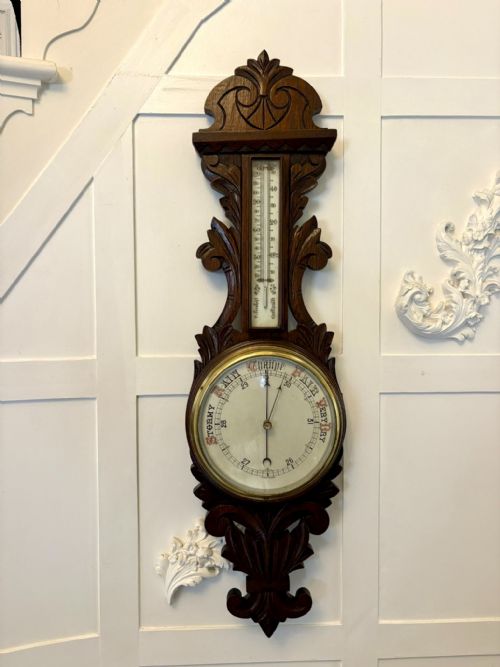
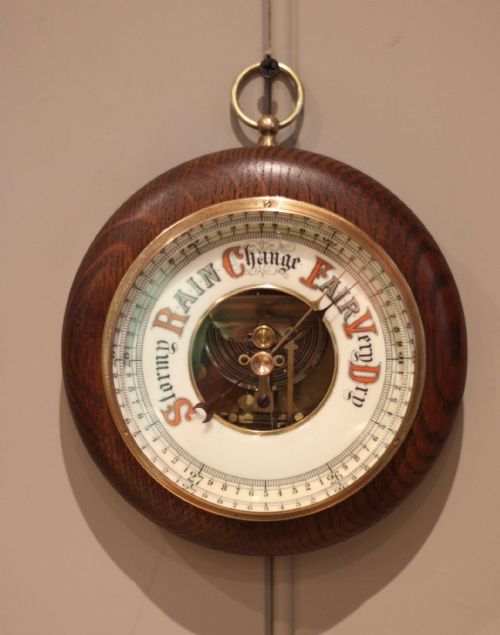
An English Victorian barometer is a functional domestic instrument designed to measure atmospheric pressure, taking the form of wall-hung banjo shapes, marine stick models, and bulkhead roundels. The pieces on this page span the nineteenth century and the Edwardian era, showing how utility met polite interior display.
Banjo barometers dominate the selection, often featuring carved wooden cases of oak, mahogany, or walnut paired with silvered metal dials. Stick barometers and ships bulkheads appear regularly, utilising glass tubes and brass bezels to record daily barometric shifts.
How they were made
Cabinetmakers constructed the wooden housings from dense hardwoods like mahogany, rosewood, and burr walnut, shaping them into turned frames, carved panels, and onion tops. These enclosures protected the delicate internal mechanisms while adding decorative presence to a room.
Instrument makers fitted silvered metal or ceramic dials with finely graduated scales, pairing them with glass lenses and brass bezels. Aneroid movements and mercury tubes were integrated alongside spirit thermometers to complete the weather-reading apparatus.
Several Victorian barometers include built-in thermometers so you can blame the weather with numerical precision.
What varies in quality
Quality rests in the precision of the maker's hand and the selection of timber, moving from plain utility models to elaborate carved cases by named opticians. Signed dials and secondary mercury tubes or thermometers indicate a higher grade of instrument.
The crispness of the dial engraving and the depth of the cabinet carving set individual pieces apart. Finer examples retain their original glass, bezels, and matching wooden cistern covers without modern replacement parts.
Short & Mason London·G & L Guanziroli London·W Watson & Sons·Blake & Son·Negretti & Zambra London·Joseph Somalvico & Co
The English Victorian Barometer Glossary
- Aneroid barometer
- A barometer that measures air pressure through the contraction and expansion of a sealed metal capsule, avoiding liquid mercury. This design allowed for compact wall instruments and portable models.
- Stick barometer
- A tall, narrow wall instrument containing a vertical glass tube filled with mercury, mounted against a wooden backboard. They offer a direct visual reading of barometric height.
- Banjo barometer
- A domestic weather glass housed in a shaped wooden case resembling a banjo, typically combining a dial barometer, thermometer, and humidity indicator. They became popular decorative objects in nineteenth-century hallways.
- Silvered dial
- A brass or copper dial treated to produce a frosted silver finish before having its numerals and graduations engraved and blackened. This surface provides high contrast for reading measurements.
- Vernier
- A small auxiliary sliding scale attached to the main dial or tube, allowing the user to read fractional measurements with greater precision. It aids in detecting slight changes in atmospheric pressure.
English Victorian Barometer: Frequently Asked Questions
How do I read an old barometer?
Locate the main pointer to see the current atmospheric pressure, then use the manual setting hand to mark its position. Checking the instrument later reveals whether pressure is rising or falling.
A rising needle generally indicates improving weather conditions, while a falling needle points toward rain or wind. Comparing the primary hand against the secondary marker provides the immediate trend.
Where should I hang a barometer?
Mount the instrument on an interior wall away from direct sunlight, radiators, and heavy drafts. Sudden temperature shifts can interfere with the internal mechanism and distort readings.
A hallway or study makes a traditional placement, provided the wall is structurally sound enough to support the weight of the hardwood case.
Do these old barometers still work?
Many survive in working order, though aneroid movements and mercury tubes can lose calibration over time. Gentle tapping on the glass often helps settle the mechanical linkage.
Professional adjustment may be necessary if the internal pressures require resetting to local altitude levels. Even uncalibrated pieces remain striking wall decorations.
What is the difference between stick and wheel barometers?
Stick barometers use a vertical tube of mercury to display pressure directly against a linear scale. They offer a minimalist appearance focused entirely on scientific utility.
Wheel barometers, or banjo barometers, translate the vertical movement of mercury or an aneroid capsule into a circular dial via a pulley and weight system. This layout allowed makers to add secondary dials like thermometers.