
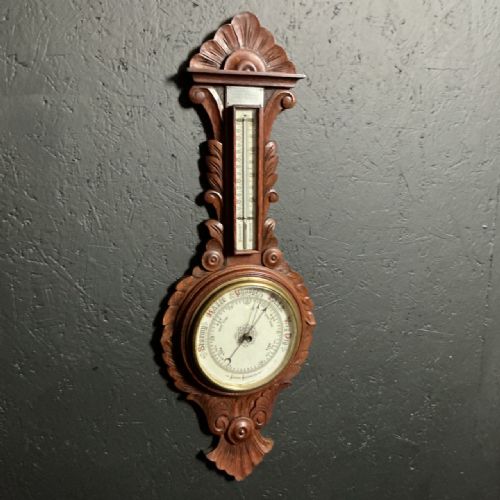
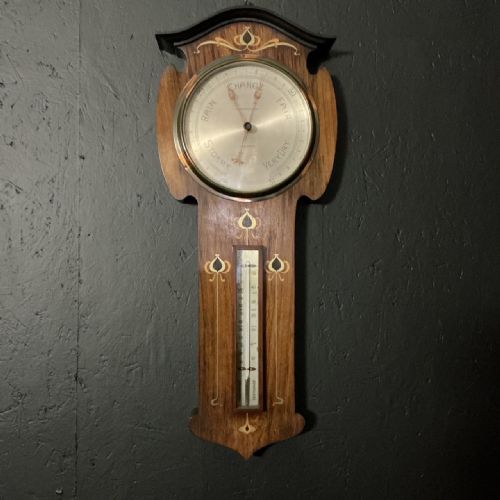


Brown Oak Weather Glass
These brown oak weather glass pieces are barometers and barographs housed in timber cases, offering reliable atmospheric readings with period character.
Brown Oak Weather Glass
When you search for a brown oak weather glass, you encounter Victorian, Edwardian, and early twentieth-century meteorological instruments housed in wooden cases. The selection spans wall-hanging barometers, wheel barometers, Admiral Fitzroy storm barometers, and mechanical barographs.
The most common examples on this page are carved oak and mahogany wall barometers from the nineteenth century. These instruments combine functional glass tubes or dial faces with decorative timber surrounds.
Makers such as Negretti & Zambra and J Hicks produced precision instruments during the Victorian and Edwardian eras. Pieces range from simple geometric designs to elaborate Arts and Crafts and Art Nouveau interpretations.
How they were made
The construction relies on solid oak, mahogany, and carved wood cases enclosing brass mechanisms and paper dials. Mercury-filled stick barometers use glass columns alongside brass scales to measure atmospheric pressure.
Aneroid barometers and barographs utilise metal bellows within glass-fronted cases to record weather changes without liquid. Skilled cabinetmakers shaped the timber surrounds, incorporating geometric patterns, bone details, and wood inlay.
Listings feature oak, mahogany, and brass across Victorian, Edwardian, and Arts and Crafts styles.
What varies in quality
Quality depends on the precision of the maker and the depth of the cabinetwork. Fine examples feature crisp carving in the oak case and signed brass dials from established instrument makers.
Simpler models offer standard timber housing with plain paper scales, whilst superior pieces integrate thermometers, clock movements, and detailed marquetry within the wood.
Negretti & Zambra·J Hicks of London·Short & Mason
The Brown Oak Weather Glass Glossary
- Aneroid barometer
- An instrument that measures air pressure using expanding metal bellows rather than liquid. It drives a pointer across a dial face.
- Stick barometer
- A tall vertical instrument containing a mercury-filled glass tube. It displays atmospheric pressure directly on a graduated scale.
- Admiral Fitzroy barometer
- A storm glass barometer developed in the nineteenth century featuring multiple thermometers and descriptive weather guides. It uses paper register sheets alongside mercury tubes.
- Barograph
- A mechanical instrument that records barometric pressure over time onto a rotating paper drum. It is typically housed in a multi-glass oak case.
- Wheel barometer
- A dial barometer where a float in a siphon tube turns a pulley and needle. It presents weather indicators on a circular face.
Brown Oak Weather Glass: Frequently Asked Questions
How do I read a stick barometer?
A stick barometer shows atmospheric pressure through the height of the mercury column in the glass tube. Rising levels indicate fair weather, whilst falling levels point towards rain.
You read the scale alongside the tube, often noting the sliding brass vernier marker to track small changes from day to day.
What is an Admiral Fitzroy barometer?
An Admiral Fitzroy barometer is a nineteenth-century weather glass designed to give advance warning of storms. It includes printed instructions and advice developed by the British meteorologist alongside the thermometer and mercury tube.
These instruments combine practical forecasting charts with decorative wooden frames, making them distinct wall fixtures.
Where should I hang a wood barometer?
Hang your barometer on an interior wall away from direct sunlight, radiators, and draughts. Rapid temperature changes can affect the internal mechanism and distort readings.
Ensure the wall fixing is secure, as timber cases with glass and mercury components carry significant weight.
How do I date a Victorian barometer?
Dating relies on the style of the timber case, the lettering on the paper dial, and any signature from the instrument maker. Victorian pieces often feature carved oak motifs, geometric borders, or maker inscriptions from firms active in London.
Check the backboards, fixings, and glass types for further clues regarding the manufacturing period.