



Carved Wood Weather Station
A carved wood weather station brings both domestic utility and heavy Victorian craftsmanship into a room.
Carved Wood Weather Station
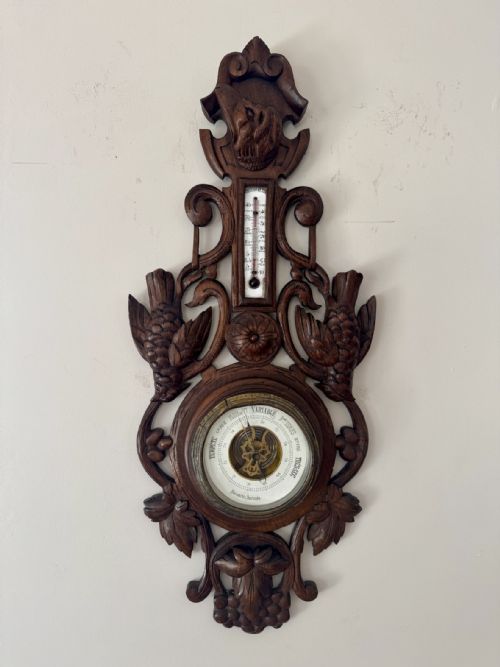
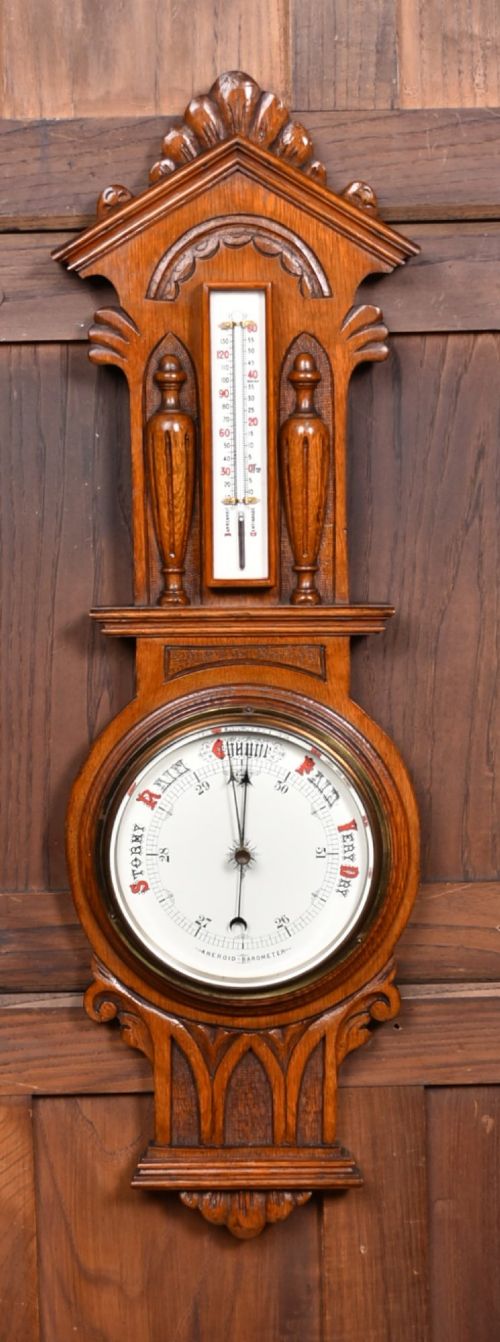
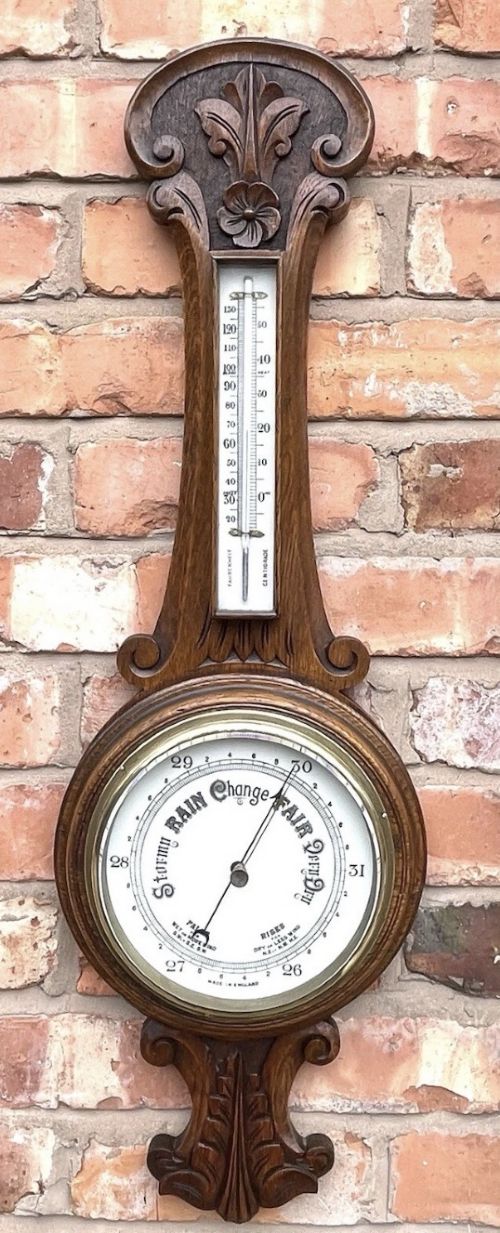
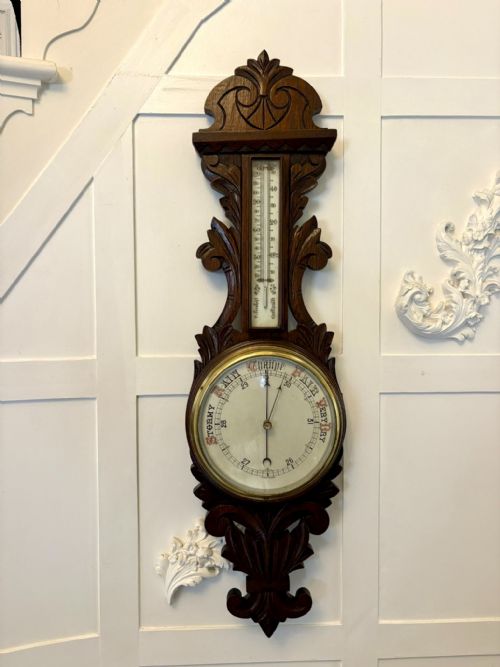
When searching for a carved wood weather station, a buyer is looking at functional domestic instruments housed in carved timber cases, mostly originating from the Victorian and Edwardian eras. These pieces take various forms, including banjo styles, wall panels, combined clocks, and mercury or aneroid barometers fitted alongside thermometers.
The most common version met on this page is the Victorian carved oak banjo barometer, often incorporating a thermometer alongside the main dial. Other notable regional variations include Black Forest carvings, German folk art pieces, and walnut or beechwood wall-hanging formats dating from the nineteenth and early twentieth centuries.
How they were made
The construction relies heavily on solid timber frames, principally oak and walnut, though beechwood also appears. Artisans carved these woods by hand, shaping intricate foliage, geometric borders, or figurative scenes directly into the housing.
Internal mechanisms utilise brass fittings and glass dial covers to protect the sensitive barometric components, while porcelain or ceramic elements occasionally contribute to the gauge faces or thermometer scales.
Some nineteenth century stations include a mercury tube alongside the dial just in case the invisible air pressure needs a shiny metallic neighbour.
What varies in quality
The standard of carving distinguishes superior examples from simpler ones, with deeply undercut foliage and crisply defined motifs marking out the better workshop output. Detail in the timber execution dictates whether a piece remains a plain utility object or achieves decorative distinction.
Maker provenance also elevates certain instruments, as signed works from established instrument makers carry greater weight than unmarked pieces. The integration of auxiliary instruments like thermometers and clocks further separates standard barometers from more complex combined stations.
W Watson & Sons·Maple & Co·James Pitkin London·Negretti & Zambra
The Carved Wood Weather Station Glossary
- Aneroid barometer
- An instrument that measures atmospheric pressure without using liquid, relying instead on a flexible metal box that expands or contracts.
- Banjo barometer
- A household weather instrument shaped roughly like a banjo, featuring a circular dial at the base and a long vertical trunk for the thermometer.
- Mercury barometer
- A traditional barometer that measures atmospheric pressure by balancing the weight of a column of mercury against the pressure of the atmosphere.
- Black Forest style
- A distinctive style of ornate wood carving originating from the Central European mountain region, known for naturalistic animal and foliage motifs.
Carved Wood Weather Station: Frequently Asked Questions
What is a carved wood weather station?
A carved wood weather station is a domestic measuring instrument housed within a decorative timber case, typically combining a barometer and a thermometer.
These pieces served both practical forecasting purposes and as prominent wall decoration in nineteenth and early twentieth century homes.
How do you read an aneroid barometer?
You read an aneroid barometer by observing the movement of the needle across the calibrated dial face, which responds to changes in air pressure.
Many instruments also feature a manual setting hand that you align with the current pointer to track whether pressure rises or falls over the day.
Where should a weather station be hung?
These wall-hanging instruments belong in interior spaces away from direct sunlight, extreme heat sources, and dampness to protect both the timber case and internal mechanisms.
They function best at a comfortable eye level in hallways, studies, or living rooms where domestic temperature remains relatively stable.
How do I identify a Victorian weather station?
A Victorian piece usually displays characteristic timber choices like dark oak or walnut, paired with deep relief carving and traditional banjo or wall panel layouts.
Details such as brass bezels, bevelled glass, and period maker signatures help confirm the nineteenth-century origin of the instrument.