
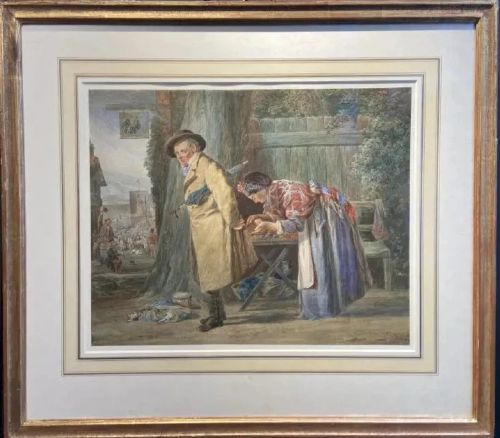


English Street Scene Watercolour
An English street scene watercolour captures the daily life and architecture of towns and cities through fluid pigment on paper.
English Street Scene Watercolour
An English street scene watercolour portrays familiar thoroughfares, village lanes, and historic marketplaces across the country. These works record local architecture, bustling markets, and quiet corners from different eras, preserving past townscapes in delicate pigment on paper.
The selections available here range from nineteenth-century views of York and Sussex to mid-century depictions of northern towns and southern villages. Buyers frequently encounter framed works executed on paper, often protected beneath glass within wooden or gilded frames.
Artists document specific locations, from Yorkshire market places to Devonshire inns and London squares. Each piece offers a direct window into historical domestic environments, combining topographical accuracy with artistic interpretation.
Materials and technique
Watercolour pigment is applied to paper using brushes of varying fineness to achieve both translucent washes and crisp architectural details. Pencil underdrawing frequently guides the composition before the pigment is laid down on the paper surface.
Finished works are typically housed in wooden frames, sometimes enhanced with gold leaf or a gilded finish, and glazed with glass to protect the paper from atmospheric damage. The combination of pigment and paper requires careful handling to preserve the integrity of the water-soluble media.
Look closely for tiny painted pedestrians and stray birds populating nineteenth-century street corners, quietly frozen mid-stride.
Judging quality
The strength of a composition rests on the artist's handling of perspective, light, and atmosphere within the townscape. Superior examples demonstrate a confident control of pigment washes alongside precise draughtsmanship in depicting stonework, figures, and shadows.
The depth of historical detail and the clarity of the location add distinction to individual paintings. Works that successfully capture the movement of daily life alongside architectural accuracy stand apart from simpler topographical sketches.
Joseph H Barnes·Louie Stanley Maurice Prince·John Smith Atherton·George Whyatt·Robert Hollands Walker·Rowland Henry Hill·Angus Rands·Walter Emsley·Fred Lawson·Tom Dudley·Annie L Lee·Alfred Leyman·T Fairfax·John Ward Knowles
The English Street Scene Watercolour Glossary
- Watercolour
- A painting method in which natural or synthetic pigments are suspended in a water-based solution and applied to paper. This medium allows for luminous washes and subtle tonal gradations.
- Gilded finish
- A decorative surface treatment resembling gold leaf, applied to wooden frames to enhance the presentation of the artwork. It provides a traditional boundary between the painting and its surroundings.
- Topographical
- Representing specific real-world locations with a focus on accurate architectural and geographical details. These views serve as historical records of changing townscapes.
- Pencil
- A graphite medium used by artists to map out initial compositions and underlying perspectives before applying watercolour pigment. It remains visible in areas where washes are kept thin.
English Street Scene Watercolour: Frequently Asked Questions
What subjects appear in these watercolours?
These paintings depict village streets, market places, historic inns, and city architecture across England. Scenes range from quiet rural lanes in Essex and Sussex to bustling thoroughfares in York and London.
Artists focus on everyday townscapes, featuring local inhabitants, stone houses, and prominent historical landmarks. Each work records specific geographical settings from past decades.
How should I display watercolour art?
Watercolours require protection from direct sunlight to prevent the pigments from fading over time. Hanging them on interior walls away from strong natural light sources ensures the longevity of the paper and colours.
Keeping the original glass and wooden frame intact safeguards the surface from dust and moisture. Environmental stability in the room helps protect the paper support.
How are different periods identified?
Stylistic clues, clothing fashions of depicted figures, and architectural details help place a watercolour within a specific era. Victorian works often show dense detail and narrative focus, while later pieces adopt looser impressions.
Inscriptions on the reverse or front, along with artist signatures and dates, provide direct evidence of creation timeframes. Comparing known working dates of recorded painters also clarifies the period.
Are these works signed by the artist?
Many examples feature signatures, initials, or monograms left by the original creator directly on the painting surface. Some pieces include inscribed titles on the front or back detailing the specific street and town.
Unsigned works from established periods are often attributed through style, technique, and provenance records. Archival documentation frequently links anonymous townscapes to known regional artists.