


English Sterling Silver Candlesticks
English sterling silver candlesticks bring weight and light to a room, formed in silver from Georgian workshops to mid-century studios.
English Sterling Silver Candlesticks
English sterling silver candlesticks include table candlesticks, chambersticks, and candelabra designed for domestic lighting and display. You will frequently meet pairs from the twentieth century, alongside eighteenth-century examples and mid-century modern designs.
The selection ranges from neoclassical revival columns to plain twentieth-century shafts and heavy cast Georgian forms. Makers adopted styles spanning Georgian, Victorian, Art Deco, and later twentieth-century idioms.
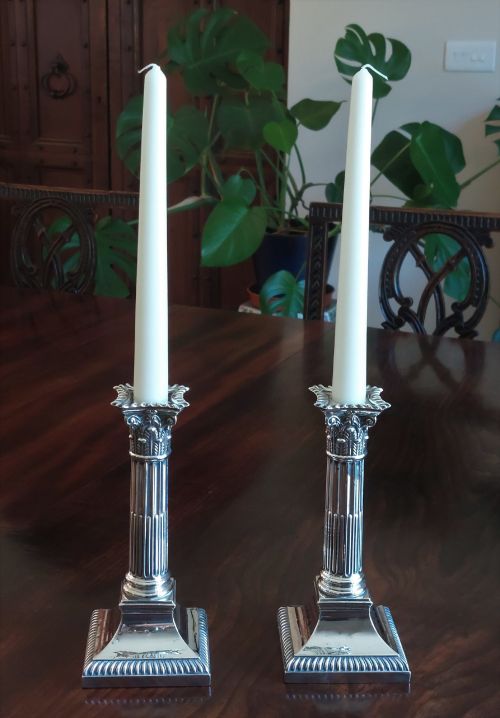
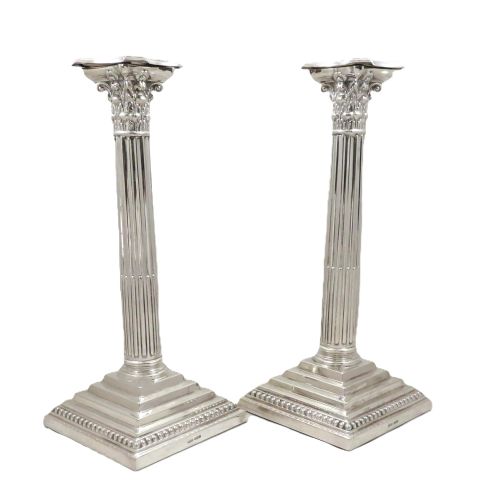
Forms vary from short chambersticks with fitted extinguishers to tall Corinthian columns and weighted candlesticks standing over thirty centimetres high. Enamel accents and cut crystal combinations also appear among the silver.
Materials and methods
Silversmiths shaped these pieces using sterling silver, frequently employing weighted internal bases of resin or plaster to provide stability to tall shafts. Sheffield plate techniques gave way to solid sterling silver cast in sections and soldered together.
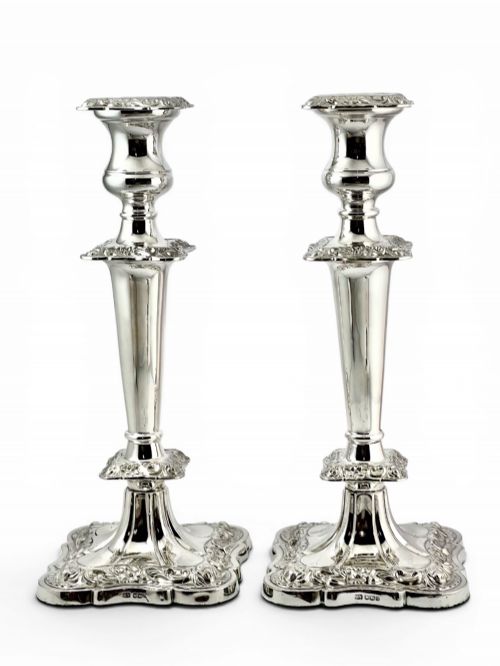
Surface decoration relies on chasing, engraving, and applied cast ornament such as rams heads or Corinthian capitals. Enamel adds colour in select mid-century pieces, contrasting with polished silver surfaces.
Listings span from the eighteenth century to the late twentieth century, incorporating sterling silver, enamel, and cut crystal materials.
Quality factors
The calibre of a candlestick rests on the crispness of its cast ornament and the weight of the silver used in its construction. Heavy gauge metal and sharp, unrubbed detail distinguish superior workshop production from lighter commercial output.
Makers who invested time in hand-chasing and careful assembly produced pieces that retain their structural integrity and aesthetic balance over centuries. Full hallmarks stamped clearly on the base and nozzle confirm the standard of the metal and the origin of the piece.
Garrard & Co·John Cafe·James Dixon & Sons·Elkington and Company·Henry Matthews
The English Sterling Silver Candlesticks Glossary
- Sterling silver
- An alloy comprising ninety-two point five percent silver and seven point five percent other metals, typically copper, used to ensure durability. British pieces bear the lion passant hallmark to indicate this standard.
- Hallmark
- A system of official marks stamped on precious metals showing the maker, assay office, and year of testing. These stamps allow accurate dating of English silver.
- Chamberstick
- A low candlestick fitted with a pan to catch dripping wax and a handle for carrying from room to room. They often include a small conical snuffer.
- Corinthian column
- A classical architectural order featuring ornate capitals decorated with acanthus leaves, frequently adopted for tall silver candlesticks. The fluted shafts mimic stone pillars.
- Candelabrum
- A branched candlestick holding multiple candles on a single base. They provide greater illumination than single sticks.
English Sterling Silver Candlesticks: Frequently Asked Questions
How do I date my candlesticks?
You date English sterling silver by reading the date letter stamp within the official hallmark cluster. Assay offices in cities such as London, Birmingham, and Sheffield used sequential alphabets to record the year of testing.
Matching the maker's mark and assay office symbol alongside the date letter provides precise confirmation of production eras from the Georgian period through to the twentieth century.
Are these candlesticks weighted?
Many tall candlesticks contain weighted internal materials such as resin, plaster, or wood to provide stability. Solid silver of that size would prove excessively heavy and expensive to produce.
Manufacturers filled the bases to prevent tipping, sealing the underside with green baize or leather.
How should I clean silver candlesticks?
Clean silver using a soft cloth and a reputable proprietary silver polish, working gently around raised cast ornament and hallmarks. Avoid abrasive materials that wear away thin plating or fine surface detail.
Wash away residue with warm soapy water and dry thoroughly to preserve the finish.