
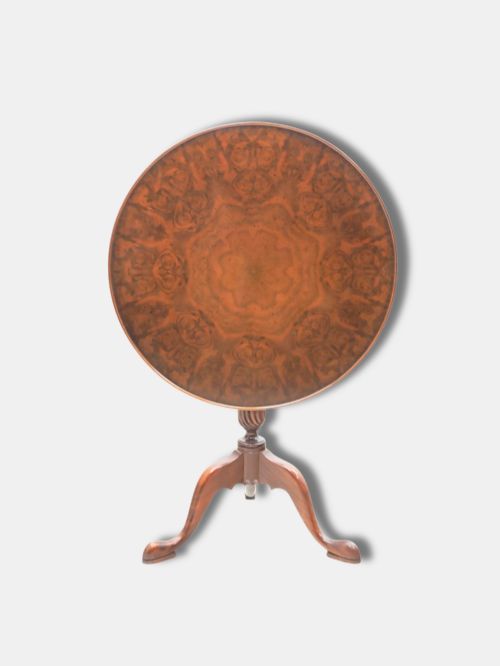


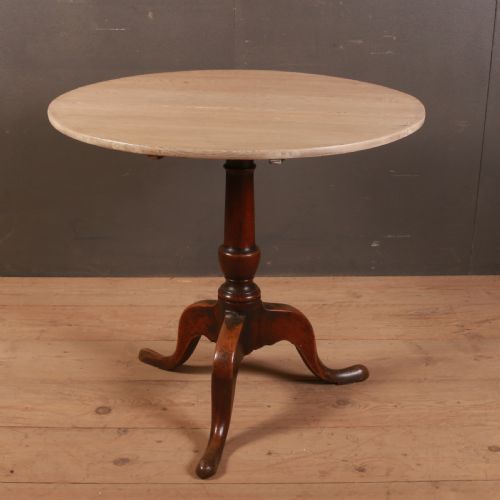


English Snap Top Table
An English snap top table pivots flat for the wall and tilts upright when not in service, saving space while bringing timber character into a room.
English Snap Top Table
An English snap top table is an adaptable piece designed for occasional dining, games, or holding a lamp, moving between a vertical stance against a wall and a horizontal surface for use. The selection spans the eighteenth century through the Victorian era, taking forms such as tripod tables, occasional tables, breakfast tables, and larger loo tables.
Country examples in oak and fruitwood sit alongside formal townhouse pieces in figured mahogany, walnut, and burr walnut veneer. More elaborate specimens appear in papier-mâché, lacquer, and japanned finishes, reflecting the tastes of the Georgian and Regency periods.
Most items you encounter rest on a central pillar supported by tripod legs, though larger pedestal bases and pillar supports also sustain the tilting mechanism. The top secures in its horizontal position via a catch or catch block beneath the surface, allowing the leaf to fold away cleanly.
Materials and construction
Cabinetmakers constructed these tables using solid native timbers like oak, fruitwood, and mahogany, alongside decorative veneers such as burr walnut. Turning and joinery created the sturdy central pillars and tripod legs required to bear the weight of the pivoting top.
The tilting action relies on a clever hinge mechanism and a brass or wooden catch beneath the tabletop, connecting the surface to the pillar block. Surface decoration ranges from simple polished mahogany to intricate japanning, lacquered work, and papier-mâché finishes on Victorian examples.
Victorian households utilised these tilting surfaces to banish card tables from the parlour once the round of loo finished for the evening.
Judging quality and character
The distinction between ordinary and superior pieces rests on the choice of timber figure, the crispness of turning on the pedestal, and the subtlety of edge moulding such as pie crust carving. Timber selection dictates whether a top displays rich grain patterns or plain, utility-grade boards.
Stability of the tilting mechanism and the snugness of the catch when locked flat indicate the original maker's precision. Surface finish, natural patina, and the retention of original brass fittings further separate utilitarian pieces from high-status furniture.
The English Snap Top Table Glossary
- Snap top
- A tabletop mounted on a pivoting block that tilts vertically to save space and locks horizontally for use.
- Tripod table
- A small freestanding table supported by three legs radiating from a central pillar.
- Pie crust table
- A table featuring a raised, carved edge shaped in undulating curves resembling pastry work.
- Japanned
- European furniture finished with varnishes and paints in imitation of East Asian lacquerware.
- Loo table
- A large Victorian round or oval table designed for the card game loo, often featuring a tilt top.
- Figured mahogany
- Timber showing distinctive grain patterns such as flame, curl, or feather, prized for cabinet work.
English Snap Top Table: Frequently Asked Questions
What is an English snap top table?
An English snap top table is a versatile piece of furniture featuring a hinged top that pivots from a horizontal surface to a vertical position against a wall.
Cabinetmakers designed these tables to save floor space when not in use, employing them for dining, tea, games, or holding a bedside lamp.
How do you use a tilt top table?
To use the table, you release the catch mechanism beneath the top and lower the surface into a flat, horizontal position where it locks securely.
When you need to clear the room, you release the catch again and tilt the leaf upward so it rests flat against the central pillar.
How do I date an English snap top table?
Dating relies on observing timber choices, leg profiles, and decorative styles, such as plain oak country furniture from the eighteenth century or burr walnut Victorian designs.
Earlier pieces often use fruitwood or oak with simple tripod bases, while Regency and Victorian examples show mahogany pedestals, brass fittings, or japanned finishes.
Where should I place a snap top table?
These tables suit corners, hallways, and living spaces where their ability to tilt flat against a wall provides flexible floor management.
In daily use, they serve as lamp tables or occasional surfaces, and when tilted upright they display the timber grain and turning of the underside as a decorative wall feature.