


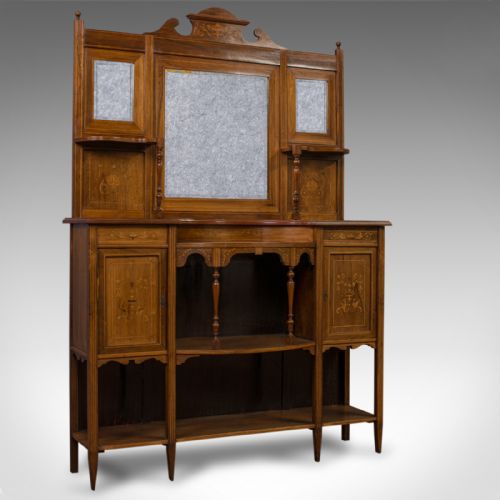
English Rosewood Chiffonier
An English rosewood chiffonier brings rich grain and refined storage to a room, offering low cupboards beneath useful shelving.
English Rosewood Chiffonier
An English rosewood chiffonier is a low cabinet designed for storage and display, appearing chiefly in Regency and Victorian forms. These pieces often feature enclosed cupboards below and open shelves or a mirrored superstructure above.
Buyers meet examples spanning the Regency, George IV and Victorian periods, with dates clustering around 1820. Side cabinets, sideboards and credenzas sit alongside dedicated chiffonier forms on this page.
Materials and Construction
Cabinet makers utilised dense rosewood timbers, frequently applying veneers over secondary woods to display rich figuring. Workshops embellished surfaces with brass inlay, brass grilles and boxwood stringing.
Internal components incorporate glass, mirror glass, marble tops and silk or fabric backing behind glazed or open lattice doors.
Listings feature pieces from the Regency, George IV, Victorian and 1930 periods, constructed in rosewood, brass, boxwood, marble and glass.
Judging Quality
Quality rests upon the selection and matching of the rosewood veneer across the doors and facade. Well-executed brass inlay and delicate boxwood stringing distinguish finer workshops from simpler production.
The integration of secondary materials such as marble tops, brass grilles and mirror glass influences the overall sophistication of the piece.
Gillows·John McLean
The English Rosewood Chiffonier Glossary
- Chiffonier
- A low cabinet with doors, often featuring shelves above for books or display. This form evolved during the Regency period.
- Rosewood
- A heavy, dark timber valued for its distinct grain and deep colour. Makers utilised it extensively for fine cabinet work.
- Boxwood
- A pale, dense wood employed for contrasting stringing and inlay work. Craftsmen used it to line borders on dark rosewood surfaces.
- Credenza
- A low side cabinet for storage, similar in function to a chiffonier. These pieces often feature glass or panelled doors.
English Rosewood Chiffonier: Frequently Asked Questions
What is an English rosewood chiffonier used for?
These cabinets served as useful storage furniture in dining rooms and parlours during the nineteenth century. They held glassware, linens or books while providing a surface for display.
Today, they function well in modern interiors as sideboards or media consoles, offering enclosed space alongside surface area.
How do I date an antique chiffonier?
Dating relies on stylistic markers, construction methods and timber characteristics seen across the Regency and Victorian eras. Pieces from around 1820 typically display restrained classical proportions and brass inlay.
Later Victorian examples often incorporate heavier mouldings and different interior fittings. Comparing hardware and secondary woods helps confirm the period.
Where were these cabinets placed in a home?
Nineteenth-century interiors featured chiffoniers against dining room and drawing room walls. They often stood beneath mirrors or windows to catch the light.
In contemporary spaces, they suit living rooms, hallways or dining areas where low-profile storage is needed.
What is the difference between a chiffonier and a sideboard?
A chiffonier is typically smaller and more enclosed than a large dining room sideboard, often incorporating a raised shelf or gallery at the back. Sideboards focused primarily on serving food and storing heavy dining plate.
Chiffoniers frequently include bookcase elements or glazed display doors above the main cupboard section.